



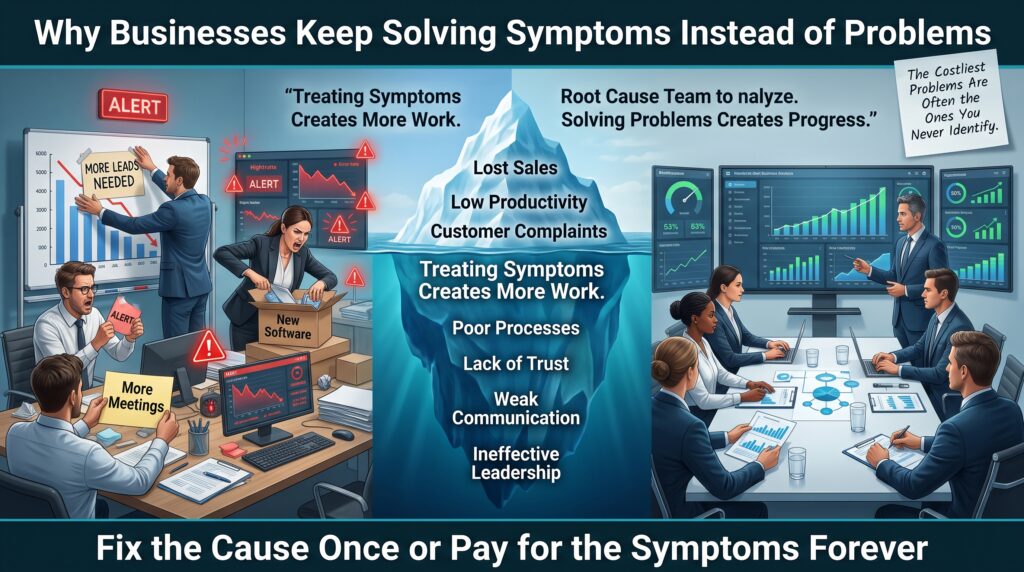
Solving symptoms instead of problems is the most expensive habit in business, and almost every organisation has it. A queue gets longer, so someone adds staff. A report arrives late, so someone adds a reminder. Sales dip, so a new campaign launches. Each response feels sensible, each one earns a tick on the action list, and six months later the same issue is back wearing a different outfit. The first fix has been paid for. Now the organisation is paying for the second.
This guide explains why businesses keep treating symptoms instead of problems, what the “pay twice” effect really costs, and how business analysts use root cause techniques to break the cycle. Whether you lead a team in Melbourne, deliver projects in Canberra or are thinking about moving into business analysis, it will give you a practical way to ask better questions before anyone spends another dollar.
What Does Solving Symptoms Instead of Problems Actually Mean?
A symptom is what you can see and feel: complaints, delays, errors, rising costs, missed targets. A problem is the underlying condition that keeps producing those signs. Think of a doctor who prescribes painkillers for a recurring headache without asking why it keeps coming back. The pain eases, the cause stays, and the patient returns.
Organisations do exactly the same thing. They respond to what is loud and visible because it is easier to describe, easier to budget for and easier to report on. The trouble is that a symptom fix only works until the real cause produces the next symptom.
Why Businesses Keep Solving Symptoms Instead of Problems
Symptoms are visible, causes are hidden
A complaint lands in someone’s inbox. A root cause sits quietly inside a process, a handover or a policy written years ago. People act on what reaches them, so the visible thing gets fixed and the hidden thing carries on.
Pressure rewards fast action
Leaders are rarely praised for saying “give me three weeks to understand this properly”. They are praised for decisive moves. Under pressure, any action looks better than careful investigation, even when the action only treats symptoms instead of problems.
Real problems cross departments
Most expensive problems do not belong to one team. A billing error might start in sales, travel through operations and land on customer service. Each team fixes its own corner, which is another way of solving symptoms instead of problems, and nobody owns the whole chain. The gap between teams is where root causes live.
The solution arrives before the question
“We need a new system” is a classic. Someone has already decided the answer before the problem was defined. New software, new staff and new training are all valid solutions, but only to the right problem. Otherwise, the organisation buys an expensive answer to a question nobody properly asked.
Success is measured by activity, not resolution
Tickets closed, tasks completed, campaigns launched. These metrics reward doing something, not fixing something. When the scoreboard counts activity, fixing symptoms instead of problems looks like winning.
Paying for It Twice: The Real Cost of Treating Symptoms
Solving symptoms instead of problems means paying twice. The first payment is the symptom fix itself: the extra staff, the quick patch, the campaign. The second payment arrives when the issue returns and the organisation has to fund a proper solution anyway, usually with less goodwill and less time. Between the two sits a quieter third cost: everything that went wrong while the root cause was still active.
| Cost type | What it looks like | Why it comes back |
| Rework | Teams repeat the same corrections every month | The step that creates the error is never changed |
| Technology spend | A new tool is bought to “fix” a messy process | The process is automated, not improved |
| Temporary headcount | Contractors added to clear a backlog | The backlog refills because inflow is unchanged |
| Customer impact | Complaints fall, then spike again | Customers meet the same root cause at a different touchpoint |
| Opportunity cost | Skilled people stay busy firefighting | Time that could fund improvement goes to repeat work |
| Change fatigue | Staff stop believing new initiatives will stick | Previous fixes never solved the underlying issue |
A Quick Example: Longer Queues, Wrong Fix
Here is a hypothetical but very familiar scenario. A Brisbane insurance team sees call wait times climbing every renewal season. The symptom is obvious, so management hires temporary agents. Wait times fall for a month, then climb again.
A business analyst asks why calls are increasing. The answer: a large share of customers ring to ask what their renewal letter means. Why? The letter changed its layout and no longer shows the premium breakdown clearly. Why was it not fixed? The letter belongs to marketing, the call centre belongs to operations, and nobody tracks calls generated per letter. The root cause is an unclear document and an ownership gap, not a shortage of agents.
Rewriting the letter and assigning an owner costs a fraction of another round of temporary staff. That is what happens when you stop solving symptoms instead of problems: the cheaper, permanent fix was available the whole time.
Solving Symptoms Instead of Problems vs Root Cause Thinking
| Area | Symptom thinking | Root cause thinking |
| First question | “What can we do about this today?” | “Why is this happening at all?” |
| Evidence | Opinions and the loudest complaint | Data, process maps and stakeholder interviews |
| Ownership | Each team fixes its own corner | One owner for the end-to-end problem |
| Solution timing | Chosen before the problem is defined | Chosen after the problem statement is agreed |
| Success measure | Tasks completed | Problem stops recurring |
| Long-term cost | Repeated spending on the same issue | Higher upfront effort, lower total cost |
How to Stop Solving Symptoms Instead of Problems: 6 Practical Steps

- Write the symptom down plainly. “Wait times have increased from X to Y since March” is useful. “Customer service is a mess” is not.
- Ask why, repeatedly. The 5 Whys technique, which grew out of Toyota’s production system, asks “why?” until the chain reaches something you can actually change. Test more than one chain, because problems often have several causes.
- Gather evidence. Pull the data, map the current process and talk to the people closest to the work. Do not rely on assumptions or on the most senior opinion in the room.
- Write a problem statement. One or two sentences that describe the root cause, who it affects and what it costs. If stakeholders cannot agree on the statement, you have found your real first problem.
- Compare options, including doing nothing. Look at cost, benefit and risk for each option. A short-term patch is sometimes sensible, as long as everyone knows it is a patch.
- Measure resolution, not activity. Agree upfront what “fixed” looks like, such as fewer repeat calls or fewer rework hours, and check it a few weeks and months after go-live.
Root Cause Analysis Techniques Business Analysts Use
Business analysis exists largely to close the gap between what organisations think the problem is and what it actually is. The BABOK Guide from IIBA lists root cause analysis among its core techniques, and these are the ones analysts reach for most often when they want to stop treating symptoms instead of problems:
- 5 Whys: a simple chain of questions that moves from the visible symptom toward a cause you can act on.
- Fishbone (Ishikawa) diagram: groups possible causes by category, such as people, process, systems and policy, so nothing obvious gets skipped.
- As-is process mapping: shows where handovers, delays and duplicated effort actually occur.
- Pareto analysis: helps identify the small number of causes behind most of the problems.
- Stakeholder interviews and observation: reveal workarounds and unwritten rules that data alone will not show.
- Cost-benefit analysis: puts a number on the “pay twice” effect so decision-makers can compare options fairly.
If you want to see how these techniques sit inside a broader career path, our posts on business analysts driving business outcomes and the business analyst skills gap are good next reads.
Where Unresolved Root Causes Get Expensive Across Australian Cities
Symptom fixing is not limited to one industry or city. Here is a general view of environments where unresolved root causes tend to get costly, and where strong analysis skills are in demand.
| City | Typical environments | Training |
| Sydney | Financial services, large corporates and regulatory change programs | Business analysis courses Sydney |
| Melbourne | Health, education, telecommunications and digital transformation | Business analysis course Melbourne |
| Brisbane | Utilities, infrastructure, insurance and government service delivery | Business analysis courses Brisbane |
| Perth | Resources, energy, engineering and operational improvement | Business analysis training Perth |
| Adelaide | Defence-related industry, health and public sector shared services | Business analysis courses Adelaide |
| Canberra | Federal government policy, program and service delivery | Business analysis courses Canberra |
Training is also available through live online delivery if you are outside a major city. Browse everything on our courses page.
How Business Analysis Training Helps You Stop Fixing Symptoms Instead of Problems
Spotting symptoms instead of problems is a learnable skill. Structured training teaches you the frameworks, the questions and the language to challenge a solution-first conversation politely and with evidence. These courses are good places to start:
- Business Analysis Techniques Course for process analysis, root cause thinking and practical BA tools.
- IREB Requirements Engineering Foundation (CPRE-FL) for turning a clearly defined problem into precise, testable requirements.
- AgileBA Foundation and AgileBA Practitioner for applying analysis inside Agile delivery.
- ISQI Agile Business Analysis Certification for a further Agile BA credential.
- BCS Business Change Foundation for understanding how change is planned, led and embedded.
- BCS Business Finance Certificate for building the financial case behind better decisions.
For wider training options, see Logitrain’s business analysis training courses. The BCS is also a useful reference for professional standards.
Frequently Asked Questions
What does it mean to solve symptoms instead of problems?
It means responding to the visible signs of an issue, such as complaints, delays or errors, without finding and fixing the underlying cause. The relief is usually temporary, and the issue returns.
Why do businesses keep fixing symptoms instead of problems?
Symptoms are easier to see, faster to act on and simpler to report. Real problems often cross teams, take time to investigate and have no single owner, so they stay untouched.
How do you find the root cause of a business problem?
Start by describing the symptom precisely, then use techniques such as 5 Whys, fishbone diagrams, process mapping and stakeholder interviews, backed by data. Agree a written problem statement before choosing any solution.
What does “paying for it twice” mean?
It means funding the quick fix first, then funding the proper solution later when the issue returns. The total cost is higher than solving the root cause once, and that is before counting the lost productivity and customer goodwill in between.
Is a quick fix ever the right choice?
Sometimes, especially when there is urgent risk to customers, safety or compliance. The key is to label it as a temporary measure and keep the root cause investigation moving at the same time.
Which course helps me learn root cause analysis?
A Business Analysis Techniques course is a strong starting point because it covers process analysis and problem definition. Agile BA, IREB and BCS courses then build requirements, delivery and business case skills on top.
The Bottom Line
Businesses keep solving symptoms instead of problems because symptoms are loud, urgent and easy to measure, while root causes are quiet and shared across teams. The result is a cycle of repeat spending, tired teams and frustrated customers. The way out is not complicated: define the problem before choosing the solution, ask why more than once, back your thinking with evidence and measure whether the issue actually stays fixed.
Ready to build those skills? Explore our business analysis courses or contact our team to find the right course and location. You can also learn more about us or read the latest articles on the blog.