



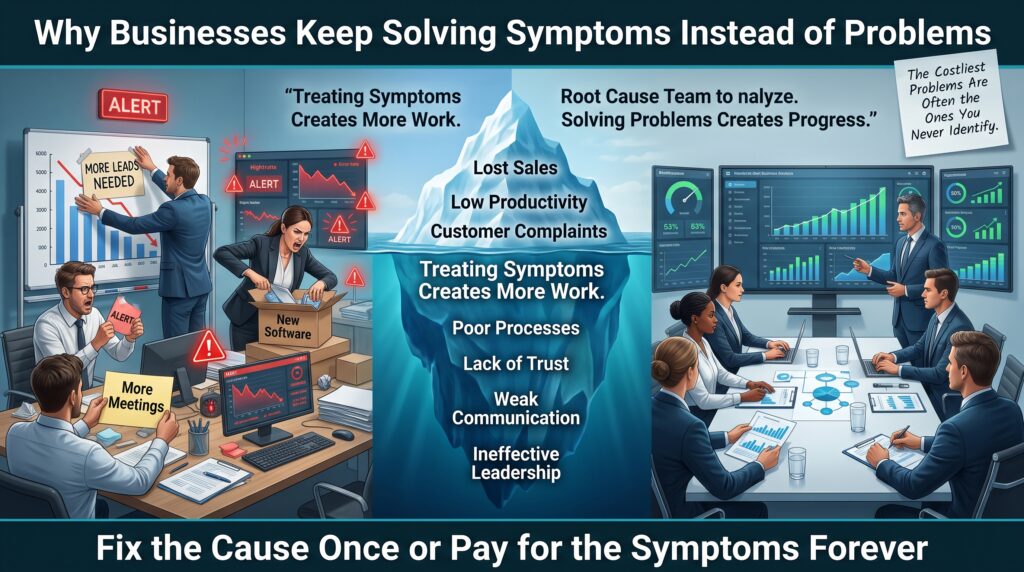
Business analysis courses spend a surprising amount of time on a problem that rarely appears on a project plan: the meeting where everyone nods, nobody objects and nobody actually understands each other. The minutes say “agreed”. The room leaves happy. Three weeks later, the build team delivers something nobody wanted, and every person involved is genuinely confused about how it happened.
That is the false alignment problem. It is not a story about lazy teams or bad intentions. It happens to smart, busy people who use the same words to mean different things and mistake politeness for agreement. In this guide you will learn how to spot it, why it keeps happening, what it costs, and how the techniques taught in practical training can replace comfortable nodding with real shared understanding.
What Is the False Alignment Problem?
False alignment is the illusion of agreement. Everyone signs off on a statement, a requirement or a goal, yet each person carries a different picture in their head. The words match. The meaning does not.
Imagine a team agreeing to “improve customer onboarding”. The sales lead pictures a shorter sign-up form. The operations manager pictures fewer manual checks. The IT lead pictures a new identity-verification system. The compliance officer pictures stricter documentation. All four say yes, and all four are right about their own version. The project then quietly splits into four directions.
Professional frameworks such as the IIBA BABOK Guide treat shared understanding as a core outcome of business analysis, not a pleasant extra. That is why the topic sits at the heart of good business analysis courses.
Why Everyone Agrees but Nobody Understands
1. A shared vocabulary hides different meanings
Words like “fast”, “simple”, “real-time”, “customer” and “done” feel precise but are not. One person’s real-time is a second. Another person’s is overnight. Until someone asks for an example, the difference stays invisible.
2. Silence gets mistaken for consent
In most meetings, no objection is treated as yes. But silence can also mean confusion, fear of looking uninformed or simple fatigue. A good analyst learns to tell the difference and to create space for honest questions.
3. Senior voices set the tone
When the most senior person states an opinion first, the rest of the room tends to align with it. People are not lying. They are saving effort and avoiding friction. The result is agreement that depends on rank rather than understanding.
4. Remote meetings flatten the signals
On a video call, you lose the puzzled frown, the half-raised hand and the whispered side comment. Cameras off and mics muted make it even easier for confusion to pass as consent.
5. Slides replace conversations
A neat slide looks like clarity. Yet a diagram with six boxes and three arrows can be read in six different ways. Without discussion, the slide becomes a mirror in which each person sees what they already believed.
The Real Cost of False Alignment on Projects
False alignment rarely announces itself. It shows up later, dressed as something else:
- Rework: features built to the wrong interpretation must be rebuilt, often late and at higher cost.
- Scope creep: unspoken expectations surface mid-project and arrive as urgent change requests.
- Delayed discovery: the gap is found at user testing or go-live, when fixing it is most expensive.
- Eroded trust: teams start blaming each other, and the next workshop is even more guarded.
- Quiet burnout: people work long hours to patch a misunderstanding they cannot quite name.
None of these costs appears under the heading “alignment” in a budget. They are absorbed as delays, overtime and frustration, which is exactly why the problem lasts.
Seven Warning Signs Your Team Is Falsely Aligned
- Decisions are made quickly and nobody asks a clarifying question.
- Different people summarise the same decision in different ways.
- Key terms are used often but never defined in writing.
- Requirements are approved without examples, scenarios or acceptance criteria.
- Feedback only arrives after something is built.
- The same issue keeps resurfacing in different meetings under different names.
- People say “I thought we agreed on that” more than once a month.
If three or more sound familiar, you are probably looking at false alignment rather than genuine consensus.
How Business Analysis Courses Teach You to Fix It
Good business analysis courses treat understanding as something you build with specific techniques, not something you hope for. Learners practise stakeholder analysis, requirements elicitation, process modelling, glossary building, user stories with acceptance criteria and prototyping. They also practise the soft skill that ties everything together: asking the next question politely until the picture is clear.

Here is how the courses on our site map to the problem:
- Business Analysis Techniques Course: the toolkit for analysing processes, eliciting needs and turning vague statements into clear specifications.
- IREB Requirements Engineering Foundation (CPRE-FL): a structured approach to writing, validating and managing requirements so they mean the same thing to everyone. Learn more about the IREB framework on its official site.
- Agile Business Analysis (AgileBA) Foundation and Practitioner: agile principles applied to analysis, with short feedback loops that expose misunderstandings early. The Agile Manifesto is a useful starting point for the thinking behind them.
- ISQI Agile Business Analysis Certification: a route to a recognised agile analysis credential for people ready to go deeper.
- BCS Business Change Foundation and BCS Business Finance Certificate: structured approaches to change and the financial thinking behind business cases.
You can compare every option on our courses page, the business analysis courses overview or the BCS business courses page.
A Practical Toolkit for Replacing False Alignment With Real Understanding
You do not need a formal qualification to start. These seven habits work in any meeting, on any project:
- Define the terms. Write down what “customer”, “complete” or “urgent” means for this project, and share it.
- Ask for an example. “Can you walk me through a real case?” turns abstract agreement into concrete detail.
- Play it back. Restate the decision in your own words and ask, “Have I got that right?”
- Write acceptance criteria. If nobody can describe how to test a requirement, nobody understands it yet.
- Show, do not tell. A rough wireframe or process map exposes differences faster than a page of text.
- Invite dissent. Ask, “What could go wrong with this?” and wait for the answer.
- Record assumptions. Keep a visible list of what you are assuming, and check it with the group each week.
Each of these takes a few minutes. Together they remove most of the room false alignment needs to hide in.
Business Analysis Courses Across Australian Cities
Training is available in major cities and through flexible online learning, so you can study close to home or from anywhere.
- Business analysis courses Sydney: suited to the city’s finance, government and technology projects.
- Business analysis course Melbourne: our head office is in West Melbourne, close to a large community of project and change professionals.
- Business analysis courses Brisbane: useful for analysts supporting infrastructure, health and public-sector programs.
- Business analysis courses Adelaide: a good fit for growing digital, defence and services teams.
- Business analysis courses Canberra: relevant for government agencies and suppliers where clear requirements matter.
- Business analysis training Perth: built for analysts working across resources, energy and professional services.
Not sure which option suits you? Contact our team and we will help you choose the right course and location.
Career Paths After Business Analysis Courses
Learners often move into roles such as Business Analyst, Process Analyst or Project Coordinator. Others use the skills to step up from IT support, operations or administration into more analytical work. Over time, many explore advanced credentials such as CBAP or PMI certifications, and some branch into project management or data analysis. If project delivery interests you, you can also explore the project management courses from our partner site. For a closer look at one pathway, read our guide on whether the BCS Business Finance certificate is worth it.
Whatever route you take, the ability to create real shared understanding is the skill that stays valuable. Tools change, methods evolve, but organisations always need people who can make sure everyone means the same thing.
Business Analysis Courses FAQs
What is the false alignment problem in business analysis?
It is when stakeholders appear to agree on a requirement or decision but hold different interpretations of it. The disagreement stays hidden until the work is built or tested.
Do I need experience before joining business analysis courses?
No prior business analysis experience is needed for foundation-level courses such as AgileBA Foundation. Advanced courses suit learners with some professional or project experience.
Which business analysis courses are best for beginners?
Foundation-level options such as the Agile Business Analysis Foundation, the IREB Requirements Engineering Foundation and the BCS Business Change Foundation are common starting points.
Can I study business analysis courses online?
Yes. Courses are available across major Australian cities and through flexible online learning, so you can choose what suits your schedule.
What skills will I gain from business analysis courses?
You will build practical skills in process analysis, requirements gathering, stakeholder communication, data-driven decision-making and real-world problem solving.
Do business analysis courses help with certification?
Yes. Course content aligns with recognised frameworks and supports preparation for professional certifications, depending on the course level you select.
Turn Agreement Into Understanding
The most dangerous sentence on any project may be “we are all aligned”. Real alignment is not the absence of disagreement. It is the presence of shared meaning, tested with examples, written down and revisited. That takes skill, and skill can be learned.
Ready to build it? Browse our business analysis courses, get in touch or call 1300 649 299, and our advisers will help you pick the right path. You can also read more about us or visit the blog.