

If you’re looking to become a business analyst in Australia, start by building solid business analysis skills and getting the right education where possible. It’s also important to get comfortable with tools like Excel, SQL, and Power BI, as they’re widely used across Aussie workplaces. From there, focus on gaining hands-on experience. Whether that’s through internships, entry-level roles, or working on real-world projects. Because practical exposure is what really sets you apart. This career is relevant and in high demand in Australia, as government statistics show. This is a good career option for those who want to work on business-related problems rather than programming-related issues.
Business analysis is not a career pursued by memorizing buzzwords and uttering terms like “stakeholder engagement” with a straight face. There is a need to demonstrate reasoning and communication skills and provide evidence that one is capable of converting vague business problems into actionable requirements. This is the crux of the career.
What Does a Business Analyst Do?
In Australia, the ICT Business Analyst position specifically involves working with users to document business requirements, analyze processes, identify inefficiencies, improve processes, assist in developing specifications, assist in testing, and serve as a first resource for information in decision-making for systems and projects. Both Jobs and Skills Australia and the Australian Computer Society (ACS) clearly articulate the ICT Business Analyst position in similar terms, which is useful for inferring the priorities that will drive actual hiring decisions.
Thus, a business analyst will typically perform tasks of the following nature:
- talking to stakeholders
- gathering business requirements
- mapping current and future workflows
- writing user stories or functional specs
- helping delivery teams understand business needs
- supporting testing and change roll-out
- improving processes, reporting, and system behavior
So, if you enjoy asking good questions, organising messy information, and making people say, “Ah, yes, that is what we actually need,” this career probably suits you.
Skills needed to Business Analyst Career Path in Australia
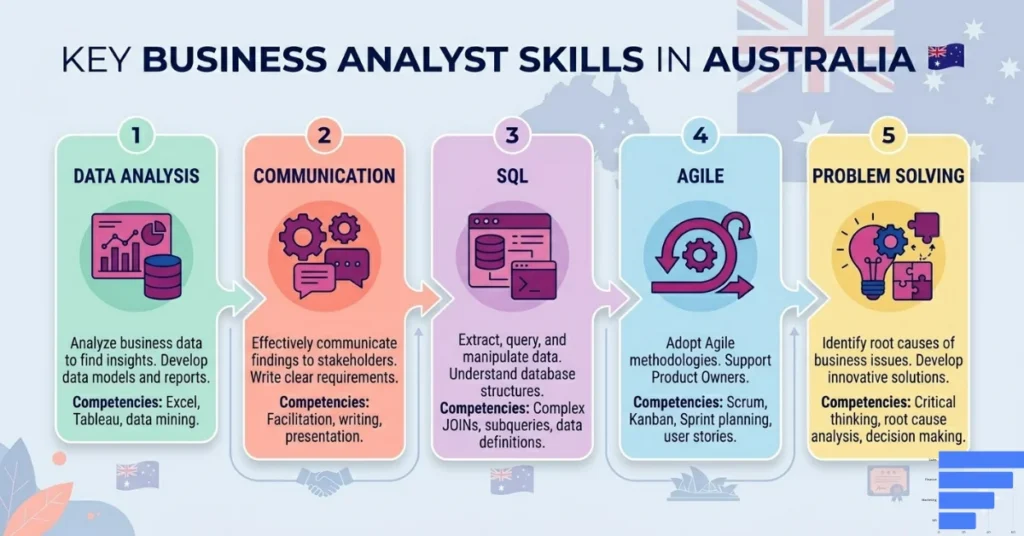
The basic competency involves integrating business acumen, communication skills, and technical knowledge. Although specific software engineering training is not required, a basic understanding of integrating systems, data, and business processes is necessary.
The most useful skills are:
-
Requirements gathering
Stakeholders must be consulted through interviews, workshops, and targeted questions to clearly identify user desires and the organization’s actual requirements. It has also been found that the two requirements are not always identical; in some cases, they are loosely linked.
-
Process mapping
You should be able to map the existing process, identify the bottlenecks, and propose a more effective future state. Such a requirement is justified because the official Australian role description emphasizes the importance of process analysis and the review of inefficiencies.
-
Documentation
Good business analysts can express information clearly. The work product may include business requirements, functional requirements, acceptance criteria, meeting notes, decision logs, and training documents. Ambiguity in writing slows progress on projects.
-
Data analysis
However, not all jobs require advanced data science skills. Knowledge in using Excel, reporting, and dashboards, as well as basic SQL skills, is a plus. There are many businesses where the person will be expected to work with data to validate a business case, identify trends, or determine whether a process change has resulted in a positive outcome.
-
Stakeholder management
This is not corporate theatre. It means knowing how to listen, clarify, manage expectations, and keep people aligned when they all want different things.
-
Agile and delivery awareness
Most organizations use Agile or a hybrid delivery methodology. Knowledge of user stories, sprint planning, backlog refinement, and test support will also enhance employability, especially in the digital and technology-enabled space. For those new to the field, communication skills, documentation, process mapping, and basic data skills should be the priority. More complex frameworks can be kept for later. A well-organized, clean spreadsheet presentation will be more effective than one full of buzzwords.
Best Courses for Business Analysts in Australia

There isn’t a universally compulsory course required by all employers, although studies in this area may be helpful. Australian qualifications are accredited within the Australian Qualifications Framework. The purpose of this framework is to ensure the existence of nationally consistent qualification types. When seeking to compare the options for formal studies, Course Seeker and Your Career are two reliable government-endorsed resources to begin with.
The most relevant study areas usually include:
- business
- information technology
- information systems
- commerce
- computer science
- data analytics
- project management
A sensible course choice depends on where you are starting:
If you are still in school or choosing a first qualification
Choosing the Business analysis Course in Australia, A bachelor’s degree in business, IT, information systems, or commerce is the cleanest path.
If you already have a degree in another field
A short course, graduate certificate, professional certificate, or targeted BA training may be enough to help you pivot, especially if you already have transferable experience in operations, finance, admin, customer service, logistics, or projects.
If you want vocational or flexible study
A diploma, advanced diploma, or stackable online learning remains a worthwhile activity, especially when a portfolio and project work are also undertaken.
The best strategy would be to avoid the course with the most elaborate marketing. Instead, a course focused on skills that can be demonstrated to potential employers, such as requirements gathering, workflow analysis, documentation, reporting, and business communication, would be best.
Do you need a degree for Business Analyst Career Path?
While the bachelor’s degree is not the only route, it remains the most common route for this occupation. According to Jobs and Skills Australia, 47.7% of ICT Business Analysts hold a bachelor’s degree, and 31.7% hold a postgraduate qualification, such as a graduate diploma or certificate. This shows the prevalence of higher qualifications in the workforce for this occupation. However, there is no single route into this occupation.
So the honest answer is this:
No, a degree is not the only possible path. Yes, it helps a lot.
If you do not have one, you will need to make up for it with practical proof. That could include:
- portfolio projects
- strong writing samples
- process maps
- sample requirement documents
- dashboard examples
- internal project experience
- adjacent work in operations, support, admin, QA, or project coordination
Employers care about evidence. If your CV says you “improved processes,” show how. If you “worked with stakeholders,” explain what changed because of your work.
Business Analyst Certifications in Australia
It is not mandatory and cannot be considered a replacement for skill. However, it can be a means to add value.
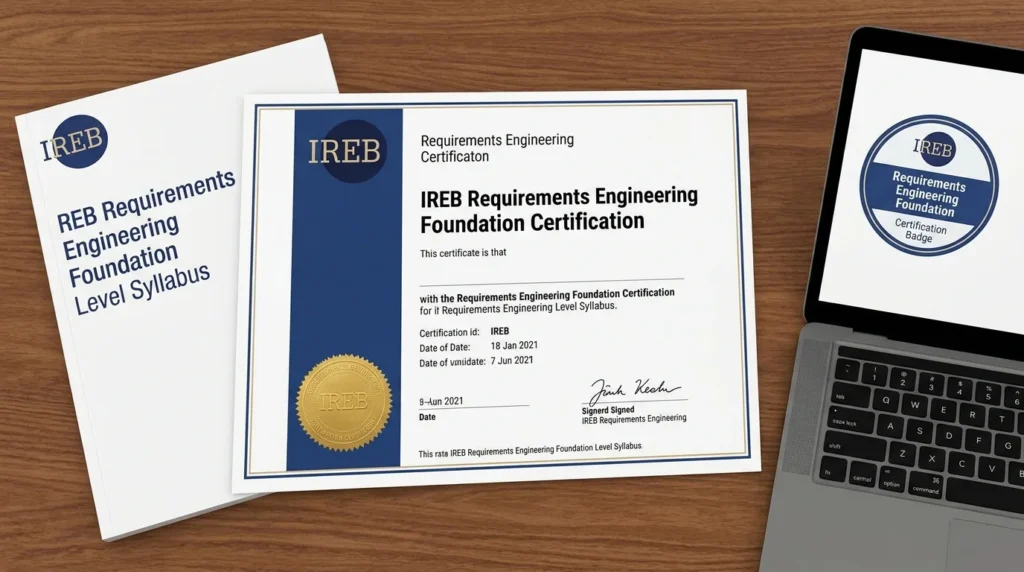
An alternative is the Entry Certificate in Business Analysis (ECBA) offered by the International Institute of Business Analysis (IIBA). IIBA describes the ECBA as an internationally accepted certification that demonstrates an individual has the basics of business analysis and is intended for those looking to get into the field. In other words, it is meant to help newcomers show their commitment and understanding of the subject.
Certifications make the most sense when:
- You are changing careers.
- You have little direct BA experience.
- You want a structured way to learn the fundamentals.
- You need a stronger signal on your CV.
They make less sense when:
- You already have strong BA experience and documented achievements.
- You are ignoring practical skills and hoping a certificate will do all the work for you.
A certificate should support your profile, not carry it on its back like an overworked project manager.
Entry-Level Business Analyst Jobs in Australia
The most common mistake among beginners is their desire for a job titled specifically as a Junior Business Analyst, without considering other relevant job opportunities. The initial entry is often seen in related job roles.
Good stepping-stone roles include:
- junior business analyst
- systems analyst support roles
- project coordinator
- operations analyst
- business support analyst
- reporting analyst
- QA or test support
- customer operations or process improvement roles
This is important because the formal role is closely related to process analysis, facilitating system changes, documenting requirements, and supporting team decisions. These skills can be developed through a number of related roles before becoming a business analyst.
A practical entry plan looks like this:
Step 1: Learn the foundations
Understand requirements, process maps, user stories, acceptance criteria, stakeholder interviews, and basic data analysis.
Step 2: Build a small portfolio
Create sample business documents from imaginary or real-world scenarios. For example:
- a process map for an online returns process
- a requirements document for a booking system
- user stories for a customer portal
- a dashboard mock-up for operations reporting
Step 3: Get hands-on experience
Volunteer for internal process work, system roll-outs, reporting clean-up, testing support, or workflow improvement projects.
Step 4: Tailor your CV
Show outcomes, not duties. “Documented business requirements for a system update that reduced rework” beats “responsible for meetings”.
Step 5: Apply broadly
Do not only apply for perfect-title roles. Apply for adjacent roles that build BA capability.
How long does it take to Business Analyst Certification?
For most people, it takes between 6 months and 3 years, depending on their starting point.
If you already have relevant experience in operations, admin, finance, IT support, customer service, or project work, you may be able to pivot within 6 to 12 months by building the missing BA skills and presenting your experience properly.
If you are starting from zero and also studying formally, the path is usually longer. That is normal. A professional role takes time to build. The good news is you do not need to wait until you feel “fully ready”. Nobody in business analysis has ever felt completely ready. Half the job is learning, while the project keeps changing shape anyway.
Business analyst salary in Australia
This is confirmed by the information in the Career profile, which shows that the average weekly salary for ICT Business Analysts in Australia is $2,800 and that there is strong future demand for these workers. Thousands of vacancies exist for ICT Business Analysts in Australia, as stated in the above profile, which again supports the argument that ICT Business Analysts is not a niche profession with only a handful of vacancies and a sole recruiter.
Salary varies by:
- experience
- industry
- state
- technical depth
- contract vs permanent work
- whether the role is closer to pure business analysis, systems analysis, or digital delivery
Jobs and Skills Australia states that the major industry sectors for these occupations are Professional, Scientific and Technical Services, Financial and Insurance Services, and Public Administration and Safety. The largest proportions of these workers at the state level are found in New South Wales and Victoria, with Queensland also contributing significantly.
So yes, the opportunity is real, but location, sector, and your skill mix will affect pay.
Career Progression for Business Analysts
A BA role can lead in several directions. That is one reason the career appeals to people who like options.
Common next steps include:
- senior business analyst
- systems analyst
- product owner
- project manager
- delivery lead
- Business Analysis Practice Lead
- process improvement specialist
- consulting roles
- data or reporting-focused roles
The optimum progression will depend on the individual’s preference. For those with a tendency towards systems and details, progression towards a systems analysis role might be the next step. For those with a tendency towards execution, a project or product role might be the next step. For those with a tendency towards strategy and process change, a role in consulting and transformation might be the next step.
What helps you move up is simple:
- better communication
- stronger stakeholder trust
- sharper problem-solving
- clearer documentation
- evidence that your work improved outcomes
In other words, your career grows when people stop saying, “Can someone figure this out?” and start saying, “Get them into the meeting.”
A Realistic Australia-Specific Pathway
If you want a straight answer with no fluff, follow this order:
- Learn the role properly by studying requirements gathering, process mapping, documentation, and basic data analysis.
- Pick a relevant study if needed, ideally in business, IT, information systems, or analytics. Use AQF-recognized options and compare them through Course Seeker or Your Career.
- Build a portfolio with one or two strong examples instead of ten weak ones.
- Get practical experience through junior, adjacent, or internal project roles.
- Add an optional entry-level certification, such as ECBA, to gain more credibility.
- Apply for roles in industries where this work is common, such as professional services, finance, and government.
If you are an international applicant, you must review the migration program regulations. The Department of Home Affairs lists ICT Business Analyst (261111) on the Skilled Occupation List. The Australian Computer Society (ACS) is the appropriate assessing authority for the ICT Skills Assessment. The Department of Home Affairs further states that the skilled visa program has specific streams in which applicants must complete a skills assessment. Each assessing authority has its own process.
Final Thoughts
This profession recognizes individuals who possess traits such as clear thinking, precise writing skills, and the ability to improve organizational processes. This job in Australia is defined by genuine demand, high relevance across industries, and compatibility for those who prefer dealing with business issues through analysis rather than mere conjecture. This is not about being conspicuous; it is about being useful.
Start with foundational principles. Develop empirical support. Communicate effectively. Demonstrate results. These are the key factors that define employability in the business analysis profession.
Frequently Asked Questions
What qualifications do I need to be a business analyst in Australia?
Usually, individuals need to have undertaken relevant academic studies or possess equivalent practical skills. A bachelor’s degree is the most common qualification, and many individuals working in the occupation have undertaken postgraduate studies.
Can I become a business analyst without experience in Australia?
However, it is necessary to replace the missing experience with concrete measures of competence, such as portfolio work, project support, process improvement, reporting, or similar roles, such as a project coordinator or an operations analyst.
Is a business analyst a good career in Australia?
Yes. Official Australian career statistics confirm the high demand for ICT Business Analysts in the coming years and the number of available positions nationwide.
What skills are needed for a business analyst in Australia?
Essential business analyst skills in Australia include requirement elicitation, process mapping, documentation, handling stakeholders, problem-solving, communication, and basic data analysis. Official role descriptions highlight process analysis, functional specification development, and assistance in testing and implementation.
Do I need a degree to become a business analyst?
No, but a degree helps because it is the most common qualification profile in the occupation. If you do not have one, you need stronger practical evidence.
Do I need certification to get hired?
No. Certification is optional. It can help beginners, career changers, or people who want a structured credential, but it does not replace practical skills.
Which certification is best for beginners?
ECBA is a strong beginner option because IIBA positions it as an entry-level, globally recognised certification for aspiring business analysis professionals.
How long does it take to become a business analyst?
It usually takes 6 months to 3 years, depending on whether you already have transferable experience and whether you are also completing formal study.
What is the salary for a business analyst in Australia?
Your Career currently lists an average weekly salary of $2,742 for ICT Business Analysts in Australia.
Do international applicants need a skills assessment?
At times, it is like that. The Department of Home Affairs says that skills assessments are required in certain visa streams, with ICT Business Analyst assessments conducted by the Australian Computer Society for migration purposes.