
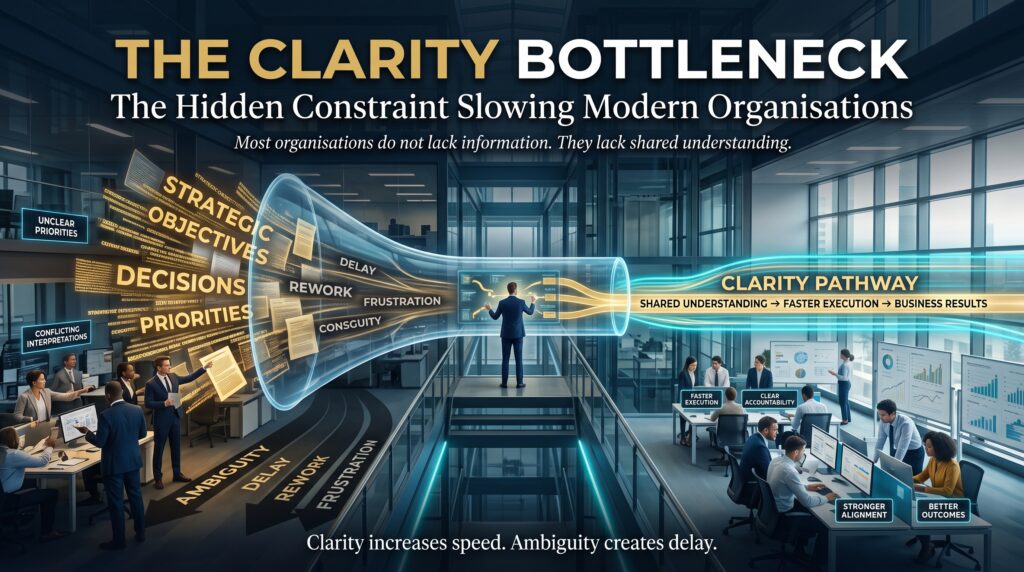



The clarity bottleneck is the constraint nobody puts on the risk register. It is not a shortage of budget, people or technology. It is a shortage of shared understanding: what problem we are solving, what “good” looks like, who decides, and what happens next. When clarity is the tightest point in the system, everything upstream piles up and everything downstream waits.
Most leaders feel it before they can name it. Projects start strongly and then stall in review cycles. Teams build the right thing for the wrong reason, or the wrong thing for the right reason. Meetings multiply because people are trying to “get aligned”. This guide explains what the clarity bottleneck is, why modern organisations are especially exposed to it, how to recognise it, and how business analysis skills help remove it.
What Is a Clarity Bottleneck?
A clarity bottleneck is a point in an organisation where progress slows because the people involved lack a clear, shared and current understanding of the goal, the requirements or the decision rights. Work does not stop because nobody is trying. It slows because every step needs another conversation to work out what is actually wanted.
The idea sits comfortably alongside the Theory of Constraints, made famous by Eliyahu Goldratt. That theory argues that the output of any system is limited by its tightest constraint, and that improving anything other than the constraint changes very little. In many knowledge-based organisations today, that tightest constraint is no longer a machine or a headcount number. It is clarity.
This is why hiring more people, buying new software or adding another project manager so often disappoints. If the clarity bottleneck is the real limit, extra capacity simply produces more work in the wrong direction, faster.
Why Modern Organisations Are Hit Hardest
Information has never been cheaper to produce, and clarity has never been harder to find. Several forces combine to make the problem worse than it was a decade ago:
- Information overload. Dashboards, chat channels, documents and reports multiply, but meaning does not. More data often creates more noise.
- Hybrid and distributed work. Context that once passed across a desk now has to be written down, and it often is not.
- Faster change. Priorities shift quarterly or even monthly, so yesterday’s briefing quietly becomes wrong.
- Tool sprawl. Requirements live in email, slides, tickets and heads, with no single trusted source.
- Layered structures. Every handover between teams is a chance for the original intent to blur.
Signs of a Clarity Bottleneck in Your Organisation
The symptoms are easy to see once you know where to look:
- Requirements keep changing after the build has started.
- Rework is routine, and teams say “that is not what we asked for” or “that is not what we meant”.
- Calendars fill with alignment meetings that end without decisions.
- Stakeholders describe the same project in different ways.
- Approvals stall because reviewers are unsure what they are approving.
- New joiners need weeks of informal briefings to understand how things really work.
Try this simple test. Ask five people involved in the same initiative to write the goal in one sentence, without talking to each other. If you receive five different answers, you have found a clarity bottleneck.
The Hidden Cost of Unclear Work
The expense rarely appears as a single line item, which is exactly why it persists. It leaks out as rework, delayed launches, duplicated effort and software features that nobody uses. It shows up as stakeholders who lose confidence and as budgets spent twice to fix a misunderstanding that a one-page brief could have prevented.
There is a people cost too. Capable employees become frustrated when they cannot get a straight answer, and decision fatigue sets in when every choice needs a fresh round of context-gathering. Left alone, a clarity bottleneck becomes a habit, and the organisation starts to accept slow and ambiguous as normal.
Where Clarity Breaks Down
Clarity rarely fails everywhere at once. It tends to leak at four predictable points.
Unclear Problem Statements
Teams jump to solutions before agreeing on the problem. A new system, a new process or a new report is proposed, but nobody can state which measurable outcome it should improve.
Vague Requirements
Phrases such as “user friendly”, “faster” or “better reporting” feel meaningful in a meeting but cannot be built or tested. Without clear acceptance criteria, each person fills the gap with their own assumption.
Unmapped Stakeholders
When nobody has mapped who is affected, who influences the decision and who must sign off, late objections appear at the worst possible time.
Invisible Decision Rights
If it is unclear who makes the final call, decisions drift upwards, slow down or get quietly reversed.
How Business Analysis Removes the Clarity Bottleneck
Business analysis is the discipline of understanding business needs and turning them into clear, testable solutions. The international BABOK Guide from IIBA describes the knowledge areas and techniques analysts use to do exactly that. In practical terms, a business analyst is a clarity specialist. The job is to make the invisible visible and the ambiguous specific.

Define the Problem Before the Solution
Techniques such as root cause analysis and the “5 Whys” help teams separate symptoms from causes. A one-sentence problem statement, linked to a measurable outcome, gives everyone the same starting point.
Map Stakeholders and Decisions
Stakeholder analysis shows who is affected, who influences and who decides. Pair it with a simple decision log and the clarity bottleneck loses one of its favourite hiding places.
Write Requirements People Can Test
User stories with acceptance criteria, process maps and requirements workshops replace opinion with specifics. If a requirement cannot be tested, it is not finished.
Prioritise Ruthlessly
Frameworks like MoSCoW (must, should, could, will not) force honest trade-offs, so teams stop treating every request as equally urgent.
7 Steps to Clear the Clarity Bottleneck This Quarter
- Find the queue. Look for where work waits for answers, not for effort. That waiting point is your constraint.
- Write a one-sentence goal. State the outcome, the audience and the measure of success.
- Map the stakeholders. List who is affected, who advises and who decides.
- Replace vague words with testable ones. Turn “faster” into “approved within two business days”.
- Create one source of truth. Choose a single place for requirements and decisions, and keep it current.
- Run short feedback loops. Show early drafts to users and sponsors before the build is complete.
- Build the skill. Train the people who translate between business and delivery teams in proven analysis techniques.
Business Analysis Training in Australian Cities
Practical training is one of the fastest ways to close the gap. Business Analysis Courses offers hands-on programs with real-world case studies for learners in Melbourne, Sydney, Brisbane, Perth, Adelaide and Canberra, as well as flexible online options across Australia.
Choose the course that matches your goals:
- Agile Business Analysis (AgileBA®) Foundation for the core principles of agile business analysis.
- Agile Business Analysis (AgileBA®) Practitioner to apply those principles on real initiatives.
- Business Analysis Techniques Course for hands-on tools like process mapping and requirements gathering.
- ISQI Agile Business Analysis Certification for a recognised agile analysis credential.
- IREB Requirements Engineering Foundation (CPRE-FL) to master writing clear, testable requirements.
- BCS Business Change Foundation and BCS Business Finance Certificate for structured change and financial awareness.
Graduates commonly move into roles such as Business Analyst, Process Analyst or Project Coordinator, and can later pursue advanced credentials like CBAP or PMI-PBA. To learn more, visit the About Us page, read the blog, or contact the team on 1300 649 299.
Frequently Asked Questions
What is a clarity bottleneck?
A clarity bottleneck is a point where work slows down because people lack a clear, shared understanding of the goal, requirements or decision rights, so every step needs extra clarification.
What causes a clarity bottleneck in organisations?
Common causes include unclear problem statements, vague requirements, unmapped stakeholders, unclear decision rights, information overload, hybrid work and too many disconnected tools.
How do you remove a clarity bottleneck?
Write a one-sentence goal, map stakeholders and decision makers, replace vague requirements with testable ones, keep a single source of truth and use short feedback loops. Business analysis techniques support each step.
How is a clarity bottleneck different from a resource bottleneck?
A resource bottleneck is limited by capacity such as people, budget or equipment. A clarity bottleneck is limited by shared understanding, so adding capacity usually creates more rework instead of more progress.
Can a business analysis course help?
Yes. Business analysis training teaches problem definition, stakeholder analysis, requirements writing and prioritisation, which are the core tools for removing unclear work from projects.
Conclusion: Clarity Is a Competitive Advantage
The clarity bottleneck is easy to overlook because it looks like normal busyness. Yet it quietly caps what even the best teams can deliver. Organisations that treat clarity as a skill, with owners, methods and training, move faster than competitors who only add more people or tools.
If you are ready to build that capability, explore the business analysis courses or talk to a course advisor today. Clear thinking is a career skill, and it starts with the next question you ask.