
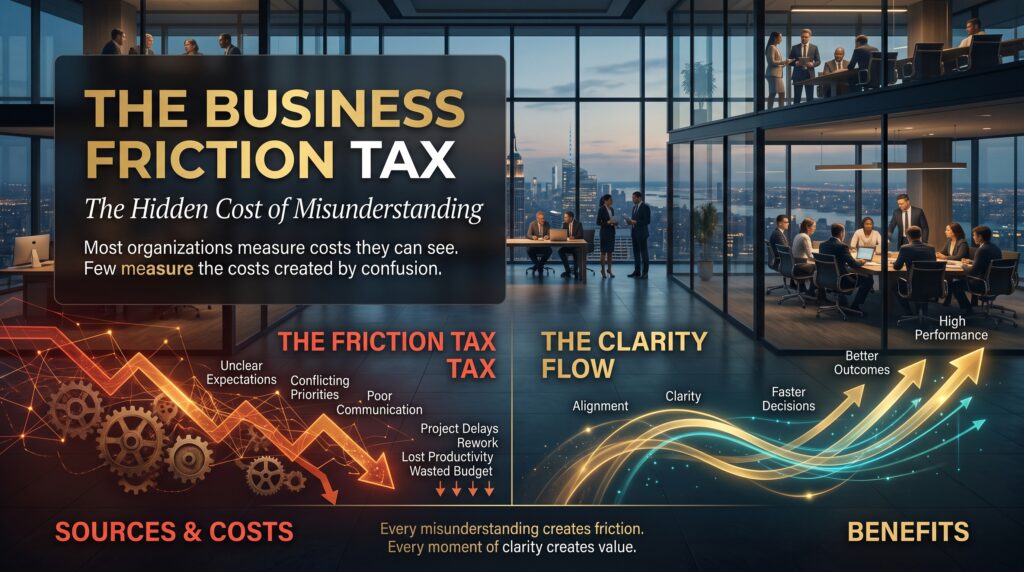


The business friction tax is what every organisation pays when people do not quite understand each other. A request is heard one way and meant another. A deadline is assumed, not agreed. A finished product solves a problem nobody actually had. No invoice arrives for any of this, yet the bill is paid in rework, delays and lost trust.
This guide shows where the business friction tax comes from, how to spot it, how to audit your own team in ten minutes and how to bring it down. You will also see which business analysis courses build the skills for the job, with training in Melbourne, Sydney, Brisbane, Perth, Adelaide and Canberra.
What Is the Business Friction Tax?
In physics, friction is the force that resists movement and turns energy into waste heat. Organisations behave the same way. Every unclear message, mismatched expectation or missing piece of context creates resistance, and the team has to spend extra effort just to keep moving.
The “tax” part matters because the cost is automatic. It is collected on every handover, every meeting and every project, whether or not anyone notices. A team that works hard but delivers slowly is usually not lazy or unskilled. It is pushing against friction that nobody has named.
Misunderstanding: The Real Source of the Business Friction Tax
Most friction traces back to misunderstanding, and misunderstanding tends to cluster in five places:
| Where | What goes wrong | What it costs |
| Requests | The ask is vague, so the doer guesses. | Work redone after review |
| Handovers | Context stays with the person who leaves the room. | Delays and repeated questions |
| Expectations | “Done” means different things to different people. | Disputes and missed deadlines |
| Language | Teams use the same word for different things. | Silent errors that surface late |
| Priorities | Changes are not communicated to everyone. | Effort spent on the wrong work |
None of these are dramatic failures. They are small, ordinary gaps, and that is exactly why they are so expensive over a year.
Warning Signs You Are Paying the Business Friction Tax
- Projects finish “on time” only after a late rush to fix surprises.
- People say “I thought you meant…” more often than anyone admits.
- Stakeholders approve work, then ask for changes when they see the result.
- Meetings end without a clear owner or next step.
- Business teams and technology teams blame each other for missed outcomes.
- New starters take months to learn how things really work because nothing is written down.
If more than two of these sound familiar, friction is already shaping your results.
The 10-Minute Business Friction Tax Audit
You do not need software to measure friction. Ask your team these six questions about their last project and score each one from 1 (never) to 5 (constantly):
- How often did we redo work because the request was misunderstood?
- How often did we wait for an answer that one clear sentence could have provided?
- How often did people disagree about what “finished” meant?
- How often did a priority change reach some people but not others?
- How often did business and technology staff use different terms for the same thing?
- How often did we learn about a problem only after delivery?
A total of 6 to 12 suggests low friction. A score of 13 to 21 points to a moderate business friction tax worth tackling this quarter. Anything above 21 means misunderstanding is a major drag on delivery. The scoring is a simple guide rather than a formal benchmark, but the pattern in the answers is what matters.
Why the Business Friction Tax Is Highest Between Business and Technology

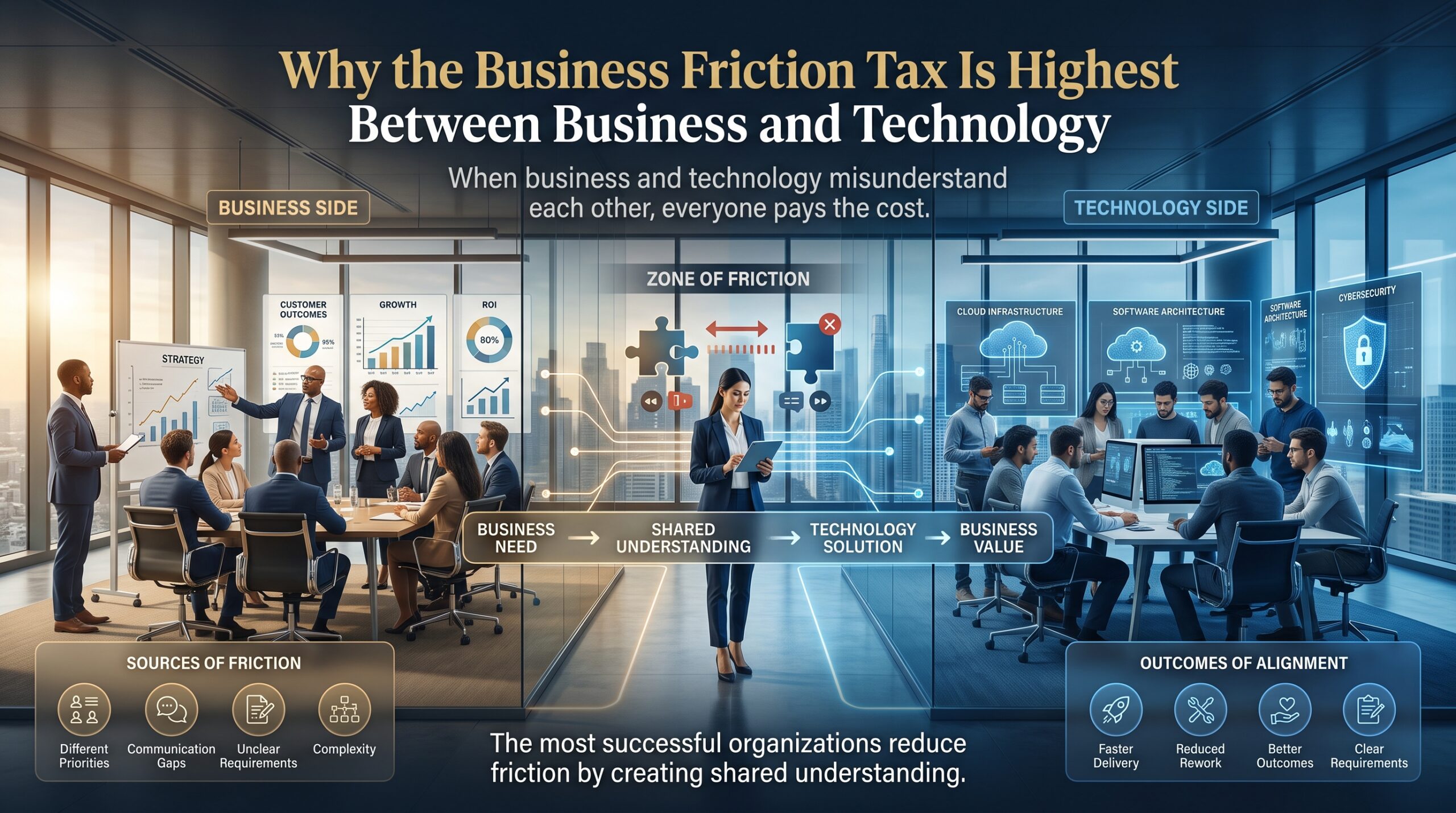
The Translation Gap
Business leaders describe outcomes. Technical teams describe systems. Without someone translating between the two, both sides assume the other understood.
Unspoken Assumptions
The most expensive requirement is the one nobody thought to state. Assumptions about security, reporting, approvals or who uses the product feel obvious to the person holding them and invisible to everyone else.
Shifting Priorities
When goals change mid-project, even small shifts create friction if the reasons are not shared. People keep working to the old brief, because nobody told them it moved.
How to Lower the Business Friction Tax in 6 Steps
- Replay the request. Ask the person doing the work to restate it in their own words before they begin.
- Define “done” up front. Agree acceptance criteria in writing, using examples where possible.
- Build a shared glossary. List key terms and what they mean in your organisation.
- Show, don’t just tell. Use simple diagrams, mock-ups and process maps so people react to something concrete.
- Close the loop on changes. When a priority moves, tell everyone affected and explain why.
- Review friction after each project. Ask where misunderstanding cost time, and fix the cause rather than the symptom.
Skills That Remove the Business Friction Tax
These habits are not common sense. They are learnable techniques, and they sit at the heart of business analysis. Professional bodies such as IIBA and IREB publish frameworks for eliciting, documenting and validating requirements so that everyone understands the same thing.
You do not need the job title to benefit. Project coordinators, team leaders, product owners and operations managers all use these skills to cut rework. Here is how the courses map to the problem:
- Business Analysis Techniques Course for process analysis and improvement methods.
- IREB Requirements Engineering Foundation (CPRE-FL) for writing clear, testable requirements.
- Agile Business Analysis (AgileBA) Foundation and Practitioner for keeping understanding aligned in fast-moving teams.
- ISQI Agile Business Analysis Certification for an internationally recognised agile pathway.
- BCS Business Change Foundation for managing the people side of change, with background on the awarding body at BCS.
- BCS Business Finance Certificate for understanding the financial side of business decisions.
Compare every option on the courses page, or browse the business analysis courses and BCS business courses categories.
Business Analysis Training Across Australia
Classroom and live online options make it possible to start lowering your business friction tax without taking time off work:
- Business analysis course in Melbourne
- Business analysis courses in Sydney
- Business analysis courses in Brisbane
- Business analysis training in Perth
- Business analysis courses in Adelaide
- Business analysis courses in Canberra
Business Friction Tax FAQs
What is the business friction tax?
It is the hidden cost of misunderstanding inside an organisation. It shows up as rework, delays, disputes and lost trust, rather than as a formal expense.
What causes friction between teams?
Common causes include vague requests, unwritten assumptions, different definitions of “done”, inconsistent terminology and priority changes that are not communicated.
How can I reduce misunderstanding at work?
Ask people to restate requests, agree acceptance criteria, keep a shared glossary, use visuals and always close the loop when plans change.
Which business analysis course should I start with?
Beginners often start with a foundation-level course such as AgileBA Foundation or the Business Analysis Techniques course. The team can recommend a path through the contact page.
Do I need experience to learn business analysis?
No prior business analysis experience is needed for foundation-level courses. More advanced courses suit people who already have some project or professional experience.
Final Thoughts: Make the Business Friction Tax Visible
The business friction tax thrives because it is invisible. Once you name it, audit it and give your team the techniques to reduce it, the gains show up fast: fewer surprises, smoother handovers and work that lands right the first time.
To build those skills, explore the business analysis courses, read more on the blog, or call 1300 649 299 to speak with the team.