



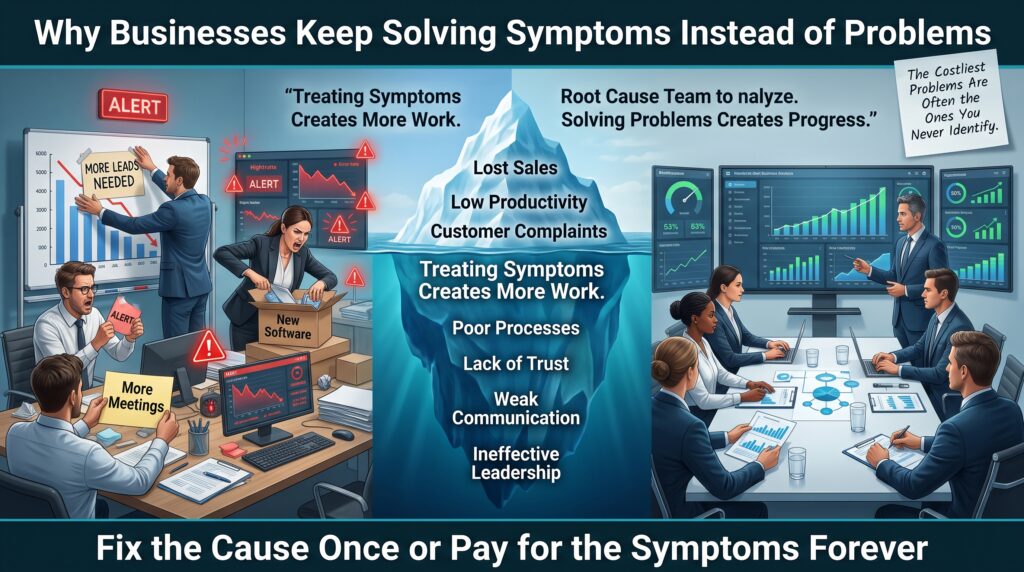
Solution bias is the habit of grabbing the first plausible answer and defending it before anyone has agreed what the problem actually is. It shows up in boardrooms, project kick-offs and vendor demos across Australia, and it quietly drains budgets every year. A team hears “customers are frustrated”, someone says “we need a new portal”, and within a week the project has a name, a sponsor and a deadline. The question that should have come first never gets asked.
This article explains why organisations fall in love with answers too early, what solution bias costs, and how the discipline of business analysis gives teams a practical way to slow down at exactly the right moment. If you want to build those skills yourself, you can explore our business analysis courses or call 1300 649 299.
What Is Solution Bias in a Business Setting?
Solution bias is a form of premature commitment. A decision-maker settles on a preferred fix, such as a new platform, a restructure, a training program or an automation, and then collects evidence that supports it. Problems are described in terms of the solution (“we have a lack of CRM”), which makes alternatives impossible to see.
It is closely related to well-known cognitive patterns. Anchoring bias gives the first idea disproportionate weight. Confirmation bias filters out inconvenient facts. The sunk cost effect keeps teams loyal to an answer after money has already been spent on it. Together, they make solution bias feel like confidence rather than risk.
The result is a project that can be delivered perfectly and still fail, because it answers a question nobody validated.
Why Organisations Fall in Love With Answers Too Early
1. Answers Feel Like Progress
A solution is concrete. It has a budget line, a timeline and a team. A problem definition looks like a pause. Leaders under pressure to show momentum naturally prefer visible action, so solution bias is rewarded long before it is exposed.
2. Vendors Sell Solutions, Not Problems
Software demonstrations, consulting pitches and conference talks all begin with an answer. When a polished product is shown early, the organisation starts to shape its problem around what the product can do. Requirements then get written to fit the tool instead of the other way around.
3. Funding Cycles Reward Certainty
Annual planning asks for a defined scope, a cost and a benefit. Teams learn that proposals with a clear solution get approved faster than proposals that say “we need to investigate”. The system trains people into solution bias without anyone intending it.
4. Senior Opinion Becomes the Anchor
When a senior executive floats an idea in the first meeting, it often becomes the default. Others test it only for feasibility, not for fit. Respectful silence replaces healthy challenge, and the idea hardens into a decision.
5. Teams Confuse Symptoms With Causes
Long call wait times, missed deadlines and rising complaints are symptoms. Without root cause analysis, they are treated as the problem itself, so the fix targets the surface. The real cause, such as unclear ownership or a broken handover, remains untouched.
6. Nobody Owns the Problem Definition
Delivery teams own the solution. Sponsors own the budget. In many organisations, no one is explicitly accountable for confirming that the problem is real, measurable and worth solving. That gap is exactly where a business analyst adds value.
The Real Cost of Solution Bias
The most obvious cost is wasted spend: systems that are launched and barely used, or features nobody asked for. The less obvious costs are rework, change fatigue and lost trust. Each failed initiative makes staff more sceptical of the next one, which makes genuine improvement harder.
There is also an opportunity cost. While a team builds the wrong thing, the actual problem keeps growing. By the time the gap becomes obvious, the organisation has often committed contracts, trained users and told customers what to expect, so reversing course feels more expensive than pressing ahead. That is how solution bias turns a small misjudgement into a multi-year burden.
Three Illustrative Scenarios
The new app. A retailer sees falling online sales and commissions a mobile app. Later analysis shows that customers abandon checkout because delivery fees appear too late, which is a pricing display issue that a small website change could have fixed in weeks.
The training program. A services firm notices repeated errors in client reports and rolls out mandatory training. A process review reveals that two systems hold conflicting data, so no amount of training could have prevented the mistakes.
The restructure. A government agency responds to slow approvals by merging two teams. Mapping the process shows that most delays sit in a single sign-off step that nobody has the authority to skip. The merger adds disruption and leaves the delay in place.
These examples are simplified, but the pattern is real: the organisation chose an answer that matched its first interpretation, and the evidence arrived too late to change it.
Warning Signs Your Team Is Jumping to Answers
Watch for project names that describe a product rather than a problem. Notice when the business case lists benefits but no alternatives. Be cautious when stakeholders cannot explain the problem without mentioning the planned solution, or when anyone who raises doubts is told the decision has already been made. Each of these is a prompt to pause and ask what evidence supports the current direction.
Solution-First vs Problem-First Thinking
| Area | Solution-First (Solution Bias) | Problem-First (Business Analysis) |
| Starting point | “We need a new system.” | “What outcome are we failing to achieve, and why?” |
| Evidence | Collected to support the idea | Gathered from stakeholders, data and process maps |
| Options considered | One, sometimes two | Several, compared against criteria and cost |
| Stakeholder role | Asked to approve | Asked to contribute and challenge |
| Success measure | Delivered on time and on budget | Business outcome achieved and sustained |
| Risk | Wrong thing built well | Slower start, much lower rework |
How Business Analysis Counters Solution Bias
Business analysis exists to sit between a business need and a proposed answer. The profession’s standards, including the BABOK Guide from IIBA, put problem definition and needs assessment ahead of solution design for exactly this reason.
Requirements elicitation uses interviews, workshops and observation to uncover what people actually need, not what they ask for first. Root cause analysis techniques such as the 5 Whys and cause-and-effect diagrams separate symptoms from drivers. Stakeholder analysis identifies whose voices are missing from the conversation. Options analysis forces the team to compare at least three realistic alternatives, including doing nothing, before recommending one. A clear business case then links the chosen option to measurable benefits.
Professional bodies such as the International Institute of Business Analysis (IIBA) and BCS, The Chartered Institute for IT define these practices, which is why employers recognise analysts who hold their certifications. For labour-market context, Jobs and Skills Australia publishes data on occupations and skills in demand.
A Five-Step Method to Slow Down Before You Commit

Step 1: Write the Problem Statement Without Naming a Solution
Describe who is affected, what is happening, how often, and what it costs. If your sentence contains a product name or the word “implement”, you are still inside solution bias.
Step 2: Test the Problem With Data and People
Check volumes, error rates and cycle times, then speak to frontline staff and customers. Look for evidence that contradicts the original assumption.
Step 3: Trace the Root Cause
Ask why at least five times, or build a fishbone diagram with the team. Stop only when you reach a cause you can act on.
Step 4: Generate and Compare Options
List several realistic responses, including process change, training, policy change and technology. Score them against cost, risk, time and benefit.
Step 5: Define Success Before Delivery Starts
Agree on measurable outcomes and a review date. Teams working in Agile environments can build these into user stories and acceptance criteria so the answer stays tied to the problem.
Where Solution Bias Hurts Most: Australian Cities and Sectors
Every capital city sees the pattern, although the industries differ. Understanding the local context helps analysts apply the right techniques.
| City | Sectors Where Premature Solutions Are Common | Training Option |
| Sydney | Banking, fintech, telecommunications, consulting | Business analysis courses in Sydney |
| Melbourne | Health, utilities, retail, higher education, technology | Business analysis course in Melbourne |
| Brisbane | Infrastructure, state government, energy, tourism | Business analysis courses in Brisbane |
| Perth | Mining, resources, engineering services | Business analysis training in Perth |
| Adelaide | Defence, health, public sector, manufacturing | Business analysis courses in Adelaide |
| Canberra | Federal government, policy, defence, digital transformation | Business analysis courses in Canberra |
Prefer to study remotely? Live online classes are available, and you can see all options on our courses page.
Courses That Build Problem-First Skills
The Business Analysis Techniques course covers elicitation, modelling and analysis methods used to challenge solution bias. Those working in Agile teams can choose Agile Business Analysis (AgileBA) Foundation and progress to the AgileBA Practitioner course. The ISQI Agile Business Analysis certification and the IREB Requirements Engineering Foundation suit analysts who want a stronger requirements focus. For change-driven work, consider BCS Business Change Foundation or the BCS Business Finance Certificate, and browse the full BCS business courses range.
Frequently Asked Questions About Solution Bias
What is solution bias?
Solution bias is the tendency to commit to a preferred answer before the underlying problem has been properly defined and tested.
How do you avoid solution bias in projects?
Write a solution-free problem statement, validate it with data and stakeholders, trace root causes, compare several options and agree success measures before delivery begins.
Is solution bias the same as confirmation bias?
They are related. Confirmation bias is the habit of favouring supporting evidence, and it is one of the mechanisms that keeps solution bias alive once an answer has been chosen.
What role does a business analyst play?
A business analyst clarifies the need, challenges assumptions, gathers requirements and recommends options, which keeps the project aligned with a validated problem.
Which course teaches problem definition and root cause analysis?
Business Analysis Techniques and the AgileBA Foundation both cover problem analysis, requirements and stakeholder engagement in a practical format.
Are business analysis courses available online in Australia?
Yes. Live online delivery is available nationwide, along with classroom options in Sydney, Melbourne, Brisbane, Perth, Adelaide and Canberra.
Final Thoughts: Fall in Love With the Problem First
Answers are attractive because they promise relief. Yet organisations that consistently perform well tend to be the ones that stay curious about the problem for a little longer than feels comfortable. That discipline is learnable, and it is the core of good business analysis.
If you want to be the person who asks the question that saves a project, browse our business analysis courses, read more on the Business Analysis Courses blog, learn about us or contact our team on 1300 649 299.