


CBAP vs PMI-PBA Australia is one of the most searched questions by business analysts looking to advance their careers in 2026. Business analysis has firmly established itself as one of the most in-demand career paths across Australia. From the bustling tech corridors of Melbourne and Sydney to the emerging business hubs of Brisbane, Perth, and Adelaide, organisations are competing fiercely to hire skilled Business Analysts who can bridge the gap between stakeholders and technology teams. According to recent labour market data, Business Analyst roles in Australia attract salaries well above the national average — and professionals who hold a recognised certification consistently command higher pay and faster promotions.
Yet one question comes up again and again in career coaching sessions, LinkedIn groups, and university business forums: which certification should you pursue — the Certified Business Analysis Professional (CBAP) offered by the International Institute of Business Analysis (IIBA), or the PMI Professional in Business Analysis (PMI-PBA) offered by the Project Management Institute (PMI)?
Both credentials are globally recognised, both are highly respected by Australian employers, and both can meaningfully accelerate your career. But they are not identical — and choosing the wrong one for your situation can cost you time, money, and momentum. This detailed guide breaks down everything you need to know about PMI-PBA vs CBAP, including eligibility requirements, exam difficulty, certification cost, salary impact, and which cities across Australia offer the best training options. By the end, you will have a clear picture of which certification is the right fit for your career goals in 2026.
What is PMI-PBA and CBAP Certification?
Before we compare, it helps to understand exactly what each certification represents and the organisation behind it.
PMI-PBA Certification (Project Management Institute)
The PMI Professional in Business Analysis, commonly known as PMI-PBA, is a certification issued by the Project Management Institute — the same global authority behind the widely-recognised PMP (Project Management Professional) credential. The PMI-PBA is specifically designed for professionals who work in business analysis roles within project-based and agile environments.
Unlike certifications that treat business analysis in isolation, PMI-PBA recognises that in the real world, business analysts regularly collaborate with project managers, delivery leads, and agile coaches. The certification validates your ability to work effectively across the full project lifecycle — from needs assessment and requirements elicitation all the way through to solution evaluation. It is particularly popular in enterprise environments in Australia where organisations run large transformation programmes using both agile and waterfall methodologies.
Key focus areas: Needs assessment, requirements management, stakeholder engagement, solution evaluation, and traceability.
CBAP Certification (International Institute of Business Analysis — IIBA)
The Certified Business Analysis Professional, or CBAP, is issued by the International Institute of Business Analysis (IIBA) and is widely regarded as the premier certification for experienced Business Analysts worldwide. It is directly aligned with the BABOK Guide (Business Analysis Body of Knowledge), which serves as the definitive framework for the business analysis profession globally.
CBAP is designed for senior-level practitioners who have spent years honing their craft in pure business analysis roles. It tests deep knowledge across all six knowledge areas of the BABOK Guide, from business analysis planning through to solution evaluation. In Australia, CBAP holders are regularly found in senior BA, lead analyst, and enterprise architect positions at major banks, government departments, healthcare organisations, and large technology firms.
Key focus areas: Business analysis planning and monitoring, elicitation and collaboration, requirements lifecycle management, strategy analysis, requirements analysis, and solution evaluation.
PMI-PBA vs CBAP: Key Differences at a Glance
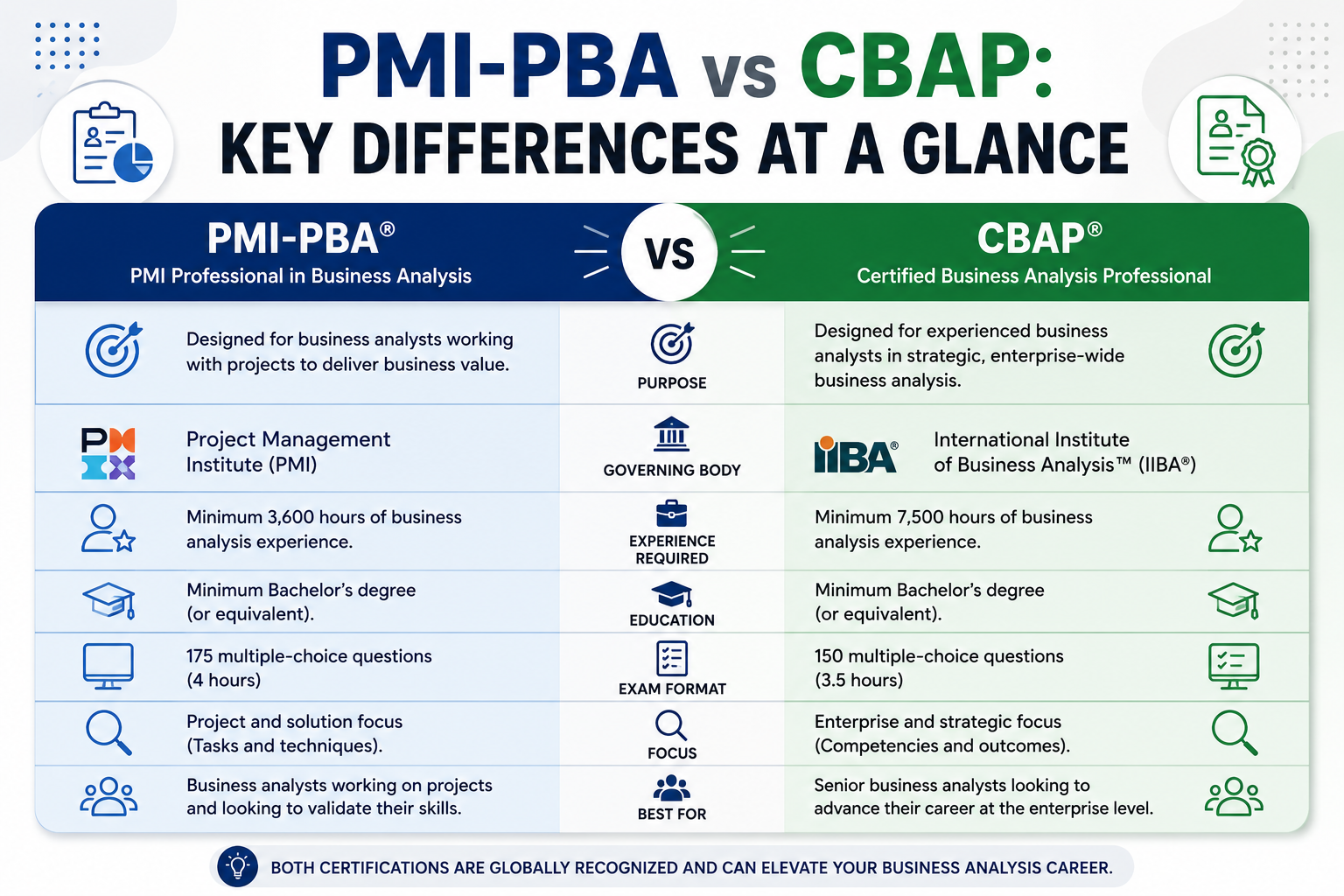
The table below gives you a structured comparison of the two certifications across the factors that matter most to Australian business analysts in 2026.
| Factor | CBAP (IIBA) | PMI-PBA (PMI) | Winner |
| Issuing Body | IIBA | PMI | Both reputable |
| Focus Area | Pure Business Analysis | BA + Project Management | Depends on role |
| Framework | BABOK Guide | PMI Framework | — |
| Best For | Senior BAs | Hybrid BA/PM roles | — |
| Experience Needed | 7,500 hours BA | 4,500–7,500 hours | PMI-PBA (easier entry) |
| Exam Format | 150 MCQ | 200 MCQ | — |
| Maintenance | 60 CDUs / 3 yrs | 60 PDUs / 3 yrs | Similar |
| Australia Demand | Very High | Growing Rapidly | — |
| Avg. Salary Boost | ~20–25% | ~18–22% | CBAP (slightly) |
While both certifications carry significant weight in the Australian job market, the table above reveals a key distinction: CBAP sits squarely within the business analysis domain and rewards deep expertise, whereas PMI-PBA bridges business analysis with project management — making it appealing to professionals in hybrid or cross-functional roles.
Eligibility Criteria: Who Qualifies for Each Certification?
One of the first practical questions every candidate asks is: am I even eligible? The requirements differ meaningfully between the two certifications, so let us walk through each one clearly.
CBAP Eligibility Requirements in Australia
CBAP has some of the most rigorous eligibility requirements in the business analysis certification space, which is part of what makes it so prestigious. To be eligible to sit the CBAP exam, candidates must meet all of the following criteria:
- A minimum of 7,500 hours of documented Business Analysis work experience within the past 10 years — this works out to approximately five years of full-time BA experience
- At least 900 hours of experience in four of the six BABOK Guide knowledge areas
- A minimum of 35 hours of professional development (training and development activities) in the past four years — this is where a formal CBAP training course from a recognised provider becomes essential
- Two professional references from a career manager, client, or CBAP holder
- Successful completion of the IIBA Code of Conduct agreement
The high experience threshold is intentional — CBAP is positioned as an advanced certification that validates mastery, not beginner-level knowledge. If you are early in your BA career, IIBA also offers the CCBA (Certification of Capability in Business Analysis), which requires only 3,750 hours of experience and can serve as a stepping stone toward CBAP.
PMI-PBA Eligibility Requirements in Australia
PMI-PBA has a slightly more accessible entry pathway, which makes it attractive to professionals who are transitioning into business analysis from project management or adjacent disciplines. The requirements depend on your educational background:
If you hold a four-year university degree (bachelor’s or equivalent):
- At least 4,500 hours of business analysis experience
- At least 35 hours of business analysis training (education)
If you hold a secondary diploma (high school certificate or associate degree):
- At least 7,500 hours of business analysis experience
- At least 35 hours of business analysis training (education)
It is worth noting that PMI uses a flexible definition of business analysis experience that includes requirements elicitation, stakeholder needs analysis, and solution assessment work — activities that many project managers and product owners undertake without carrying a formal BA title. This makes PMI-PBA more accessible to career changers and hybrid professionals in Australia’s dynamic job market.
| Logitrain Tip: Not sure if your experience qualifies? Our experienced trainers can help you audit your work history and build a strong PMI-PBA or CBAP application. Get in touch at www.logitrain.com.au |
Certification Cost in Australia: What Will You Spend?
Understanding the total investment required for each certification — beyond just the exam fee — is critical for planning your professional development budget in 2026. Here is a realistic breakdown of costs for Australian candidates.
CBAP Certification Cost in Australia
The CBAP exam fee is charged in USD by IIBA, which means the exact AUD cost fluctuates with the exchange rate. As a general guide:
- IIBA Membership fee: approximately AUD $175 per year (required to access member exam pricing)
- CBAP exam fee for IIBA members: approximately USD $325 (around AUD $500–$520)
- CBAP exam fee for non-members: approximately USD $450 (around AUD $700–$720)
- CBAP training course with Logitrain: courses are competitively priced and include comprehensive study materials, practice exams, and expert instructor support — visit www.logitrain.com.au for current pricing
- Study materials and practice tests: these are typically included in Logitrain course packages
Total investment for CBAP (including training): most Australian candidates budget between AUD $2,000 and $3,500 depending on the training format they choose (classroom, virtual, or self-paced).
PMI-PBA Certification Cost in Australia
PMI-PBA fees are similarly structured around PMI membership, which provides significant savings on the exam fee:
- PMI Membership fee: approximately USD $139 per year (around AUD $215)
- PMI-PBA exam fee for PMI members: USD $405 (around AUD $625–$645)
- PMI-PBA exam fee for non-members: USD $555 (around AUD $855–$875)
- PMI-PBA training course with Logitrain: includes all course materials, case studies, and exam preparation resources — visit www.logitrain.com.au for current course fees
Total investment for PMI-PBA (including training): Australian candidates typically budget between AUD $2,000 and $3,200 for a complete exam-ready package.
| Both certifications require 35 hours of pre-approved training, which makes enrolling with a quality provider like Logitrain a mandatory and strategic investment — not an optional extra. |
Business Analyst Salary and Career Opportunities in Australia
One of the most compelling reasons to pursue either CBAP or PMI-PBA is the direct impact on your earning potential and career progression. Business analysis is a well-paid profession in Australia, and certified professionals consistently out-earn their non-certified peers.
Based on current job market data and salary survey reports for 2025-2026, here is what certified Business Analysts can expect across Australia’s major cities:
Business Analyst Salary in Melbourne
Melbourne is home to Australia’s largest concentration of financial services, consulting firms, and government agencies, making it one of the strongest markets for Business Analysts. Certified BAs in Melbourne typically earn between AUD $95,000 and $145,000 per year, with senior BAs and CBAP holders at the top end of that range. Business analyst jobs in Melbourne are consistently among the highest advertised in volume on major job boards.
Business Analyst Salary in Sydney
Sydney’s tech sector, banking industry (Westpac, CBA, ANZ, NAB), and large consulting practices create intense demand for skilled BAs. Business analyst salaries in Sydney range from AUD $100,000 to $155,000 for certified professionals, with PMI-PBA holders in project-heavy financial services environments commanding premium packages. BA certification jobs in Sydney are among the most competitive and rewarding in the country.
Business Analyst Salary in Brisbane, Perth, and Adelaide
Brisbane’s growing tech and infrastructure sector, Perth’s resources and mining industry, and Adelaide’s emerging defence and technology precinct are all creating strong demand for Business Analysts. Salaries in these cities typically range from AUD $85,000 to $130,000 for certified professionals — with the gap narrowing as these markets mature.
In-Demand Job Roles for Certified Business Analysts
- Senior Business Analyst — the most common role for CBAP holders in large enterprises
- Product Owner — increasingly sought after for PMI-PBA certified professionals in agile environments
- Business Analysis Manager / Lead BA — senior leadership roles typically requiring CBAP
- Project Analyst — a hybrid role perfectly suited to PMI-PBA certified professionals
- Digital Transformation Analyst — high-growth area in banking, healthcare, and government
- Enterprise Business Analyst — strategic roles at tier-one companies and government agencies
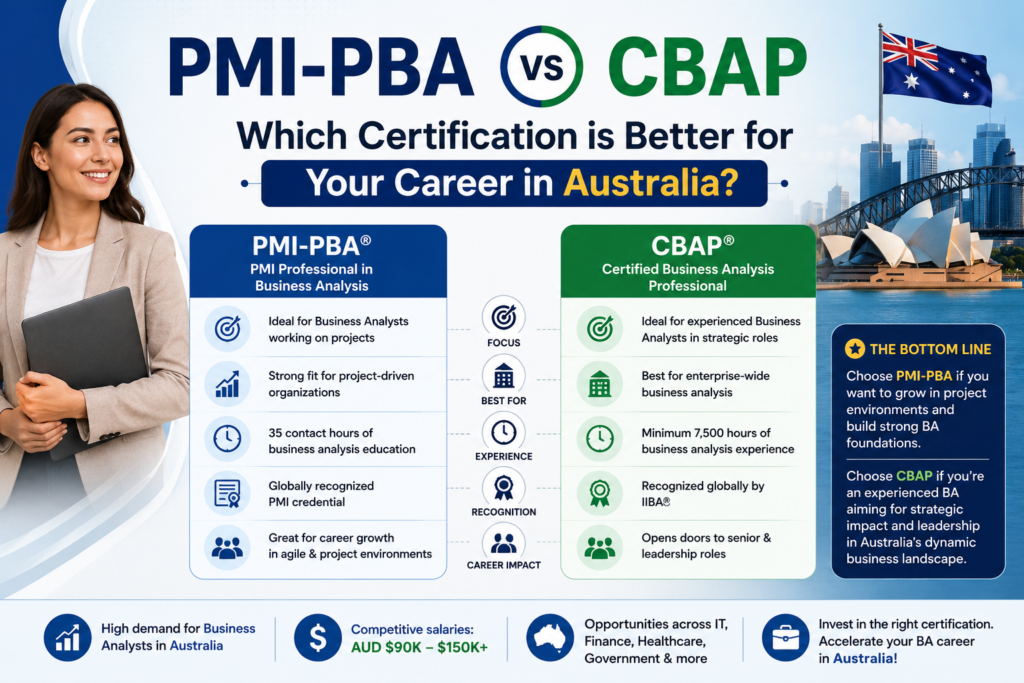
CBAP vs PMI-PBA: Which is Better for Your Career in Australia?
This is the question at the heart of the debate, and the honest answer is: it depends on your specific career situation. Rather than declaring a universal winner, here is a framework to help you decide.
Choose CBAP if:
- You are a dedicated Business Analyst with five or more years of experience in BA roles
- Your career goal is to become a Senior BA, Lead BA, or Principal Business Analyst
- You work primarily in industries that recognise IIBA credentials — including government, banking, healthcare, and enterprise IT in Australia
- You want the most prestigious and recognised pure-BA credential in the world
- You are building deep expertise in the BABOK Guide framework, which is increasingly referenced in Australian government procurement and enterprise standards
- You want a credential that signals mastery rather than breadth
Choose PMI-PBA if:
- You work in project-based environments where you collaborate closely with Project Managers and delivery teams
- You are transitioning from project management into business analysis, or you hold a hybrid BA/PM role
- You already hold a PMP or other PMI credential and want to build a complementary PMI portfolio
- You work in agile, scrum, or product-focused environments where PMI-PBA’s cross-domain skills are highly valued
- You have a bachelor’s degree but fewer than 7,500 hours of BA experience, making CBAP’s eligibility threshold harder to meet
- You are looking to work in consulting, digital transformation, or project delivery roles in Australia’s growing technology sector
| Still undecided? Speak with a Logitrain career advisor who can review your experience profile, career goals, and timeline to recommend the right certification path. Visit www.logitrain.com.au or call 1800 LOGITRAIN. |
CBAP and PMI-PBA Training Options Across Australia
Logitrain delivers expert-led CBAP and PMI-PBA training across all major Australian cities, with flexible formats to suit different schedules and learning preferences. Whether you prefer face-to-face learning in a structured classroom environment, live virtual training from home, or a combination of both, Logitrain has an option for you.
CBAP and PMI-PBA Training in Melbourne
Logitrain’s Melbourne training centre delivers regular CBAP training Melbourne sessions and PMI-PBA course Melbourne intakes throughout the year. Our Melbourne courses are led by experienced industry practitioners who have worked as Senior BAs and Project Analysts in Melbourne’s financial services, government, and technology sectors. Business analyst courses Melbourne students frequently highlight the practical, real-world focus of our training as a key differentiator.
CBAP and PMI-PBA Training in Sydney
Our Sydney training options include both PMI-PBA training Sydney classroom sessions and live virtual delivery for professionals across the greater Sydney metropolitan area. CBAP certification Sydney candidates benefit from our exam simulation tools, mock exam sessions, and comprehensive BABOK Guide study materials. BA certification Sydney professionals can choose from multiple intake dates to fit around their work commitments.
CBAP and PMI-PBA Training in Brisbane
Logitrain provides CBAP training Brisbane and PMI-PBA Brisbane courses on a regular schedule, with both in-person and virtual attendance options. Business analyst courses Brisbane candidates appreciate the flexibility of our blended delivery model, which allows participants from across Queensland to access world-class training without needing to travel to the city.
CBAP and PMI-PBA Training in Perth
For professionals in Western Australia, Logitrain offers CBAP certification Perth and PMI-PBA training Perth options through our virtual classroom platform, with occasional in-person workshop dates. BA courses Perth candidates receive the same high-quality materials, practice exams, and instructor support as our east coast cohorts.
CBAP and PMI-PBA Training in Adelaide
Adelaide’s growing technology and defence sectors are creating strong demand for certified Business Analysts. Logitrain’s business analyst certification Adelaide options include virtual PMI-PBA course Adelaide and CBAP Adelaide training, delivered by instructors who understand the unique characteristics of South Australia’s industry landscape.
| Can’t find a session near you? Logitrain offers fully live, instructor-led virtual training accessible from anywhere in Australia. Search ‘business analyst certification near me Australia’ and you’ll find Logitrain consistently among the top-rated providers. |
Exam Difficulty: CBAP vs PMI-PBA
A common question from prospective candidates is: which exam is actually harder? The honest answer is that both exams are challenging, but they test different things — and your background will significantly influence which one you find more demanding.
CBAP Exam Difficulty
CBAP is widely regarded as the more conceptually dense of the two exams. It requires deep familiarity with all six knowledge areas of the BABOK Guide, including nuanced understanding of tasks, techniques, and underlying concepts. The exam consists of 120 scored multiple-choice questions (plus 10 unscored pilot questions), and candidates have three and a half hours to complete it. CBAP questions are scenario-based, often requiring you to identify the most appropriate BA approach in complex, ambiguous situations.
Many candidates report that the volume of content to master — the entire BABOK Guide plus real-world application — makes preparation feel intense. Logitrain’s CBAP courses are specifically designed to break the BABOK framework into digestible, exam-relevant modules, with extensive scenario-based practice that mirrors the actual exam format.
PMI-PBA Exam Difficulty
PMI-PBA is broadly considered slightly more accessible than CBAP, but that does not mean it is easy. The exam has 200 questions (with a 4-hour time limit) and covers five performance domains: needs assessment, planning, analysis, traceability and monitoring, and evaluation. What makes PMI-PBA challenging is its scenario-based format, which requires applied thinking rather than rote knowledge. Candidates are expected to demonstrate sound judgement across both predictive and agile project environments.
Professionals with project management backgrounds often find PMI-PBA more intuitive because of its alignment with the PMI framework they already know. Conversely, pure BA professionals may initially find the project management integration unfamiliar.
Pros and Cons: An Honest Assessment
CBAP — Pros
- The most recognised and prestigious pure-BA certification in the world
- Deep alignment with the BABOK Guide, which is considered the definitive BA standard globally
- High credibility with senior hiring managers in banking, government, and enterprise IT in Australia
- Demonstrates genuine mastery — the high eligibility barrier itself signals seniority
- Opens doors to Lead BA, Principal BA, and BA Manager roles
CBAP — Cons
- Strict eligibility requirements (7,500 hours) mean it is inaccessible to early-career professionals
- Narrow focus on pure business analysis — less relevant for hybrid roles
- Exam preparation is time-intensive given the breadth and depth of the BABOK Guide
- Renewal requires 60 CDUs (Continuing Development Units) every three years
PMI-PBA — Pros
- More flexible eligibility requirements, making it accessible to degree holders with 4,500 hours of experience
- Strong recognition from PMI’s global brand, particularly in project-driven organisations
- Highly relevant for professionals in agile, scrum, and hybrid project environments
- Complements PMP and other PMI credentials, creating a powerful professional portfolio
- Growing demand in Australia’s expanding technology and transformation project sectors
PMI-PBA — Cons
- Less specialised than CBAP — may be seen as broader rather than deeper in pure BA circles
- Requires ongoing PDU maintenance (60 PDUs every 3 years) similar to PMP holders
- Less widely known than PMP among some Australian hiring managers who are less familiar with the PMI certification family beyond project management
- May not carry the same weight for senior pure-BA roles where CBAP is the benchmark
How to Choose the Right Certification: A Practical Framework
Making the right choice between CBAP and PMI-PBA comes down to four key factors. Work through each one honestly before committing to a certification path.
- Your Current Experience Level
If you have more than five years of dedicated business analysis experience, you likely meet CBAP’s eligibility criteria and should strongly consider it. If you have three to five years of experience — or your experience spans BA and PM roles — PMI-PBA may be the better starting point. You can always pursue CBAP later as your career progresses.
- Your Career Path and Target Role
Where do you want to be in three to five years? If your answer is Senior Business Analyst or Lead BA in a large Australian enterprise, CBAP is the clear choice. If you see yourself moving between BA, product owner, and project delivery roles — or building a consulting career — PMI-PBA’s broader scope is an advantage.
- Your Budget and Timeline
Both certifications require a similar overall investment when you factor in exam fees, membership, and training. However, if your experience level means you need to wait before you can qualify for CBAP, pursuing PMI-PBA now keeps your career development on track and adds a valuable credential to your resume while you build toward CBAP eligibility.
- Your Location and Employer Landscape in Australia
In Melbourne and Sydney, both certifications are well recognised by major employers. Government agencies and large enterprises in these cities show a slight preference for CBAP. In Brisbane, Perth, and Adelaide, where project-based and technology transformation work dominates, PMI-PBA often resonates strongly with hiring managers who work in PMI-aligned organisations.
Final Verdict: Our Recommendation for Australian Business Analysts
After examining every angle of the CBAP vs PMI-PBA debate, here is our honest recommendation for Australian professionals in 2026:
If you are a seasoned Business Analyst with the experience to qualify — and your goal is to cement your position as a senior BA specialist — CBAP is the undisputed champion. It carries the deepest industry recognition in pure business analysis circles, it aligns with the globally accepted BABOK Guide, and it signals a level of mastery that commands respect (and salary premiums) in boardrooms across Australia.
If you work in a hybrid environment, have a project management background, or are looking for a flexible credential that opens multiple career paths — PMI-PBA is an excellent, strategically smart choice. It is growing in recognition, highly relevant in agile and transformation environments, and more accessible for professionals who are still building their BA experience hours.
And here is the good news: you do not necessarily have to choose just one. Many of Australia’s most successful Business Analysts hold both credentials, using PMI-PBA as an accessible entry point and then building toward CBAP as they accumulate the necessary experience hours.
| Whether you choose CBAP or PMI-PBA, the most important next step is to start with quality training. Logitrain’s expert-led courses in Melbourne, Sydney, Brisbane, Perth, and Adelaide give you everything you need to pass your exam with confidence. |
Ready to Advance Your Business Analysis Career?
Enrol in CBAP or PMI-PBA training in Melbourne, Sydney, Brisbane, Perth, or Adelaide today.
Visit www.businessanalysiscourses.com.au | Call 1300 649 299
Frequently Asked Questions (FAQ)
Is CBAP worth it in Australia in 2026?
Absolutely. CBAP remains one of the most respected and highest-value certifications for Business Analysts in Australia. Certified CBAP holders consistently report significant salary increases, faster promotions, and greater confidence in senior stakeholder environments. Given the ongoing demand for experienced BAs across Australian industries — from banking and government to healthcare and technology — CBAP is a worthwhile investment for professionals with the required experience
Is PMI-PBA recognised in Australia?
Yes, PMI-PBA is well recognised across Australia, particularly in organisations that align with the PMI project management framework. Major consulting firms, technology companies, financial institutions, and government contractors are all familiar with the credential. Its recognition is growing rapidly as agile and hybrid delivery models become the norm in Australian workplaces, making PMI-PBA an increasingly valuable addition to any BA’s professional profile.
Which certification is best for business analysts in Australia?
The best certification depends on your experience, career goals, and current role. CBAP is the gold standard for dedicated, experienced Business Analysts looking to cement their expertise and pursue senior specialist roles. PMI-PBA is the better choice for professionals working in project management environments, hybrid roles, or agile product teams. Both are highly valued by Australian employers, and holding both certifications provides a significant competitive advantage.
Can I do CBAP and PMI-PBA together?
There is no rule preventing you from pursuing both certifications, and many experienced professionals in Australia do exactly that. In practice, most candidates find it more efficient to focus on one at a time. A common approach is to pursue PMI-PBA first (given its slightly more accessible eligibility requirements) and then build toward CBAP once you have accumulated the required 7,500 hours of experience. Logitrain can help you plan a structured certification roadmap that makes the most of your time and investment.
How long does it take to prepare for CBAP or PMI-PBA?
Most candidates require between 8 and 16 weeks of dedicated study time, depending on their background and how much time they can commit each week. Logitrain’s structured course programs are designed to guide you through the required content in a structured, exam-focused format, helping you maximise your preparation efficiency. Our courses include practice exams, scenario workshops, and direct support from experienced instructors who have helped hundreds of Australian professionals pass both exams.
What is the best CBAP training provider in Melbourne?
Logitrain is consistently rated among the top business analyst certification training providers in Melbourne and across Australia. Our CBAP training Melbourne courses are delivered by certified practitioners with real-world industry experience, and our pass rates reflect our commitment to practical, high-quality instruction. Visit www.logitrain.com.au for upcoming Melbourne course dates and current pricing.