




If you are trying to decide between a career as a Business Analyst or a Project Manager in Australia, you are not alone. Both roles are in strong demand across every major city, from Sydney and Melbourne to Brisbane, Perth, and Canberra. But they serve very different purposes inside a business. This guide breaks down everything you need to know — from day-to-day responsibilities and required skills to salary figures and career paths — so you can make a confident, informed decision in 2026.
Business Analyst vs Project Manager Australia: Quick Role Comparison
At a high level, a Business Analyst figures out what a business needs and defines the right solution. A Project Manager takes that solution and makes sure it gets built and delivered on time, within budget, and to the agreed scope. One focuses on the ‘what’ and ‘why’, the other on the ‘how’ and ‘when’. Here is a side-by-side comparison to start:
| Area | Business Analyst | Project Manager |
| Primary Focus | Business needs and solutions | Project delivery and execution |
| Main Goal | Define the right solution | Deliver the solution on time and budget |
| Works With | Stakeholders, developers, end users | Project team, clients, sponsors |
| Key Documents | BRD, user stories, process maps | Project plan, risk register, status reports |
| Agile Role | Product Owner / BA in Scrum | Scrum Master / PM in Agile |
| Budget Control | No direct budget ownership | Manages full project budget |
| Timeline Owner | Rarely | Always |
| Risk Management | Identifies business risks | Manages all project risks |
| Avg Salary (AU) | $95K – $140K | $108K – $160K |
What Does a Business Analyst Do in Australia?
A Business Analyst (BA) acts as the bridge between business stakeholders. Their core job is to understand business problems, gather and document requirements, and recommend solutions that align with business goals. In Australia, BAs are found across IT, banking, government, consulting, healthcare, and digital transformation projects.
Key responsibilities of a Business Analyst in Australia include:
- Conducting stakeholder interviews and workshops to capture business requirements
- Writing Business Requirements Documents (BRDs), user stories, and acceptance criteria
- Performing gap analysis to identify the difference between current and desired state
- Creating process maps and workflow diagrams to visualise business processes
- Supporting UAT (User Acceptance Testing) to ensure solutions meet business needs
- Collaborating with development and technical teams to translate requirements into workable solutions
- Documenting change management impacts and training requirements
A skilled Business Analyst does not just write documents — they are active problem-solvers who ask the right questions, challenge assumptions, and make sure the business builds the right thing before spending time and money building it wrong.
What Does a Project Manager Do in Australia?
A Project Manager (PM) is responsible for planning, executing, and closing projects. They own the project timeline, budget, risk register, and team coordination from start to finish. In Australia, Project Managers are in demand across construction, IT, mining, healthcare, government, and financial services.
Key responsibilities of a Project Manager in Australia include:
- Defining project scope, objectives, and deliverables with stakeholders
- Building and managing detailed project plans and timelines
- Tracking project milestones and reporting progress to leadership and sponsors
- Managing project budgets, forecasting costs, and controlling expenditure
- Identifying, assessing, and mitigating project risks throughout the project lifecycle
- Leading and coordinating cross-functional teams to deliver outcomes
- Managing stakeholder expectations and resolving issues and blockers quickly
- Running post-project reviews and capturing lessons learned
A great Project Manager keeps everything moving. They are the person everyone looks to when timelines slip, budgets tighten, or teams lose direction. Their job is to deliver — no excuses.
Business Analyst vs Project Manager Australia: Main Differences Explained
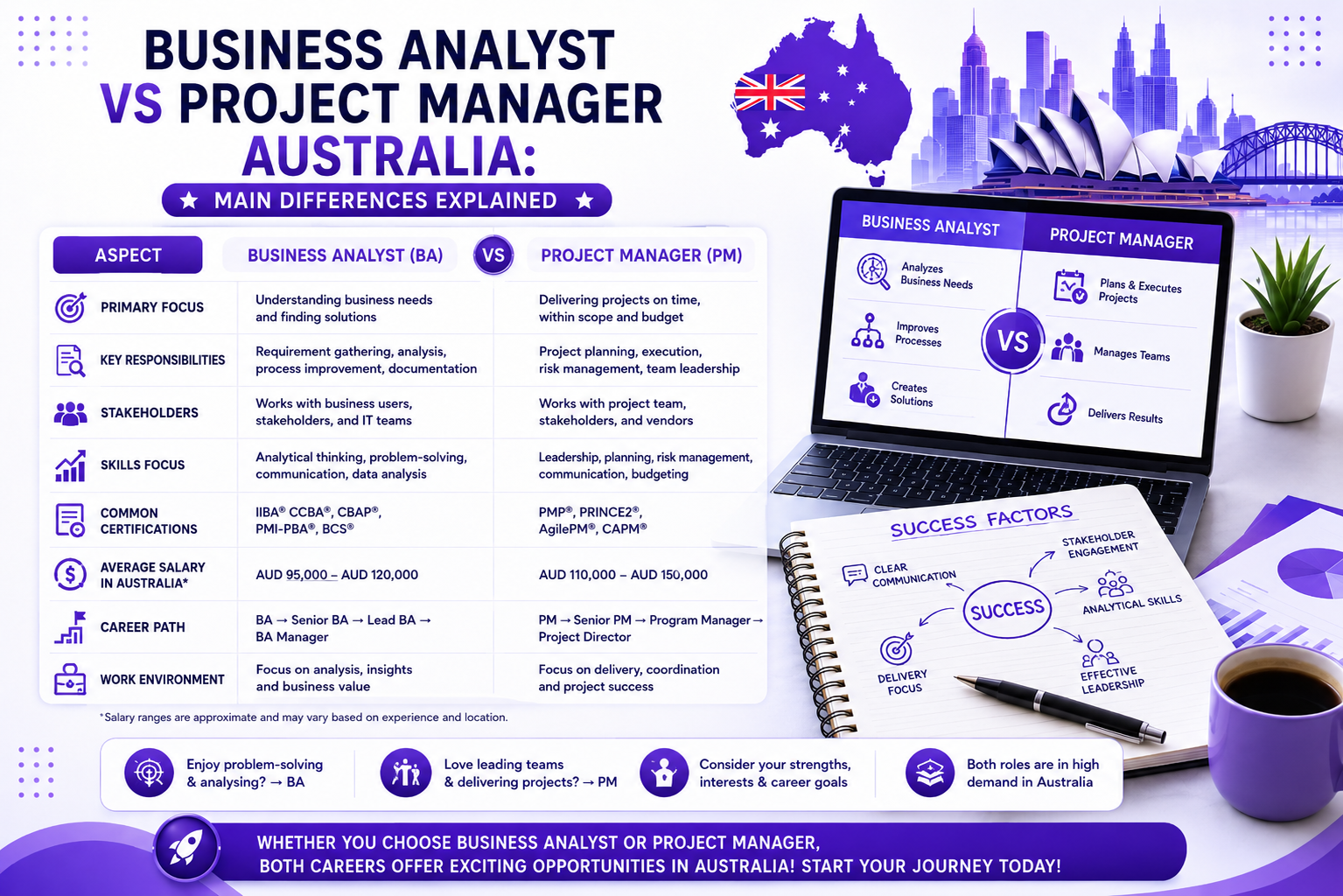
Both roles are critical to successful project delivery, but they operate very differently. Here is a deeper look at where they diverge.
Business Analyst vs Project Manager: Role Focus
The Business Analyst is focused on understanding the business problem and defining the right solution. They spend their time talking to stakeholders, mapping processes, writing requirements, and ensuring the proposed solution will actually fix the underlying issue. The Project Manager, on the other hand, is focused on execution. Once the solution is defined, the PM takes ownership of delivering it. Their attention is on timelines, budgets, team performance, risks, and communication with sponsors.
In short: the BA defines what needs to be done, and the PM makes sure it gets done.
Business Analyst vs Project Manager: Daily Responsibilities
On any given day, a Business Analyst in Australia might be:
- Running a requirements workshop with a group of business stakeholders
- Reviewing user stories with a development team in a sprint planning session
- Updating process maps based on new information from subject matter experts
- Facilitating a UAT session to confirm a system change meets acceptance criteria
On the same day, a Project Manager might be:
- Reviewing the project plan and updating task progress with team leads
- Running a weekly status meeting with the project sponsor
- Escalating a resource conflict to senior leadership before it affects the deadline
- Updating the risk register after a supplier flagged a potential delay
Business Analyst vs Project Manager: Required Skills
Business Analyst skills:
- Strong analytical thinking and structured problem solving
- Requirements gathering and documentation (BRD, user stories, use cases)
- Process mapping and business process redesign
- Stakeholder management and facilitation
- Understanding of Agile, Scrum, and waterfall methodologies
- Data analysis and the ability to turn numbers into business insights
- Communication — both written and verbal — to translate between technical and business audiences
Project Manager skills:
- Project planning, scheduling, and timeline management
- Budget control and financial reporting
- Risk management and issue resolution
- Leadership and team coordination across diverse groups
- Stakeholder communication and executive reporting
- Proficiency in project tools such as MS Project, Jira, or Smartsheet
- Change management to guide teams through transitions
Business Analyst vs Project Manager: Documents and Deliverables
The documents each role produces are very different. Business Analysts typically produce:
- Business Requirements Document (BRD)
- Functional Specification Documents
- User Stories and Acceptance Criteria
- Process Maps and Workflow Diagrams
- Gap Analysis Reports
- UAT Test Plans and Sign-Off Documents
Project Managers typically produce:
- Project Charter and Project Plan
- Risk Register and Issue Log
- Status Reports and Steering Committee Packs
- Budget Forecasts and Cost Reports
- Change Request Logs
- Post-Implementation Reviews
Business Analyst vs Project Manager: Career Growth
Both roles offer strong career growth in Australia. Business Analysts can move into Senior BA, Lead BA, Business Architecture, Product Management, or transition into consulting. Project Managers can progress to Senior PM, Program Manager, Portfolio Manager, or move into PMO (Project Management Office) leadership roles.
Interestingly, the two career paths often converge. Many Senior BAs take on project delivery responsibilities, and many experienced PMs develop deep business analysis capabilities. The professionals who can do both are among the most sought-after in the Australian market.
Business Analyst vs Project Manager Salary in Australia 2026
Salary is one of the biggest factors when choosing between these two careers. In Australia, both roles are well-paid, but Project Managers generally earn slightly more — particularly at senior levels where budget and accountability are higher. Here is a detailed breakdown.
Business Analyst Salary in Sydney, Melbourne and Brisbane
- Sydney: $110,000 – $140,000 per year (senior roles can exceed $160,000)
- Melbourne: $100,000 – $130,000 per year
- Brisbane: $95,000 – $125,000 per year
- Perth: $95,000 – $120,000 per year
- Adelaide: $85,000 – $110,000 per year
- Canberra: $100,000 – $130,000 per year (government contracts often pay above market)
Project Manager Salary in Sydney, Melbourne and Brisbane
- Sydney: $125,000 – $160,000 per year (senior PMs on major projects can earn $180,000+)
- Melbourne: $115,000 – $150,000 per year
- Brisbane: $108,000 – $140,000 per year
- Perth: $110,000 – $145,000 per year (mining and resources sector pays a premium)
- Adelaide: $95,000 – $125,000 per year
- Canberra: $115,000 – $150,000 per year (federal government projects offer strong rates)
Salary Difference Between Business Analyst and Project Manager in Australia
Below is a clear comparison across major Australian cities:
| City | BA Salary (AUD) | PM Salary (AUD) | Difference |
| Sydney | $110,000 – $140,000 | $125,000 – $160,000 | PM earns ~$15K–$20K more |
| Melbourne | $100,000 – $130,000 | $115,000 – $150,000 | PM earns ~$15K more |
| Brisbane | $95,000 – $125,000 | $108,000 – $140,000 | PM earns ~$13K–$15K more |
| Perth | $95,000 – $120,000 | $110,000 – $145,000 | PM earns ~$15K more |
| Adelaide | $85,000 – $110,000 | $95,000 – $125,000 | PM earns ~$10K–$15K more |
| Canberra | $100,000 – $130,000 | $115,000 – $150,000 | PM earns ~$15K more |
Note: Salaries vary based on industry, contract type (permanent vs contract), years of experience, and certifications held. Contractors typically earn 20–40% more than permanent employees in equivalent roles.
Business Analyst vs Project Manager in Sydney
Sydney is Australia’s largest city for Business Analyst and Project Manager roles, driven by its position as the country’s financial and commercial capital. The finance and banking sector — home to the big four banks, investment firms, and insurance companies — is one of the biggest employers of both BAs and PMs. IT and consulting firms also hire heavily, particularly for digital transformation and enterprise system implementations. Government projects, from transport infrastructure to public health systems, create strong demand for experienced Project Managers. BAs working in Sydney’s tech and fintech space often command some of the highest salaries in the country, especially those with experience in Agile delivery environments.
Business Analyst vs Project Manager in Melbourne
Melbourne is a major hub for Business Analyst and Project Manager careers, particularly in technology, education, healthcare, and corporate services. The city’s large financial services sector mirrors Sydney, but Melbourne also stands out for its strong presence of technology companies, professional services firms, and government agencies running large-scale corporate transformation projects. Healthcare and education institutions regularly seek BAs to map and improve complex business processes, while Project Managers are needed to oversee system upgrades and facility expansions. Melbourne’s corporate culture values structured methodology, making certifications like CBAP for BAs and PMP or PRINCE2 for PMs particularly attractive to employers.
Business Analyst vs Project Manager in Brisbane
Brisbane has grown rapidly as a destination for both Business Analyst and Project Manager professionals, with strong demand across construction, healthcare, government, energy, and IT sectors. The city’s infrastructure pipeline — accelerated by major government investment — is creating ongoing demand for experienced Project Managers who can run complex, multi-stakeholder delivery programs. Healthcare and government digital transformation initiatives are also generating consistent work for Business Analysts. The energy sector, including Queensland’s transition to renewable energy, is increasingly seeking BAs to map new operational processes and PMs to manage large capital projects. Brisbane’s job market is competitive but growing, and salaries are rising to reflect that.
Business Analyst vs Project Manager in Perth
Perth’s economy is closely tied to the mining, resources, and engineering sectors, which makes it a unique market for both Business Analysts and Project Managers. Project Managers in Perth are frequently engaged on major capital works in the resources and construction industries, where large budgets, complex logistics, and remote site management create high demand for experienced delivery professionals. Business Analysts play a key role in improving the business systems that support these industries — from enterprise resource planning (ERP) implementations to operational process improvements. As Perth’s economy continues to diversify into technology and professional services, opportunities for both roles are expanding beyond the traditional resources sector.
Business Analyst vs Project Manager in Adelaide
Adelaide offers solid career opportunities for both Business Analysts and Project Managers, particularly in the defence, education, healthcare, and public sector. The defence industry — one of Adelaide’s biggest employers — drives demand for Project Managers who can navigate complex, regulated, and often long-term programs. Business Analysts are regularly sought by government agencies and public sector organisations to support process improvement and digital service delivery initiatives. Healthcare and university sectors also provide steady demand for both roles. While salaries in Adelaide are generally lower than Sydney or Melbourne, the cost of living is significantly more affordable, making it an attractive city for professionals seeking strong work-life balance alongside a stable career.
Business Analyst vs Project Manager in Canberra
Canberra is Australia’s government capital, which means that Business Analyst and Project Manager roles here are dominated by federal and territory government departments and their associated contractors. BAs in Canberra are commonly engaged to support policy analysis, business process improvement, digital services transformation, and compliance-related initiatives across agencies. Project Managers run large public sector delivery programs, often working across multiple departments on national digital infrastructure projects. Security clearances are often required for senior roles, which can be a distinguishing factor in the Canberra market. Salaries in Canberra, particularly for government contractors, are competitive and often exceed those offered in equivalent private sector roles elsewhere in Australia.
Business Analyst vs Project Manager Australia: Which Career Is Better in 2026?
There is no single answer to which career is better — it depends entirely on your strengths, work style, and what excites you professionally. Here is a simple guide to help you decide.
Choose a Business Analyst Career If You Like Problem Solving
If you enjoy digging into complex business challenges, asking difficult questions, and designing elegant solutions, the Business Analyst path will suit you well. BAs tend to thrive when they are:
- Naturally curious and analytical in their thinking
- Comfortable facilitating workshops and interviews with diverse stakeholders
- Passionate about understanding how businesses work and where they can improve
- Interested in working closely with both business leaders and technical teams
- Detail-oriented when it comes to documentation and requirements
The BA career path rewards people who think clearly, communicate well, and genuinely care about building the right solution — not just any solution.
Choose a Project Manager Career If You Like Leading Teams
If you get energy from driving results, leading people, and making sure things actually get done, the Project Manager path is a natural fit. PMs tend to do well when they:
- Enjoy being accountable for outcomes and taking ownership of delivery
- Are comfortable managing competing priorities, tight deadlines, and uncertain situations
- Have strong leadership presence and can motivate teams under pressure
- Are organised and structured in how they plan and track work
- Can communicate with confidence at every level — from team members to C-suite executives
Project Managers are respected across every industry in Australia because they make difficult things happen. If you want a career where you can see the direct impact of your leadership, project management is an excellent choice.
Can a Business Analyst Become a Project Manager in Australia?
Absolutely — and it happens regularly in the Australian market. Business Analysts who have worked on large projects often develop a strong understanding of project planning, stakeholder management, timeline pressures, and risk management. Over time, many BAs naturally move into delivery-focused roles, taking on more project coordination and management responsibilities alongside their analysis work.
The transition is even smoother in Agile environments, where BAs and PMs often share overlapping responsibilities. A BA who has been working as a Product Owner in a Scrum team, for example, has already developed many of the skills a Project Manager needs.
To make the move from Business Analyst to Project Manager in Australia, most professionals benefit from:
- Gaining a certification such as PMP (Project Management Professional) or PRINCE2
- Deliberately taking on project coordination tasks in their current BA role
- Seeking mentorship from an experienced Project Manager
- Building experience with project management tools such as MS Project, Smartsheet, or Jira
The reverse transition — from PM to BA — is equally achievable, though it typically requires developing stronger documentation and analytical skills.
Business Analyst vs Project Manager in Agile and Scrum Teams
Agile has changed the way BAs and PMs work together — and in some cases, blurred the lines between the two roles significantly.
In a traditional waterfall project, the BA gathers requirements upfront and hands them to the PM, who then builds and manages the delivery plan. In an Agile or Scrum environment, things work differently:
- The Business Analyst often takes on the Product Owner role, maintaining the backlog, writing user stories, and prioritising features with the business and development team
- The Project Manager often takes on responsibilities similar to a Scrum Master — removing blockers, facilitating ceremonies, and protecting the team from distractions
- Both roles may be performed by one person on smaller Agile teams, or remain separate on larger, more complex programs
In larger Australian organisations running scaled Agile frameworks such as SAFe (Scaled Agile Framework), both BAs and PMs continue to play distinct and important roles — but collaboration between them is tighter than ever. Understanding Agile methodology is now an expectation, not an option, for both roles in the Australian job market.
Final Verdict: Business Analyst vs Project Manager Australia
Both the Business Analyst and Project Manager are essential, well-respected, and well-paid careers in Australia. The right choice depends on who you are and what you want your working life to look like.
Choose Business Analyst if you want to spend your career solving business problems, defining solutions, and working at the intersection of business and technology. Your impact is in the quality of thinking that shapes what gets built.
Choose Project Manager if you want to lead teams, own outcomes, and be the person who turns plans into reality. Your impact is in the results you deliver — on time, on budget, and to the satisfaction of everyone involved.
In Australia in 2026, both paths offer strong demand, excellent salaries, and the opportunity to build a long and rewarding career. The best advice? Be honest with yourself about where your strengths lie, then commit fully to developing them.
FAQs About Business Analyst vs Project Manager Australia
What is the main difference between Business Analyst and Project Manager in Australia?
The Business Analyst focuses on identifying business problems and defining the right solutions, while the Project Manager focuses on delivering those solutions on time, within budget, and to the agreed scope. BAs work heavily on requirements and stakeholder engagement, while PMs own the delivery plan, timeline, budget, and risk management.
Who earns more in Australia, Business Analyst or Project Manager?
In most Australian cities, Project Managers earn slightly more than Business Analysts — typically $10,000 to $20,000 more per year at comparable experience levels. This reflects the greater accountability PMs carry for budget, timelines, and project outcomes. However, senior or principal-level Business Analysts can earn competitive salaries comparable to mid-level Project Managers.
Is Business Analyst better than Project Manager in Sydney?
Neither role is universally better than the other in Sydney — both are in strong demand and offer excellent career prospects. Business Analysts are highly sought-after in Sydney’s finance, banking, and fintech sectors, while Project Managers are essential across IT, infrastructure, and government projects. The better choice depends on your individual strengths and career goals.
Is Project Manager a good career in Melbourne?
Yes, Project Manager is an excellent career choice in Melbourne. The city has a large and diverse economy with strong demand for PMs in technology, financial services, healthcare, and government. Melbourne employers frequently look for candidates with formal project management certifications such as PMP Certification (PMI Official) or PRINCE2, and experienced PMs can earn $115,000 to $150,000 or more per year.
Can a Business Analyst become a Project Manager in Australia?
Yes, and it is a common career transition in Australia. Many Business Analysts develop strong project delivery instincts over time and move naturally into Project Manager roles. Gaining a PMP or PRINCE2 certification, building experience with project management tools, and taking on delivery-related responsibilities in your current role are the most effective ways to make the transition successfully.
Which city is best for Business Analyst and Project Manager jobs in Australia?
Sydney and Melbourne offer the highest volume of jobs and the highest salaries for both Business Analysts and Project Managers. Canberra is particularly strong for government-focused roles, Perth is excellent for resource and engineering sector positions, and Brisbane is a growing market with increasing opportunities across construction, healthcare, and government. The best city for you depends on your industry specialisation and lifestyle preferences