




Breaking into the business analyst career in Australia as a beginner can feel overwhelming — job ads demand 2-3 years of experience, yet everyone has to start somewhere. The good news? The demand for junior business analyst jobs in Australia has never been stronger, and with the right approach, you can land your first role even without prior BA experience.
This guide covers exactly how to become a first business analyst job in Australia — step by step — whether you are a fresh graduate, a career changer, or someone with transferable skills from a different industry. By the end, you will have a clear business analyst roadmap Australia you can act on immediately.
What Does a Business Analyst Do in Australia?
A business analyst (BA) acts as the bridge between business stakeholders and technical teams. In Australia, BAs work across banking, government, healthcare, retail, and tech — helping organisations improve processes, define requirements, and deliver projects that create real value.
Day-to-day responsibilities typically include:
- Running stakeholder workshops and interviews to gather requirements
- Writing user stories, Business Requirements Documents (BRDs), and Functional Specs (FRDs)
- Creating process maps and workflow diagrams using tools like Visio or Lucidchart
- Analysing data using SQL, Excel, and Power BI
- Managing project backlogs and collaborating with developers using Jira and Confluence
- Facilitating UAT (User Acceptance Testing) and sign-off
Business Analyst Salary Australia — Entry Level to Senior
One of the most common questions from beginners is: how much does a business analyst salary Australia entry level look like? Here’s a realistic breakdown:
| Entry Level (0-2 yrs) | Mid-Level (2-5 yrs) | Senior (5+ yrs) |
| $70,000 – $85,000
AUD per year |
$90,000 – $110,000
AUD per year |
$120,000+
AUD per year |
Sydney and Melbourne offer the highest salaries, especially in financial services and enterprise tech. Government roles in Canberra are also well-paying with strong job security. Consulting firms typically pay a premium over in-house corporate roles.
Business Analyst Skills Required in Australia
Employers hiring for entry level business analyst jobs in Australia look for a mix of technical and soft skills. You do not need all of them from day one — knowing the full picture gives you a clear learning roadmap.
| Skill | Why It Matters |
| SQL & Excel | Data querying and analysis — the baseline for any BA role in Australia |
| Power BI | Dashboard creation and visual reporting for stakeholder presentations |
| Jira / Confluence | Agile project management, backlog management, sprint ceremonies |
| Requirements Writing | BRDs, FRDs, user stories, use cases, acceptance criteria |
| Stakeholder Management | Workshops, interviews, elicitation techniques, conflict resolution |
| Process Mapping | BPMN, swimlane diagrams, Visio, AS-IS and TO-BE process documentation |
Soft skills matter just as much. Strong communication, active listening, critical thinking, and the ability to manage ambiguity are consistently rated as the top differentiators for entry-level BAs by Australian hiring managers.
Can You Become a Business Analyst Without Experience?
Yes — and thousands of Australians do it every year. The key is how you position yourself.
Many successful junior business analyst jobs Australia holders come from backgrounds in project coordination, customer service, finance, operations, administration, and even teaching. These roles build the communication, problem-solving, and stakeholder skills that BAs use daily.
The strategy is to bridge the gap: complete a business analyst course Australia that covers practical tools and real-world scenarios, build a portfolio of practice projects, and target smaller organisations or government agencies that are more open to career changers and juniors.
| Key Insight:
When employers say ‘entry level’ they mean entry level to the BA role — not entry level to the workforce. Your existing professional experience is valuable and should be reframed through a BA lens on your resume. |
Step-by-Step Business Analyst Career Path Australia
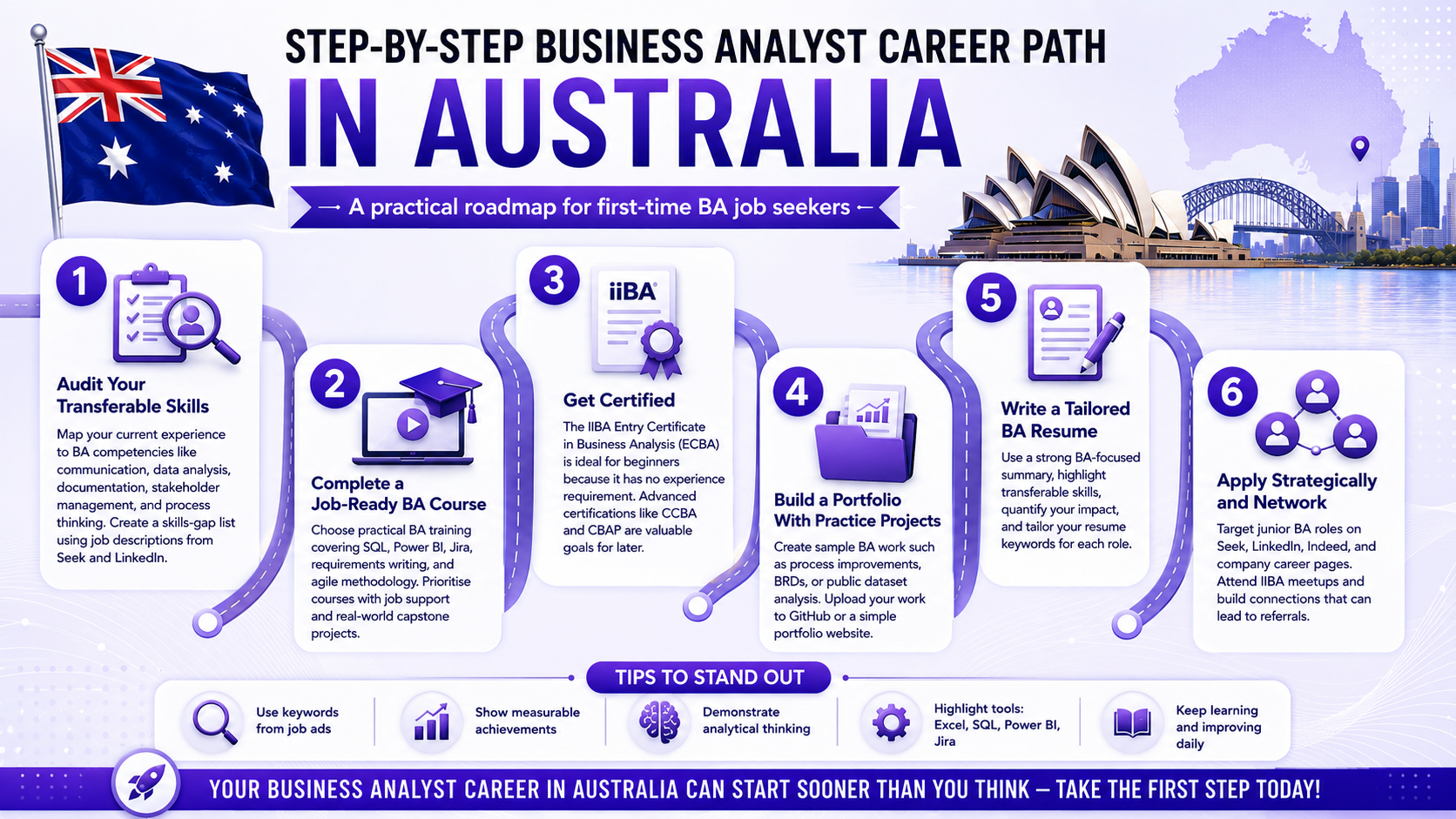
Here is the business analyst roadmap Australia that has worked for hundreds of first-time job seekers:
Step 1 — Audit Your Transferable Skills
Map your current experience to BA competencies. Communication, data analysis, documentation, stakeholder management, and process thinking all count — even from non-BA roles. Create a skills gap list based on the job descriptions you find on Seek and LinkedIn.
Step 2 — Complete a Job-Ready BA Course
Enrol in a best business analyst course Australia that covers practical tools — SQL, Power BI, Jira, requirements writing, and agile methodology — not just theory. Prioritise courses with business analyst training with job support and real-world capstone projects you can include in your portfolio.
Step 3 — Get Certified (Optional but Valuable)
The IIBA Entry Certificate in Business Analysis (ECBA) has no experience requirement — ideal for beginners. More advanced certifications like the CBAP and CCBA require experience but are worth planning for. Business analyst certification Australia credentials signal credibility and commitment to employers.
Step 4 — Build a Portfolio With Practice Projects
Document a process improvement for a local business, write a sample BRD for a hypothetical product, or analyse a public dataset and present insights. Upload your work to GitHub or a simple portfolio site. Employers love seeing that you have applied the skills in a realistic context.
Step 5 — Write a Tailored BA Resume
Use a business analyst resume sample Australia entry level as a structural guide. Lead with a strong professional summary that positions you as a BA (not as your previous role). Highlight transferable skills, quantify impact wherever possible, and tailor your resume for each application — especially the keywords in the job description.
Step 6 — Apply Strategically and Network
Target junior business analyst jobs Australia on Seek, LinkedIn, Indeed, and company career pages. Do not overlook government contracts and consultancies — they hire entry-level BAs regularly. Attend local IIBA chapter meetups and connect with BAs on LinkedIn. Many roles are filled through referrals before they are ever advertised.
How to Become a Junior Business Analyst in Australia in 2026
The 2026 job market is competitive but very favourable for well-prepared juniors. Here are the key trends shaping business analyst jobs Australia right now:
Agile Is Everywhere
Most Australian organisations now run Scrum, SAFe, or hybrid agile frameworks. Familiarity with agile ceremonies — sprint planning, retrospectives, backlog refinement, and story pointing — is a real differentiator for entry-level candidates. Mention it in your resume and be ready to discuss it in interviews.
Data Literacy Is the New Baseline
Even junior BAs are expected to be comfortable with data. If you can write a basic SQL query, pull data from a database, or build a Power BI report, you are ahead of most applicants. The business analyst tools SQL Excel Power BI Jira stack is the standard — prioritise these in your learning.
Government and Consulting Are Hiring
Federal and state government agencies regularly bring on graduates and career changers through structured APS programs and panel arrangements. Consulting firms (Big 4, boutique, and technology consulting) also run graduate programs. These are excellent entry points that often lead to permanent roles or strong referrals into industry.
Conclusion — Your First BA Job Is Closer Than You Think
Getting your first business analyst job in Australia without experience is absolutely achievable — it just requires a clear plan, the right skills, and consistent effort. Focus on what you can control: upskill deliberately with a job ready business analyst course, build evidence of your capabilities through portfolio projects, and apply to roles that match where you are now, not where you hope to be in five years.
The business analyst career path Australia offers clear progression, strong salaries, and work that genuinely makes a difference to organisations across every industry. The first step is always the hardest — but with the right roadmap, you can make it happen.
Frequently Asked Questions (FAQs)
These are the most common questions we receive at Business Analysis Courses Australia. If your question is not answered here, contact our team at 1300 649 299 or visit www.businessanalysiscourses.com.au.
1. What is a Business Analyst course?
A Business Analyst course teaches you how to understand business problems, analyze data, and suggest solutions. It prepares you to bridge the gap between business needs and technical solutions.
2. What business analyst courses do you offer in Australia?
We offer a comprehensive range of business analyst courses in Australia, including:
- Agile Business Analysis (AgileBA) Foundation and Practitioner
- Business Analysis Techniques Course
- ISQI Certified Agile Business Analysis
- IREB Requirements Engineering Foundation (CPRE-FL)
- BCS Business Finance Certificate
- BCS Business Change Foundation
All courses are available across our training centres in Sydney, Melbourne, Brisbane, Adelaide, Perth, and Canberra, as well as online through our flexible live virtual classroom format.
3. Are your courses available online?
Yes. All of our business analyst training Australia courses are available in both online (live virtual classroom) and in-person formats at our training centres. This means you can learn from anywhere in Australia — or internationally — without compromising on quality or interaction with your instructor.
4. How long does it take to complete a business analysis course?
Course duration varies by program. Foundation-level courses typically run over 2 to 3 days in an intensive format. Practitioner and certification-level courses may require additional self-study time for exam preparation. Our team will provide you with a full learning schedule when you enrol so you can plan around your work and personal commitments.
5. Will I receive a certification after completing the course?
Yes. Our courses align with globally recognised certifications and frameworks including AgileBA, BCS, ISQI, and IREB. Upon successful completion, you will receive a certification that is recognised by employers across Australia and internationally. Our course content is specifically structured to prepare you for the associated certification exams with confidence.
6. What is the business analyst salary in Australia for beginners?
The business analyst salary Australia entry level typically ranges from $70,000 to $85,000 AUD per year, depending on industry and location. Mid-level BAs with 2 to 5 years of experience earn $90,000 to $110,000, while senior BAs can earn $120,000 or more. Cities like Sydney and Melbourne generally offer higher packages, especially in financial services and enterprise technology.
7. Can I become a business analyst in Australia without a degree?
Yes. Many successful BAs in Australia do not have a formal degree in business analysis. What matters most to employers is demonstrated competency — the right business analyst certification Australia, practical skills (SQL, Power BI, Jira, requirements writing), and relevant experience. Our courses are designed to give you exactly these capabilities, regardless of your educational background.
8. Which cities do you offer Business Analysis training in?
Business Analysis Courses Australia delivers training across all major Australian cities:
- Sydney — CBD and suburban training centres
- Melbourne — West Melbourne training centre (Suite 3, 53 Dryburgh Street)
- Brisbane — CBD training venue
- Adelaide — city centre location
- Perth — CBD training centre
- Canberra — convenient city location
All locations are accessible via public transport, and online options are available for learners who cannot attend in person.
9. How is Business Analysis Courses Australia different from other providers?
| At Business Analysis Courses Australia, we focus on practical, job-ready skills — not just theory. Our courses use real-world case studies, hands-on exercises, and structured learning paths that reflect actual Australian workplace environments. We offer comprehensive support from enrolment through to certification and beyond, with expert instructors who have real industry experience. |
10. How do I enrol or get more information?
Getting started is easy. You can:
- Visit our website: www.businessanalysiscourses.com.au
- Call our course advisors: 1300 649 299
- WhatsApp us: +61 1800 159 151
- Use the enquiry form on our website for a callback
Our team will help you choose the right course based on your background, goals, and schedule — and answer any questions about business analyst training Australia costs, dates, and formats