



In the rapidly changing world of digital delivery in Australia, the role of the business analyst is not just to document the requirements. Instead, the business analyst must facilitate the stakeholders, manage the scope, manage the change, and deliver the correct solution. This is where the IREB Foundation Certification in Requirements Engineering (CPRE-FL) can add tremendous value to the business analysts in Australia.
The IREB Certified Professional for Requirements Engineering – Foundation Level is a globally accepted and vendor-independent qualification that demonstrates the fundamental skills of requirements engineering. This qualification is of immense value to business analysts in government, banking, financial services, consulting, software development, infrastructure, and other sectors.
What is the IREB Requirements Engineering Foundation Certification?
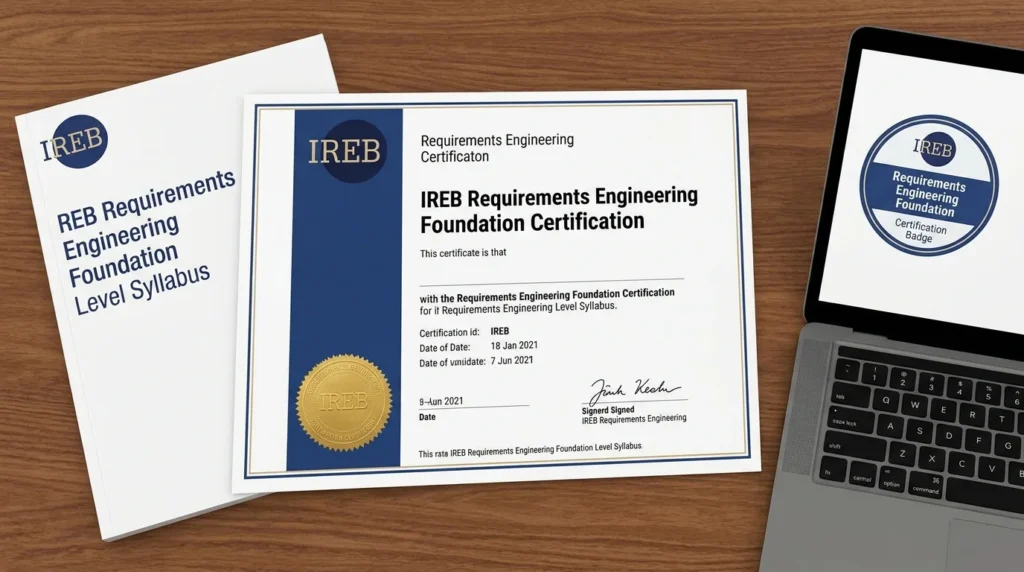
The IREB Certified Professional for Requirements Engineering – Foundation Level (CPRE-FL) certifies essential skills in eliciting, documenting, validating and managing requirements. It’s part of IREB’s globally recognised CPRE program and is anchored to an official syllabus and handbook. The certificate focuses on practical RE fundamentals that apply across industries and development approaches (agile and traditional).
Exam format (Foundation):
- ~45 multiple-choice questions
- 75 minutes (with +15 minutes extra time option where applicable)
- Closed book (no aids)
- Pass mark: 70%
- Lifetime validity of certificates
IREB oversees the program, while exams are delivered by licensed certification bodies such as iSQI, Certible, GASQ, and TÜV SÜD. This separation preserves independence and quality—IREB sets the syllabus and exam content, while certifiers conduct the tests and issue certificates.
Why is the IREB Foundation Certification so popular?
- Global credibility & independence – CPRE is a globally recognised personal certification in Requirements Engineering, maintained by a not-for-profit board of international experts. Certificates are valid indefinitely.
- Practice-oriented syllabus & handbook – The official syllabus and handbook teach practical techniques such as natural-language and model-based documentation, prioritisation, conflict resolution, and validation.
- Flexible learning & exam options – You can attend recognised training or self-study using IREB’s free downloads, glossary, practice exam, and online self-assessment that simulates real exam conditions.
- Clear pathway for progression – CPRE offers four levels—Foundation, Practitioner, Specialist, and Expert—allowing greater skills in areas like Elicitation, Management, Modelling, or RE@Agile.
Is the IREB Foundation Certification worth it today?
If you work in or around digital delivery Business Analysis, Product, Software, Testing, UX/CX, or Project—this certification provides a structured, vendor-independent way to learn and prepare for real-world requirements work. It proves you can:
- Elicit and consolidate stakeholder needs using fit-for-purpose techniques
- Write clear, testable requirements (in natural language or models)
- Validate, negotiate, prioritise, and manage requirements across their lifecycle
Because IREB certificates are globally accepted and don’t expire, CPRE-FL is a strong long-term investment that travels with you across roles, industries, and countries.
Pros of IREB Foundation Certification
Job availability
Projects succeed when requirements are clear and testable. CPRE-FL builds capabilities employers seek in BA, Product, Systems, QA/Test, and Delivery roles, independent of specific tools or vendors.
IREB Foundation salary potential
While salary tables aren’t published, CPRE-FL signals verified RE skills backed by an international body and a lifetime credential. Pair it with project experience to be competitive for roles where requirements quality drives success.
Global recognition
CPRE is recognised worldwide. Exams are offered by multiple licensed certifiers with remote and test-centre options. Certificates are valid indefinitely, supporting career mobility.
Career pathways
The certification offers a structured progression: Foundation → Practitioner → Specialist → Expert, with modules focused on Elicitation, Management, Modelling, and RE@Agile. This helps you grow as your career advances.
Cons of IREB Foundation Certification
Cost considerations (Australia)
IREB does not sell exams directly; pricing is set by licensed certification bodies and varies by country and delivery mode. For example, some certifiers list the CPRE-FL exam fee around €200 (excluding VAT). Australian candidates typically book through iSQI or TÜV SÜD South Asia. Use the certifier’s country selector to view the live fee in AUD.
Bottom line: Pricing depends on the certifier. Always check live Australian pricing before booking.
Evolving industry demands
Requirements work keeps evolving with agile, DevOps, and product-led delivery. CPRE-FL stays relevant by focusing on enduring principles—validation, prioritisation, and documentation quality—rather than transient tools.
Certification difficulty
The Foundation exam is closed-book and time-boxed, requiring a 70% pass mark. It’s approachable with preparation, but you’ll need familiarity with the syllabus and question formats. Non-native speakers may receive extra time depending on the certifier.
Where to begin to get your IREB Foundation Certification
- Download official study materials – Get the syllabus, handbook, glossary, and a practice exam from the IREB downloads centre.
- Try the online self-assessment – Simulate exam timing and question style to check readiness.
- Choose training or self-study – IREB recognises global training providers, but self-study is also supported.
- Book the exam – For Australia, book via iSQI, TÜV SÜD South Asia, or other licensed certifiers.
- Take the exam and receive your certificate – Certifiers conduct, score, and issue certificates; IREB maintains the syllabus and exam standards.
If you’re serious about becoming a certified professional in requirements engineering, now is the perfect time to take the next step. The IREB Requirements Engineering Foundation Certification can open doors to higher-paying roles and global career opportunities.
At Business Analysis Certification, we provide expert-led training designed to help you pass the exam with confidence, whether you prefer online or in-person learning.
Key topics covered in the IREB Foundation
- Introduction & foundations – RE benefits, roles, communication, and requirement types.
- System & system context – Boundaries, stakeholders, surrounding systems, and processes.
- Requirements elicitation – Sources, stakeholder duties, technique selection, and creativity methods.
- Documentation approaches – Natural language vs. model-based documentation, templates, and quality criteria.
- Validation & negotiation – Conflict handling, quality checks, and acceptance criteria.
- Requirements management – Prioritisation, traceability, and change control.
- Tool support – How tools enhance collaboration, documentation, and traceability.
Frequently Asked Questions
Is a CPRE-FL enough to get a job?
A certification helps, but employers also look for hands-on experience and the ability to apply techniques such as workshops, prioritisation, and trade-off negotiation. CPRE-FL provides a credible foundation to demonstrate your readiness for requirements-related roles.
Is CPRE-FL worth it in Australia?
Yes. Australian teams increasingly expect business analysts, product owners, and engineers to deliver clear, testable requirements. CPRE-FL is globally recognised, valid for life, and available via remote or local testing options, making it a strong credential for the Australian market.
Does having a CPRE-FL pay well?
While no official salary data is published, validated RE skills plus experience often lead to higher-responsibility roles such as Business Analyst, Product Analyst, Requirements Manager, or Solution Analyst.
Is the CPRE-FL very difficult?
It’s rigorous but fair. Success depends on time management and understanding quality criteria, context modelling, and technique trade-offs. Using the official practice exam and self-assessment makes preparation easier.
Is the CPRE-FL certification stressful?
Like any timed, closed-book exam, it can be stressful. IREB’s free glossary and self-assessment tools help you build familiarity and confidence before booking. Some certifiers provide extra time for non-native speakers.
How many fail CPRE-FL?
Official pass/fail rates aren’t published since exams are conducted by independent certifiers. However, the pass mark is 70%. Strong preparation using the syllabus and official materials is the key to success.
The future of networking jobs in Australia
Although CPRE-FL is focused on requirements engineering, its skills—scoping, validation, and traceability—are valuable in networking and infrastructure projects. As Australia modernises networks and systems, professionals who bridge business needs with technical delivery remain in demand.