




Conflicting business requirements are one of the most uncomfortable problems a business analyst will ever face, mostly because nobody is wrong. Sales wants a checkout with no friction. Risk wants every customer verified. Operations wants fewer manual steps. Compliance wants a signed record of every one. Each request is reasonable, each has a senior person behind it, and the project plan quietly assumes all of them can be delivered together.
They can’t. That moment, when two valid needs collide and the project stalls, is what we call the requirements collision problem. In this guide we’ll look at why conflicting business requirements happen, how to spot them early, and the practical steps a business analyst can use to get a decision made without burning relationships. It’s written for working Australian professionals, not for a textbook.
What Are Conflicting Business Requirements?
Conflicting business requirements are two or more requirements that cannot all be satisfied at the same time, even though each one is legitimate on its own. The conflict might sit between two stakeholders, two departments, two regulations, or even two requirements from the same person who hasn’t noticed the contradiction yet. If you want the formal background, Wikipedia’s overview of requirements analysis is a decent starting point.
The key word is valid. A bad requirement is easy to push back on. A collision between two good ones is much harder, because whichever way you go, someone loses something they genuinely need.
Why Conflicting Business Requirements Happen in Almost Every Project
It would be nice to think collisions only appear on badly run projects. In reality they are built into how organisations work. Different teams are measured on different goals, so they naturally ask for different things. A few common causes:
- Competing goals. Marketing is rewarded for growth, finance for cost control, risk for avoiding loss.
- Different views of the same process. The person who sees the customer and the person who sees the audit trail rarely describe the process the same way.
- Requirements gathered in silos. Interviews happen one stakeholder at a time, so nobody hears the contradiction until the build is underway.
- Fixed constraints. A hard deadline, a fixed budget or a regulatory obligation squeezes the available options until two needs no longer fit.
- Unspoken assumptions. One team assumes a legacy system will be retired. Another assumes it will be extended.
None of this signals a failing team. It just means conflicting business requirements should be expected, planned for and surfaced on purpose.
Common Types of Conflicting Business Requirements
Naming the type of collision helps you pick the right way to resolve it. Here are the patterns that turn up most often.
| Type of conflict | Illustrative example | Typical way forward |
| Stakeholder vs stakeholder | Sales wants no login at checkout; fraud team wants identity checks. | Explore the underlying goals and test a middle option. |
| Speed vs control | Operations wants one-click approvals; audit wants two sign-offs. | Risk-based rules: simple approvals below a threshold, dual sign-off above it. |
| Features vs budget | Three departments each want a custom dashboard; funding covers one. | Prioritise by value and agree a phased release. |
| Business need vs regulation | A team wants to share staff data widely; privacy obligations limit access. | Role-based access and a documented legal check. |
| Functional vs non-functional | A rich report page versus a strict page-speed target. | Prototype, measure, then decide the trade-off. |
These examples are illustrative, not from a specific client. But if you’ve worked on any project of size, at least one of them probably sounds familiar.
The Hidden Cost of Ignoring Conflicting Business Requirements
The danger isn’t the conflict itself. It’s leaving the conflict unresolved. When conflicting business requirements go unnoticed, they usually surface at the worst possible moment: during testing, at user acceptance, or just after go-live. At that point fixing them means rework, delay and some awkward conversations about who signed off what.
There’s also a quieter cost. When stakeholders feel their needs were quietly dropped, trust in the project drops with them. Future requests become more defensive, workshops become more political, and the analyst starts to look like a messenger rather than a facilitator. Surfacing the clash early, openly and calmly protects both the project and the relationships around it.
How to Spot Conflicting Business Requirements Early
The earlier you detect a collision, the cheaper it is to resolve. These habits help:
- Keep a single, shared requirements list. When all requirements live in one place, contradictions become visible. Scattered documents hide them.
- Build a traceability matrix. Linking each requirement to a business objective and an owner shows where two requirements pull against the same objective.
- Listen for absolute words. Phrases like “always”, “never”, “must be instant” or “no exceptions” often signal a clash waiting to happen.
- Review requirements side by side. Put the sales view and the risk view next to each other in a workshop and ask, “can both of these be true?”
- Prototype early. A simple wireframe or process diagram often exposes a conflict that a written requirement hid.
The aim isn’t to hunt for blame. It’s to make sure conflicting business requirements are found while changing them is still cheap.
A Six-Step Method to Resolve Conflicting Business Requirements
There’s no magic formula, but this sequence works consistently across IT, finance, government and healthcare projects.
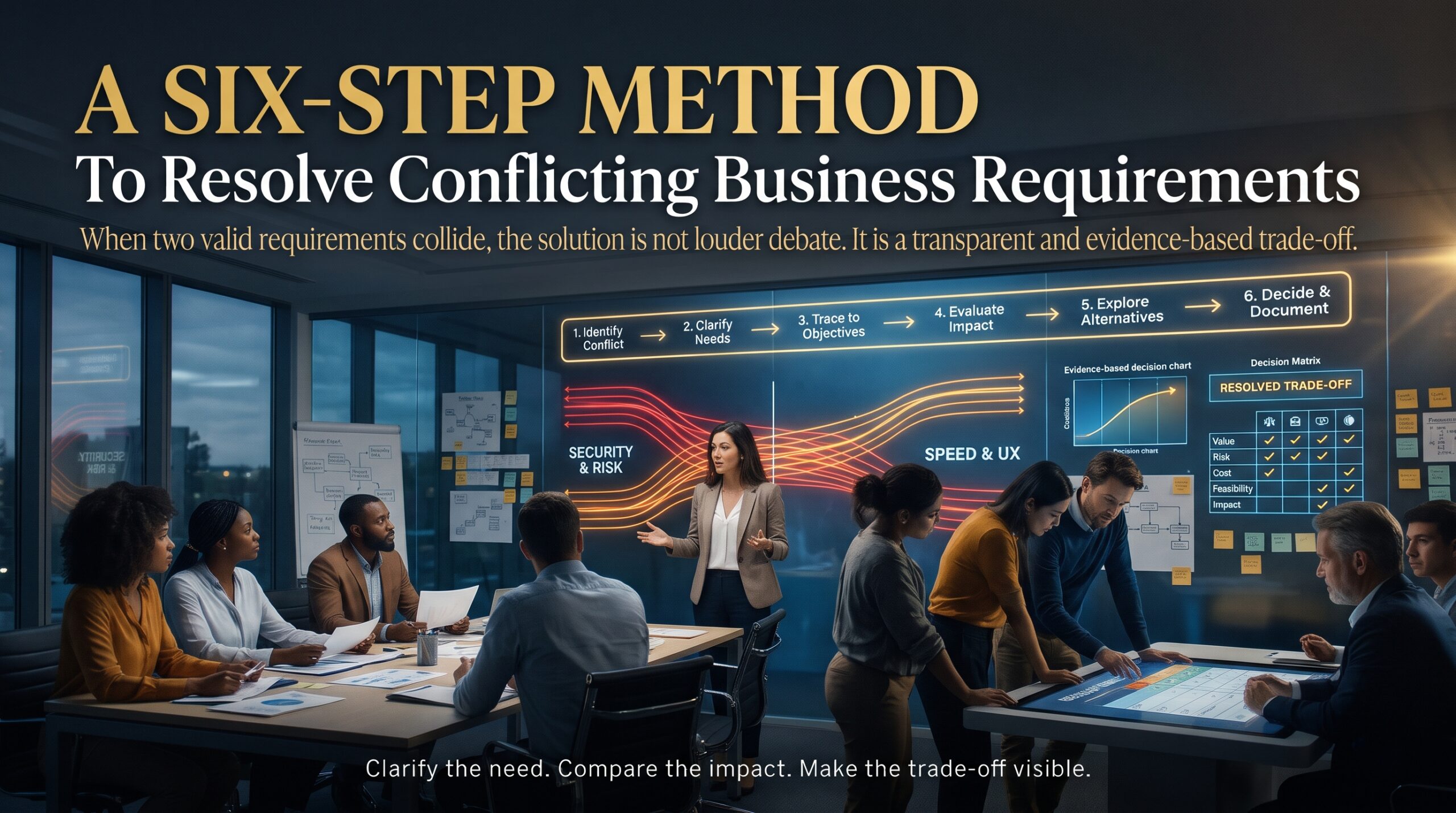
Step 1: Detect and name the conflict
State it plainly and neutrally: “Requirement A says X. Requirement B says Y. We can’t deliver both as written.” Avoid language that sounds like one side is the problem.
Step 2: Separate positions from interests
A position is what someone asks for. An interest is why they want it. “No login at checkout” is a position; “reduce abandoned carts” is the interest. “Verify every customer” is a position; “avoid fraud losses” is the interest. Once you’re talking about interests, there’s often more room than anyone expected.
Step 3: Dig for the root cause with the five whys
Keep asking why until you reach the real driver. Sometimes a requirement turns out to be a habit, a workaround for an old system, or a preference rather than a genuine need. Dropping it dissolves the conflict.
Step 4: Generate options, not just verdicts
Instead of asking a sponsor to pick a winner, bring two or three options, each with its trade-offs. Maybe checkout stays frictionless for small orders and adds verification only for high-risk ones. Maybe the project releases in phases. Good options often satisfy both interests partly, rather than one fully.
Step 5: Prioritise using a clear framework
When trade-offs are unavoidable, use a shared method rather than gut feel. The MoSCoW method (Must, Should, Could, Won’t) is popular because it forces an honest conversation about what is essential. You can also score options against agreed criteria such as value, risk, cost and urgency.
Step 6: Decide, document and communicate
Take the decision to the person with the authority to make it, usually the project sponsor or product owner. Then record what was decided, why, who agreed, and what was traded away. A short decision log prevents the same argument from restarting three months later.
Techniques Business Analysts Use to Handle Conflicting Business Requirements
Most of the tools below are standard parts of the business analysis toolkit. The IIBA’s BABOK Guide describes the wider body of knowledge, and many of these techniques are practised in hands-on exercises on a good course.
- Facilitated workshops. Bring the conflicting parties into one room with a clear agenda and an agreed goal.
- Stakeholder analysis. Map who has influence and interest so you know who needs to be involved in the decision.
- Impact analysis. Show what each option changes in cost, time, risk and customer experience.
- Options analysis. Compare alternatives side by side against the same criteria.
- Prototyping and wireframes. Let people react to something concrete rather than debate abstractions.
- Change control and a decision log. Keep a visible record so decisions stick and changes are deliberate.
Real-World Scenario: Resolving Conflicting Business Requirements in Practice
Here’s a simplified, illustrative scenario. A mid-sized insurer is redesigning its online claims form. The customer experience team wants the form to take under five minutes with minimal questions. The claims assessment team wants detailed information up front so fewer claims need follow-up. Both are right.
The analyst runs a joint workshop and asks why each team wants what it wants. The experience team is worried about people abandoning the form. The assessment team is worried about delays and repeat contact. Neither of those interests is actually opposed. They agree to a short initial form for simple claims, with extra questions that appear only when the claim type or value triggers them. Both teams get most of what they need, the decision is logged, and the build goes ahead without an eleventh-hour fight.
The lesson: the best way to handle conflicting business requirements is rarely “pick a side”. It’s usually “find the interest underneath, then design around it”.
Soft Skills That Make the Difference
Tools matter, but conflict between valid needs is mostly a people problem. The analysts who handle it well tend to share a few habits. They stay neutral and curious rather than defensive. They paraphrase what each side said so everyone feels heard. They separate the person from the problem. And they’re comfortable saying, “This needs a decision, and it isn’t mine to make,” then escalating clearly, with options attached.
Build These Skills with Business Analysis Training in Australia
Reading about conflicting business requirements helps. Practising on realistic case studies with an experienced trainer helps far more. Business Analysis Courses offers practical, job-ready training with live online and classroom options. Here’s where each course fits:
- Want a solid grounding in requirements? The IREB Requirements Engineering Foundation (CPRE-FL) course covers eliciting, documenting and managing requirements, including conflict resolution.
- Need a broader toolkit? The Business Analysis Techniques course builds practical skills in process analysis, stakeholder work and options analysis.
- Working in agile teams? See the AgileBA Foundation and AgileBA Practitioner courses for prioritisation and collaboration in iterative delivery.
- Aiming for a recognised credential? Explore the ISQI Agile Business Analysis Certification.
- Leading or supporting change? The BCS Business Change Foundation course teaches structured approaches to organisational change.
- Work with budgets and cases? The BCS Business Finance Certificate helps you speak the language of finance.
You can compare everything on the business analysis courses page or contact the team on 1300 649 299 for advice on the right starting point.
Business Analysis Courses in Your City
Prefer learning alongside other professionals, or need a flexible online option? Training is available across major Australian cities:
- Business analysis course in Melbourne, with a training centre in West Melbourne.
- Business analysis courses in Sydney.
- Business analysis courses in Brisbane.
- Business analysis training in Perth.
- Business analysis courses in Adelaide.
- Business analysis courses in Canberra.
For more guides like this, browse the Business Analysis Courses blog.
Frequently Asked Questions About Conflicting Business Requirements
What are conflicting business requirements?
They are requirements that cannot all be met at once, even though each one is valid. Typical examples include speed versus control, features versus budget, or a business need versus a regulation.
How do you resolve conflicting requirements as a business analyst?
Name the conflict neutrally, uncover the interests behind each position, generate options, apply a prioritisation method, then get a decision from the right authority and document it.
Who makes the final call when requirements conflict?
Usually the project sponsor, product owner or a governance group with authority over scope and priorities. The analyst’s job is to prepare clear options and facilitate the decision, not to make it alone.
Can conflicting requirements both be satisfied?
Sometimes. Once you move from positions to interests, a hybrid option, a phased approach or a rule-based design can meet most of both needs.
Which techniques help prioritise competing requirements?
MoSCoW, weighted scoring, cost-benefit comparison and risk-based ranking are widely used. The best choice depends on how formal your organisation is.
Where can I learn requirements and stakeholder skills in Australia?
Structured training with real case studies is the quickest route. Business Analysis Courses offers foundation to professional level options, live online or in person.
Final Thoughts: Treat Collisions as Information
A collision between two valid needs isn’t a sign the project has failed. It’s information. It tells you where priorities, assumptions or constraints haven’t been aligned yet. Teams that surface conflicting business requirements early, explore the interests underneath and record clear decisions end up with calmer projects and better outcomes.
Ready to handle conflicting business requirements with confidence? Talk to the Business Analysis Courses team and find the course that fits your next step.