



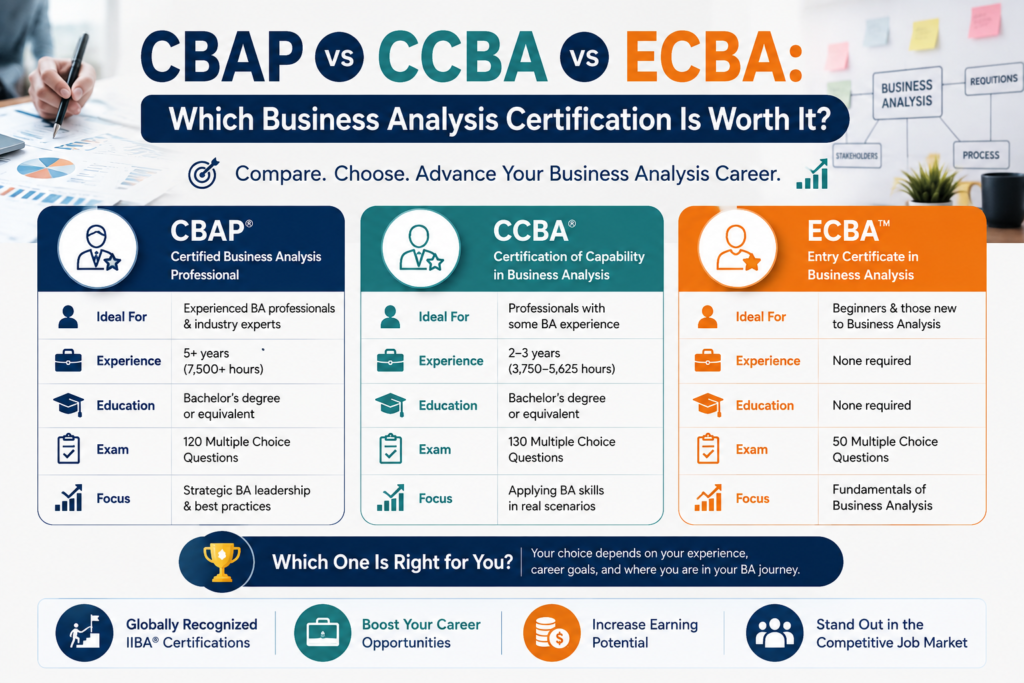
If you’re weighing up CBAP vs ECBA vs CCBA, the right choice usually comes down to one thing: how many hours of real business analysis experience you already have. All three are IIBA (International Institute of Business Analysis) certifications built on the BABOK Guide, but they’re designed for very different career stages from graduates with zero experience through to senior BAs leading complex programs.
This guide breaks down CBAP vs ECBA vs CCBA by eligibility, exam format, cost and career fit in the Australian job market, so you can pick the certification that actually matches where you are right now, not just the one with the most impressive letters after your name.
CBAP vs ECBA vs CCBA: Quick Comparison
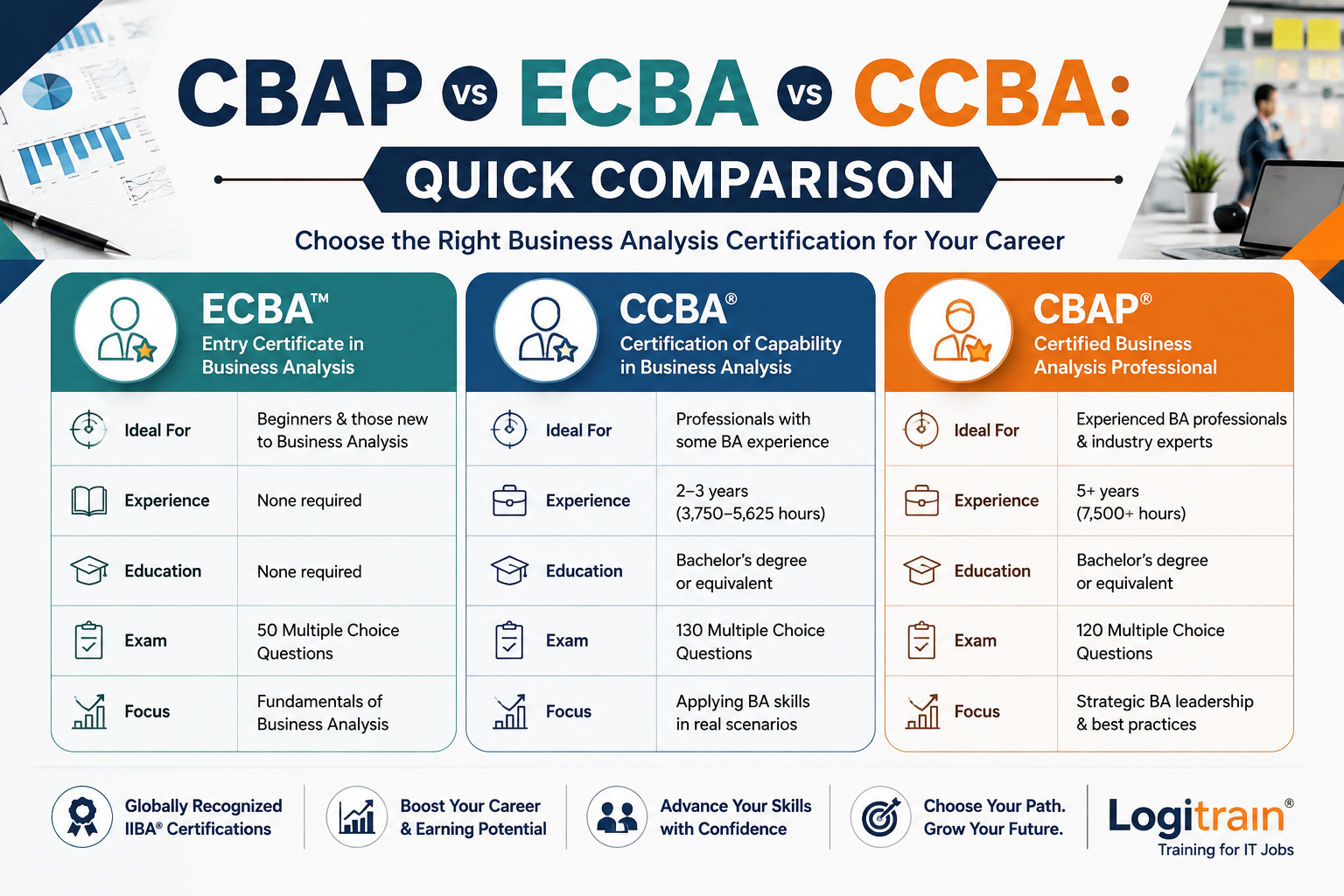
| Feature | ECBA | CCBA | CBAP | Notes |
| Experience needed | None required | 3,750 hrs (~2–3 yrs) | 7,500 hrs (~4–7 yrs) | Hours self-reported, IIBA audits randomly |
| Exam length | 50 MCQs / 1 hr | 130 MCQs / 3 hrs | 120 MCQs / 3.5 hrs | CBAP is case-study heavy |
| Exam fee (member) | $150 | $325 | $350 + $145 application | Non-member fees are higher |
| Best for | Graduates, career changers | Practising BAs, 2–5 yrs in | Senior/lead BAs, 5+ yrs in | Pick based on real experience, not ambition |
| PD hours required | None | 21 hrs (4 yrs) | 35 hrs (4 yrs) | Courses like ours count toward this |
These figures reflect current IIBA pricing and eligibility rules always confirm the latest details on the official IIBA certification page before applying, since fees and hour requirements are reviewed periodically.
What Is ECBA (Entry Certificate in Business Analysis)?
ECBA is the entry point for anyone starting out in business analysis, and it’s the one certification in the CBAP vs ECBA vs CCBA comparison that has no minimum experience requirement. It’s aimed at graduates, career changers, and professionals moving into a BA role from adjacent areas like project coordination or IT support.
The ECBA exam is 50 multiple-choice questions completed in one hour, based on the BABOK Guide’s core concepts. It costs around $150 for IIBA members and more for non-members. Because there’s no experience bar, it’s the fastest way to get an internationally recognised credential on your resume while you build up real project hours.
What Is CCBA (Certification of Capability in Business Analysis)?
CCBA sits in the middle of the CBAP vs ECBA vs CCBA ladder. It’s designed for practitioners with roughly 2–3 years of hands-on business analysis work specifically 3,750 hours of documented BA work history within the last seven years, plus 21 hours of professional development within the last four years.
The CCBA exam runs for three hours and includes 130 scenario-based multiple-choice questions covering all six BABOK knowledge areas. It suits people who are already doing BA work day-to-day writing requirements, running elicitation sessions, and liaising between stakeholders and delivery teams but aren’t yet leading large-scale change initiatives.
What Is CBAP (Certified Business Analysis Professional)?
CBAP is the senior credential in the CBAP vs ECBA vs CCBA comparison and is widely regarded as the gold standard for experienced business analysts. Eligibility requires 7,500 hours of BA work experience within the last ten years, with at least 900 hours in four of the six BABOK knowledge areas, plus 35 hours of professional development.
The CBAP exam is tougher too: 120 case-study and scenario-based questions delivered over 3.5 hours, with a scaled pass mark generally understood to sit around the 70% mark. It’s the certification hiring managers look for when they need someone who can own requirements strategy on complex, multi-stakeholder programs particularly in banking, insurance, telecommunications and government, all strong employers of BAs in Australia.
CBAP vs ECBA vs CCBA: Which One Fits Your Experience Level?
Rather than choosing based on prestige, match the certification to your actual hours logged:
- 0–2 years experience or new to BA entirely → ECBA is the realistic starting point
- 2–5 years, doing hands-on requirements and stakeholder work → CCBA fits your current stage
- 5+ years, leading requirements on complex or cross-functional projects → CBAP reflects your seniority
- Not sure how many hours you’ve logged? Start documenting BA-related tasks now — most people underestimate their hours
IIBA does randomly audit work-history hours, so it’s not worth inflating your experience to jump straight to CBAP. Many Australian BAs follow ECBA → CCBA → CBAP as their career progresses, using each certification as a checkpoint.
Business Analyst Salaries and Demand Across Australia
Business analysis skills are in demand across every major Australian city, and certification tends to support faster progression into senior or lead roles. Whether you’re based in Sydney, Melbourne, Brisbane, Perth, Adelaide or Canberra, banking, government, healthcare and insurance employers consistently list ECBA, CCBA or CBAP as preferred or highly regarded on business analyst job ads.
How to Prepare for ECBA, CCBA or CBAP in Australia
Whichever certification you’re targeting, structured training makes a measurable difference to first-attempt pass rates. Our Business Analysis Courses cover BABOK fundamentals, requirements techniques and exam preparation, and count toward the professional development hours needed for CCBA and CBAP eligibility.
- New to BA? Start with the Business Analysis Techniques course to build core BABOK foundations
- Working in agile teams? The Agile Business Analysis (AgileBA®) Foundation and Practitioner courses map well to modern delivery environments
- Want a broader change-management grounding? The BCS Business Change Foundation complements ECBA/CCBA study
You can browse all options on the Courses page, read more on the About Us page, or get in touch for advice on which certification pathway suits your current experience.
Frequently Asked Questions
Can I skip ECBA and go straight to CBAP?
Yes, if you already meet the 7,500-hour CBAP experience requirement, you can apply directly without holding ECBA or CCBA first. Many experienced BAs do exactly this.
Is CCBA worth it if I’m close to CBAP eligibility?
If you’re within a year or two of the CBAP hours threshold, some professionals skip CCBA and study directly for CBAP. CCBA is most useful as a mid-career checkpoint rather than a mandatory step.
Which certification do Australian employers prefer?
CBAP carries the most weight for senior and lead BA roles, but ECBA and CCBA are well recognised for junior to mid-level positions and demonstrate genuine commitment to the profession.
Do these certifications expire?
Yes. IIBA certifications require recertification through ongoing continuing development units (CDUs) to stay current check the IIBA recertification handbook for exact cycles.
Final Thoughts: CBAP vs ECBA vs CCBA
There’s no universally “best” answer in the CBAP vs ECBA vs CCBA decision — the right certification is simply the one that matches your current experience and where you want your BA career to go next. If you’re just starting out, ECBA gets you certified now. If you’re already doing the work, CCBA or CBAP will validate skills you’ve already built. Contact us for a free chat about which pathway fits your background.