



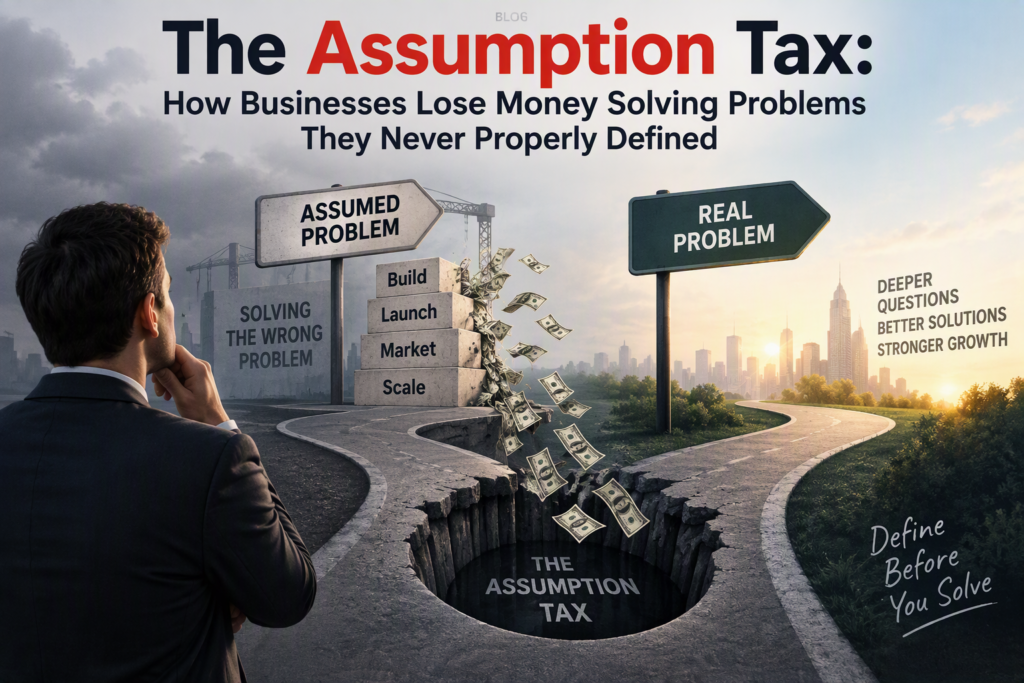
Business problem definition is the step most organisations skip, and it is usually the most expensive one to skip. Somewhere between a stressed executive saying “we need a new system” and a project team opening a blank backlog, the real question gets dropped: what exactly is going wrong, and why? The work goes ahead anyway. Money is spent. Months pass. Then somebody asks why nothing has improved.
We call that hidden cost the Assumption Tax. It is the extra money, time and goodwill a business pays every time it builds a solution on top of a problem it never properly examined. It never appears as a line item in the budget. It hides inside rework, endless change requests, software nobody logs into, and the slow loss of trust between the business and the people delivering the work.
This guide explains where the Assumption Tax comes from, what it looks like inside real projects, and how strong business problem definition helps Australian organisations stop paying it. If you already work in business analysis, or you want to move into it, it also shows why this single skill is worth more than any tool or template you will ever learn.
What Is the Assumption Tax in Business?
An assumption is a belief that gets treated as a fact without anyone checking it. Every project runs on dozens of them. “Customers want a mobile app.” “The team just needs more training.” “The data is accurate.” Most assumptions are harmless. A few are load-bearing, meaning the whole project quietly depends on them being true.
The trouble is that nobody sees the bill until much later. When a load-bearing assumption turns out to be wrong, the business pays in three ways at once:
- Build cost. You paid to deliver something that never addressed the real issue.
- Rework cost. The team goes back, patches, rebuilds and renegotiates scope, often more than once.
- Opportunity cost. While everyone was busy fixing the wrong thing, the actual problem kept growing.
Careful business problem definition catches these costs before any money moves, but without it, the tax is hard to spot. It is charged at the end of a project, with interest, and it usually gets blamed on “poor execution” rather than on a weak starting point.
Why Business Problem Definition Gets Skipped
Nobody sets out to solve the wrong problem. It happens because the pressure to act is louder than the discipline to think. In our experience training analysts across Australia, the same five reasons come up again and again:
- Leaders want visible progress, and asking questions feels like standing still.
- Solution-first thinking. Someone saw a slick software demo at a conference and the “problem” was reverse-engineered to fit it.
- Loud opinions. The most senior person in the room describes the problem, and nobody feels comfortable challenging that description.
- No clear owner. When everyone touches the problem but nobody owns it, each department defines it differently.
- Fear of delay. Proper business problem definition looks like an extra phase, so it gets cut to protect the timeline.
Here is the irony. Defining the problem feels slow, yet it is the cheapest moment in a project to be wrong. A flawed assumption costs almost nothing to fix on day one. By month six it can cost hundreds of thousands of dollars.
Where the Assumption Tax Shows Up: Common Examples
The pattern is remarkably consistent across industries. A visible symptom gets mistaken for the root cause, and a solution is bought to match. The table below shows five situations business analysts see regularly.
| What leadership assumed | What was built | What the real problem was | Where the tax landed |
| “Customers leave because our app looks outdated.” | A full mobile app redesign | New customers found the onboarding steps confusing; the interface was fine | Redesign budget spent, churn unchanged |
| “Our staff need more training.” | A series of training workshops | A simple request needed three separate approvals | Training hours lost, same delays |
| “We need a new CRM.” | A new CRM platform rollout | Sales staff entered the same data into two systems and stopped bothering | Licences and migration costs, low adoption |
| “Reporting takes too long.” | Extra analysts hired | Departments stored the same data in inconsistent formats | Salaries paid, reports still slow |
| “We need more leads.” | Higher advertising spend | The enquiry form failed on mobile phones | Ad budget wasted on lost visitors |
Notice that none of these teams were careless. Each one acted sensibly on the information they believed they had. What was missing was structured business problem definition before the money moved.
A Simple Example: The Dashboard Nobody Opened
The following is an illustrative scenario, not a real client case.
Picture a mid-sized logistics company in Melbourne. Operations managers complain that they “can’t see what’s happening across depots.” The leadership team concludes they need a real-time dashboard and approves a significant build.
Six months later the dashboard is beautiful and almost nobody opens it. A business analyst is brought in to find out why. After a handful of short conversations with depot supervisors, the picture becomes clear. The managers didn’t lack visibility. They lacked trust in the numbers, because each depot recorded delivery times differently. The dashboard simply displayed unreliable data faster.
Had someone spent two weeks on proper business problem definition, the company would have found the real issue, inconsistent data capture, before writing a single requirement. The fix would have been a shared data standard and a short process change, at a fraction of the cost.
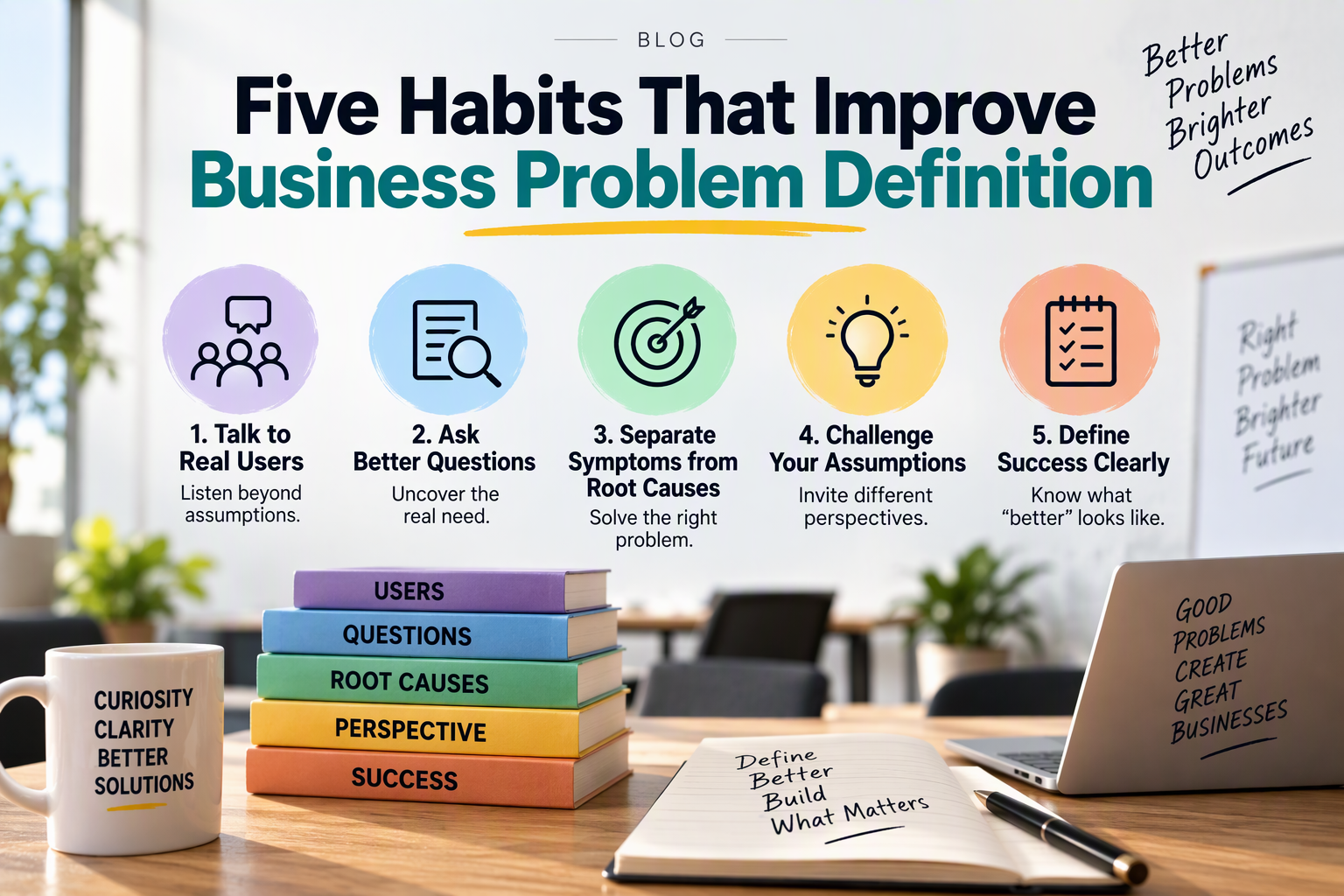
Five Habits That Improve Business Problem Definition
Good analysts don’t have a magic trick. They have habits. These five are the ones that make the biggest difference.
1. Keep asking why until the answer stops being obvious
The classic “Five Whys” technique is simple on purpose. Ask why the problem is happening, then ask why that answer is true, and repeat. By the third or fourth round you are usually past the symptom and into something the organisation can actually change. Good business problem definition starts with this kind of persistence.
2. Separate symptoms from causes
“Sales are down” is a symptom. “Leads are dropping off at the quote stage because pricing takes four days” is closer to a cause. Write both down and label them. If your problem statement describes only a symptom, you are not finished.
3. Write a problem statement you can measure
A useful statement names who is affected, what is happening, how often, and what it costs. Compare “onboarding is slow” with “new clients wait an average of 11 working days to be activated, and roughly one in five cancels before that.” The second version gives you a baseline, which means you can later prove whether the solution worked.
4. Keep an assumption log
List every belief the project depends on, then mark each one as confirmed, unconfirmed or disproved. It takes twenty minutes, and it turns hidden assumptions into visible risks. Revisit it at each project checkpoint.
5. Talk to the people who live with the problem
Requirements written in a boardroom rarely survive contact with the front line. Spend time with the customer service team, the warehouse crew or the claims processors. Ten minutes watching someone work often reveals more than a ten-page briefing document.
Tools Business Analysts Use for Problem Definition
Business analysis has a well-developed toolkit for business problem definition. You don’t need all of it on every project, but knowing what is available makes you far more effective. Common techniques include root cause analysis, fishbone (Ishikawa) diagrams, process mapping, stakeholder analysis, gap analysis, and structured interviews and workshops.
The BABOK Guide from IIBA treats understanding the business need as the foundation of every other task in the profession, which is why these techniques appear so early in most certification syllabi. If you want broader context on why projects succeed or fall short, the Project Management Institute’s Pulse of the Profession research is a useful read. Harvard Business Review has also explored the idea directly in its article Are You Solving the Right Problem?, which pairs well with the techniques above.
If you’d like to practise these techniques with an instructor rather than teach yourself, the Business Analysis Techniques course is built around exactly this kind of hands-on work.
How to Estimate Your Own Assumption Tax
You can’t reduce a cost you haven’t measured. A rough estimate is enough to start the conversation with leadership. Add up these four components for any recent project that missed its goal:
| Component | What to include | Where to find the numbers |
| Wasted build cost | Features or systems delivered but rarely or never used | Usage reports, licence logs, user feedback |
| Rework cost | Hours spent on change requests, fixes and rebuilds after go-live | Timesheets, project tracking tools |
| Delay cost | Revenue or savings that arrived later than planned | Original business case versus actual results |
| Opportunity cost | Other initiatives postponed while the team was fixing this one | Portfolio roadmap, project managers |
Even a conservative estimate usually gets attention, and it gives you a practical argument for better business problem definition. A hypothetical example: if a $400,000 project delivers features that staff largely ignore, and the team then spends a further $90,000 on rework, the visible cost has already grown by nearly a quarter before you count any lost opportunity. Numbers like these make a strong case for investing in business problem definition at the start.
Business Problem Definition Across Australian Cities
The need for strong business problem definition skills isn’t limited to one industry or one capital city. Different regions bring different flavours of the same challenge:
- Sydney: Large enterprise, banking and fintech programs where unclear requirements can multiply across dozens of connected systems. Explore business analysis courses in Sydney.
- Melbourne: Health, education, retail and government transformation projects that depend on analysts who can translate between technical teams and the business. See business analysis courses in Melbourne.
- Brisbane: Infrastructure, resources and state government programs where scope needs to be pinned down early. Find business analysis courses in Brisbane.
- Perth: Mining, energy and engineering organisations where a wrong assumption can be very costly to reverse. Read about business analysis training in Perth.
- Adelaide: Defence, advanced manufacturing and public sector projects that value disciplined requirements work. Check business analysis courses in Adelaide.
- Canberra: Federal government agencies where policy intent must be turned into precise, defensible requirements. Browse business analysis courses in Canberra.
Prefer to study from home? The same programs are also available through flexible online learning, so location doesn’t have to limit your options.
Business Analysis Courses That Build Problem-Definition Skills
Reading about business problem definition is a start. Practising it with feedback is what changes how you work. These courses from Business Analysis Courses Australia cover the skills discussed above at different levels:
- Agile Business Analysis (AgileBA®) Foundation suits beginners and career changers who want a solid grounding in agile business analysis.
- Agile Business Analysis (AgileBA®) Practitioner builds on the foundation with applied, scenario-based practice.
- Business Analysis Techniques focuses on the core toolkit, from stakeholder analysis to process modelling.
- IREB Requirements Engineering Foundation (CPRE-FL) covers how to elicit, document and manage requirements properly.
- ISQI Agile Business Analysis Certification is aimed at analysts working in agile delivery environments.
- BCS Business Change Foundation and BCS Business Finance Certificate help you connect problem definition to organisational change and financial outcomes.
You can compare every option on the full courses page, or speak with a course advisor about which pathway fits your background. For broader project delivery and certification options across the network, see Logitrain and Business Analyst Course.
Business Problem Definition: Frequently Asked Questions
What is business problem definition?
It is the process of clearly describing what is wrong, who it affects, what it costs and what a successful outcome would look like, before any solution is chosen. It is one of the first and most important tasks in business analysis.
Who is responsible for defining the business problem?
Ownership of business problem definition is usually shared. A business analyst typically leads the investigation, but the business sponsor, subject matter experts and affected users all contribute. What matters is that one person is accountable for the final problem statement.
How long should problem definition take?
It depends on the size of the initiative. For a small process improvement it may take a few days. For a major program it can take several weeks. Either way, the time is usually recovered many times over through less rework later.
Do I need experience to learn these skills?
No prior business analysis experience is needed for foundation-level courses. Beginners, career changers and professionals from operations, IT, finance or project support can all start there.
Which business analysis course should I start with?
Most newcomers begin with the AgileBA Foundation or the Business Analysis Techniques course. If your work leans towards documentation and specifications, the IREB Requirements Engineering Foundation is a strong choice.
Final Thoughts: Stop Paying the Assumption Tax
Every organisation pays the Assumption Tax at some point. The ones that pay it less often share one habit: they treat business problem definition as real work, not as a formality to rush through. They ask better questions, test their beliefs, and refuse to fund a solution until the problem is properly understood.
If you want to become the person who brings that discipline to your team, the right training makes it faster. Explore our business analysis courses, or contact our team on 1300 649 299 to find the right course for your goals.