



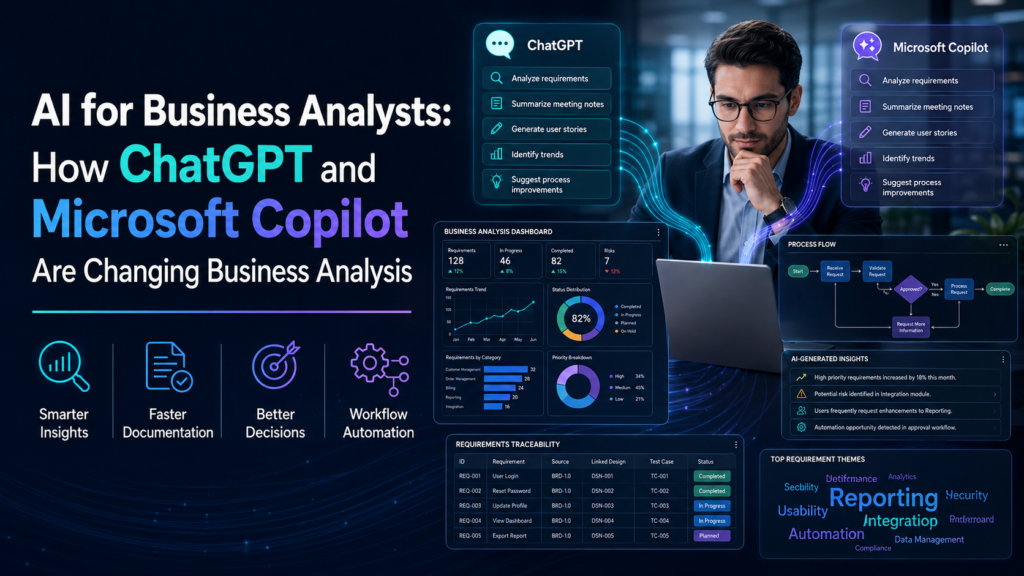
AI for business analysts is no longer a future trend it is already part of daily project work. Business analysts across banking, government, retail and healthcare are using ChatGPT and Microsoft Copilot to draft requirements faster, tidy up process documentation, and turn messy stakeholder feedback into clear, actionable insight. This shift is changing what a business analyst does day to day, and it is changing the skills that employers now look for.
In this guide, we break down exactly how AI for business analysts is playing out in real workplaces, compare ChatGPT and Microsoft Copilot side by side, and explain how you can build the AI skills employers are asking for through practical business analysis courses in Australia.
What Does AI for Business Analysts Actually Mean?
At its core, AI for business analysts means using generative AI tools to speed up the repetitive, time-consuming parts of the role writing, summarising, formatting and first-pass analysis — so the analyst can spend more time on judgement calls: understanding stakeholder needs, resolving conflicting requirements and shaping a solution that actually fits the business. AI does not replace the analyst; it removes friction from the process. Analysts who understand the BABOK framework are finding that AI tools slot neatly into existing techniques like elicitation, requirements documentation and stakeholder analysis, rather than replacing them.
How ChatGPT Is Changing Business Analysis
Faster Requirements Gathering and User Stories
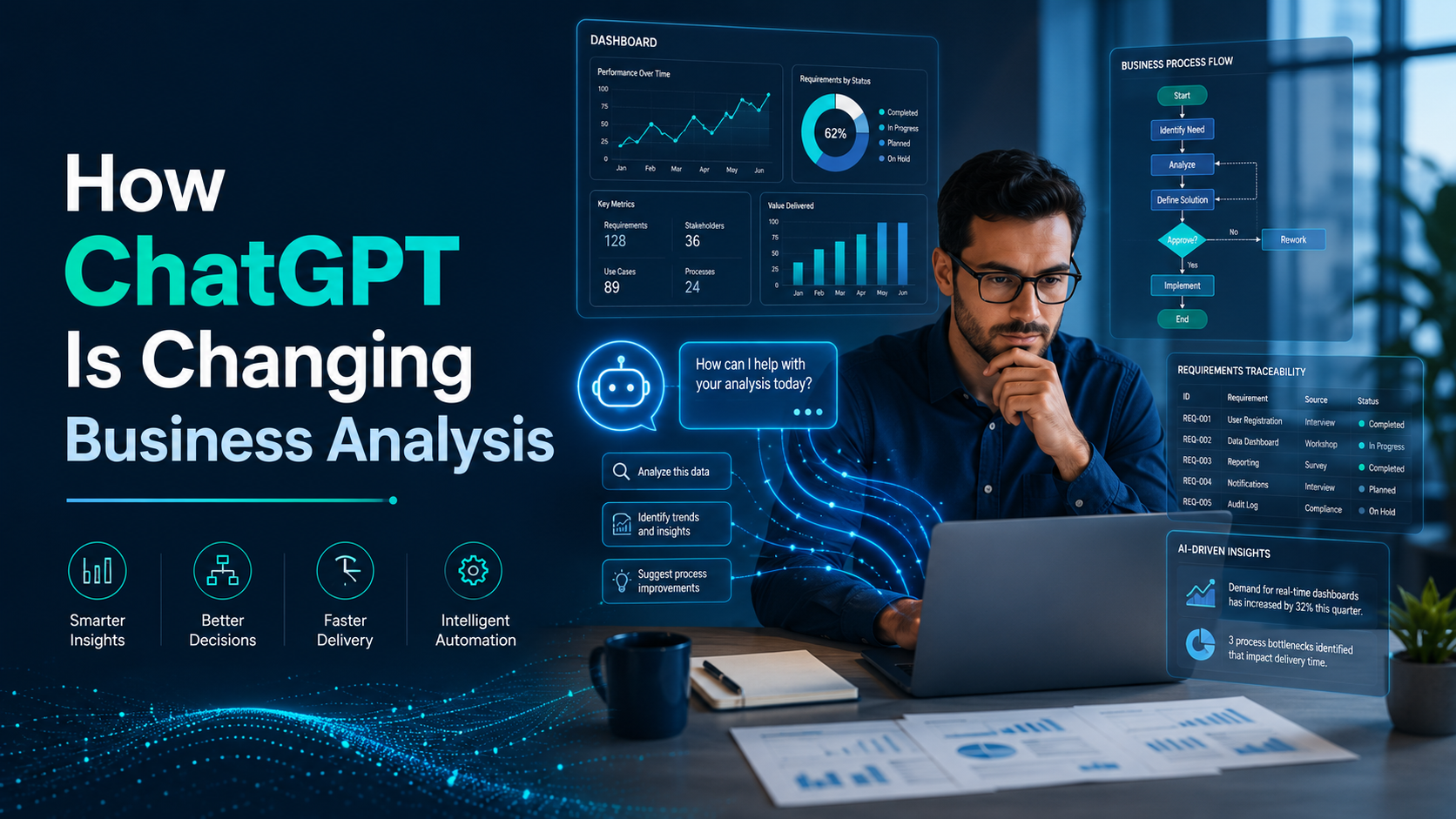
Business analysts use ChatGPT to turn rough meeting notes into structured functional and non-functional requirements, draft user stories with acceptance criteria, and generate the questions they should ask stakeholders before a workshop. What used to take an hour of drafting can take ten minutes of prompting and reviewing.
Cleaner Process Documentation
Instead of starting a process map or standard operating procedure from a blank page, analysts describe the current process in plain language and ask ChatGPT to structure it into numbered steps, swimlanes or a RACI table, which they then verify against the real workflow.
Better Stakeholder Communication
ChatGPT is also used to translate technical detail into plain-English updates for non-technical stakeholders, and to draft the first version of status reports, meeting agendas and change-impact summaries.
How Microsoft Copilot Is Changing Business Analysis
Copilot in Excel for Data Analysis
Copilot works inside the analyst’s live spreadsheet, so it can summarise trends, build pivot tables, and explain formulas without the data ever leaving the workbook — useful for quick gap analysis, KPI tracking and requirements traceability matrices.
Copilot in Word and PowerPoint for BA Deliverables
In Word, Copilot helps draft business requirement documents (BRDs) and functional specifications from an outline. In PowerPoint, it turns a BRD or discovery report into a stakeholder-ready slide deck in minutes, which is a major time saver during project mobilisation.
Copilot in Teams for Meeting Notes and Actions
Copilot in Teams automatically summarises requirements workshops and stakeholder interviews, captures decisions and action items, and flags who owns each follow-up — reducing the manual note-taking that has traditionally eaten into an analyst’s day.
ChatGPT vs Microsoft Copilot: Which Should Business Analysts Use?
Most analysts don’t have to choose one over the other. ChatGPT tends to be the better general-purpose thinking partner brainstorming, drafting and research. Microsoft Copilot tends to be the stronger fit inside a corporate environment, because it works directly with an organisation’s Excel, Word, Teams and SharePoint data under existing Microsoft 365 governance and security settings. Many business analysis teams now use both, depending on the task.
| Task | ChatGPT | Microsoft Copilot |
| Drafting requirements & user stories | Strong — flexible prompting, good for first drafts | Good — works directly inside Word templates |
| Analysing spreadsheets | Needs data pasted or uploaded | Strong — native to Excel, reads live workbook data |
| Meeting notes & actions | Manual — needs a transcript pasted in | Strong — built into Teams, auto-summarises calls |
| Enterprise data security | Depends on plan and settings | Strong — inherits Microsoft 365 compliance controls |
| Brainstorming & research | Strong — broad general knowledge | Good — grounded in your own organisation’s files |
New Skills Business Analysts Need in the AI Era
- Prompt writing: giving AI tools clear, structured instructions to get useful first drafts
- AI output validation: checking AI-generated requirements and data summaries against real source information before they go to stakeholders
- Data and AI governance awareness: knowing what data is safe to put into an AI tool, and what isn’t
- Critical thinking and stakeholder judgement: the parts of the role AI still can’t do
Where AI Still Needs a Human Business Analyst
AI tools do not attend the room where stakeholders disagree, do not carry organisational context from three years of change programs, and cannot be held accountable for a decision. Reading a hesitant stakeholder, negotiating scope, and knowing which requirement is politically sensitive versus technically difficult all still rest with the human analyst. AI is a drafting and analysis accelerator — the judgement, facilitation and accountability stay with the business analyst.
Build Your AI-Ready Business Analysis Career in Australia
Employers are increasingly looking for business analysts who can combine solid BA fundamentals with confident use of tools like ChatGPT and Microsoft Copilot. A structured business analysis course builds both: the core techniques covered in our Business Analysis Techniques course, agile delivery skills through Agile Business Analysis (AgileBA®) Foundation, and broader change capability through our BCS Business Change Foundation course.
We run live online and in-person training from local centres in Melbourne, Sydney, Brisbane, Perth, Adelaide and Canberra, so you can build these skills close to home or entirely online. Read more about our approach or get in touch with a course advisor to find the right course for where you are in your career.
Frequently Asked Questions
Will AI replace business analysts?
No. AI speeds up drafting, documentation and data summarisation, but stakeholder negotiation, judgement and accountability still require a human business analyst.
Do I need coding skills to use ChatGPT or Copilot as a business analyst?
No coding is required. Both tools are used through everyday prompts and the familiar Microsoft 365 apps business analysts already work in.
Is it safe to put client requirements into ChatGPT?
Only with organisational approval and the right data-handling settings. Many organisations prefer Microsoft Copilot for sensitive work because it operates inside existing Microsoft 365 compliance controls.
How do I start learning AI skills for business analysis?
Start with strong BA fundamentals requirements gathering, process modelling and stakeholder management then layer AI tools on top. Our business analysis courses build both together.
Conclusion
AI for business analysts is reshaping how requirements are gathered, how documentation gets written, and how quickly insights reach stakeholders. ChatGPT and Microsoft Copilot are each changing business analysis in their own way, but the analysts who benefit most are the ones who pair these tools with strong core BA skills. Explore our business analysis courses to build an AI-ready career, or browse our blog for more on the future of business analysis.