

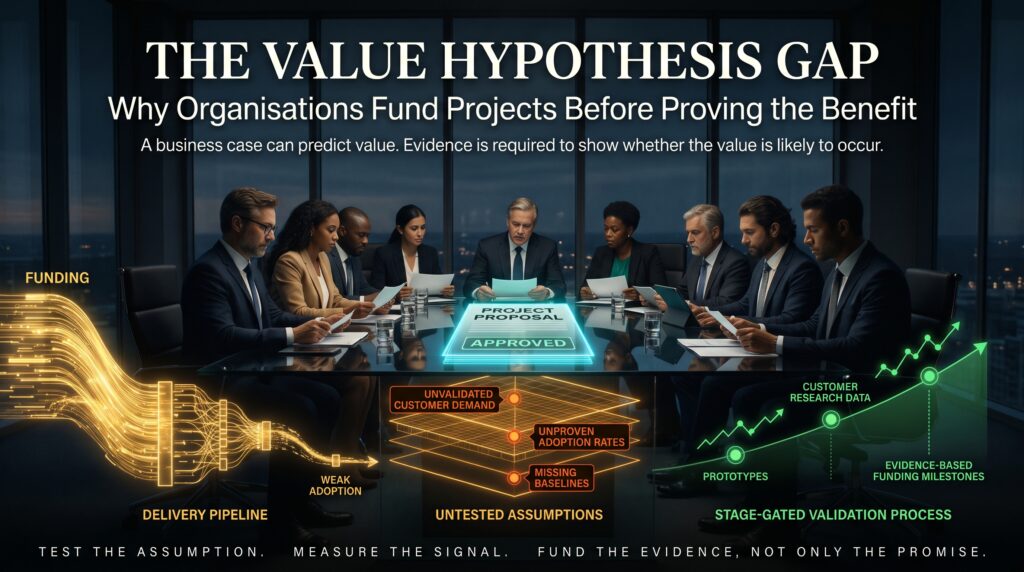


A value hypothesis is a plain-language bet about what a project will change, for whom, and by how much. Most organisations never write one down. They write a business case, approve the budget, appoint a vendor, and only later discover that nobody can explain how the benefit will be measured. That space between approval and proof is the value hypothesis gap, and it is one of the most expensive blind spots in Australian project delivery.
If you work in business analysis, project delivery or change, you have probably watched it happen. The steering committee nods at a slide full of projected savings. Funding is released. Eighteen months later the system is live, the project is called a success because it landed on time, and the savings are nowhere to be found. Nobody lied. Nobody was careless, exactly. The benefit was simply never tested before the money was spent.
This guide explains why the value hypothesis gap keeps appearing, what it really costs, and how a capable business analyst closes it. You will also see where the gap bites hardest across Australian cities and which business analysis courses build the skills to deal with it.
What Is a Value Hypothesis?
A value hypothesis is a testable statement linking a change to a measurable result. It says: if we do this, then these people will behave differently, and we will see this number move. The important word is testable. A hypothesis can be wrong, and the whole point is to find that out before the large cheque is signed rather than after.
It sounds simple, yet it is rarely done. A typical business case describes a solution, lists the costs, and projects a return based on assumptions that nobody has checked. A value hypothesis does the opposite. It starts from the benefit, names the assumptions underneath it, and asks what evidence would make those assumptions believable.
| Traditional business case | Value hypothesis approach | |
| Starting point | The preferred solution | The outcome the organisation wants |
| Purpose | Win approval and funding | Test whether the benefit is real |
| Benefits | Estimated once, then filed away | Defined with a baseline, a target and an owner |
| Assumptions | Buried in a spreadsheet | Listed openly and ranked by risk |
| When it is wrong | Discovered after go-live | Discovered early, while changing course is cheap |
| Who it serves | The approval committee | The people who must change how they work |
Why Organisations Fund Projects Before Proving the Benefit
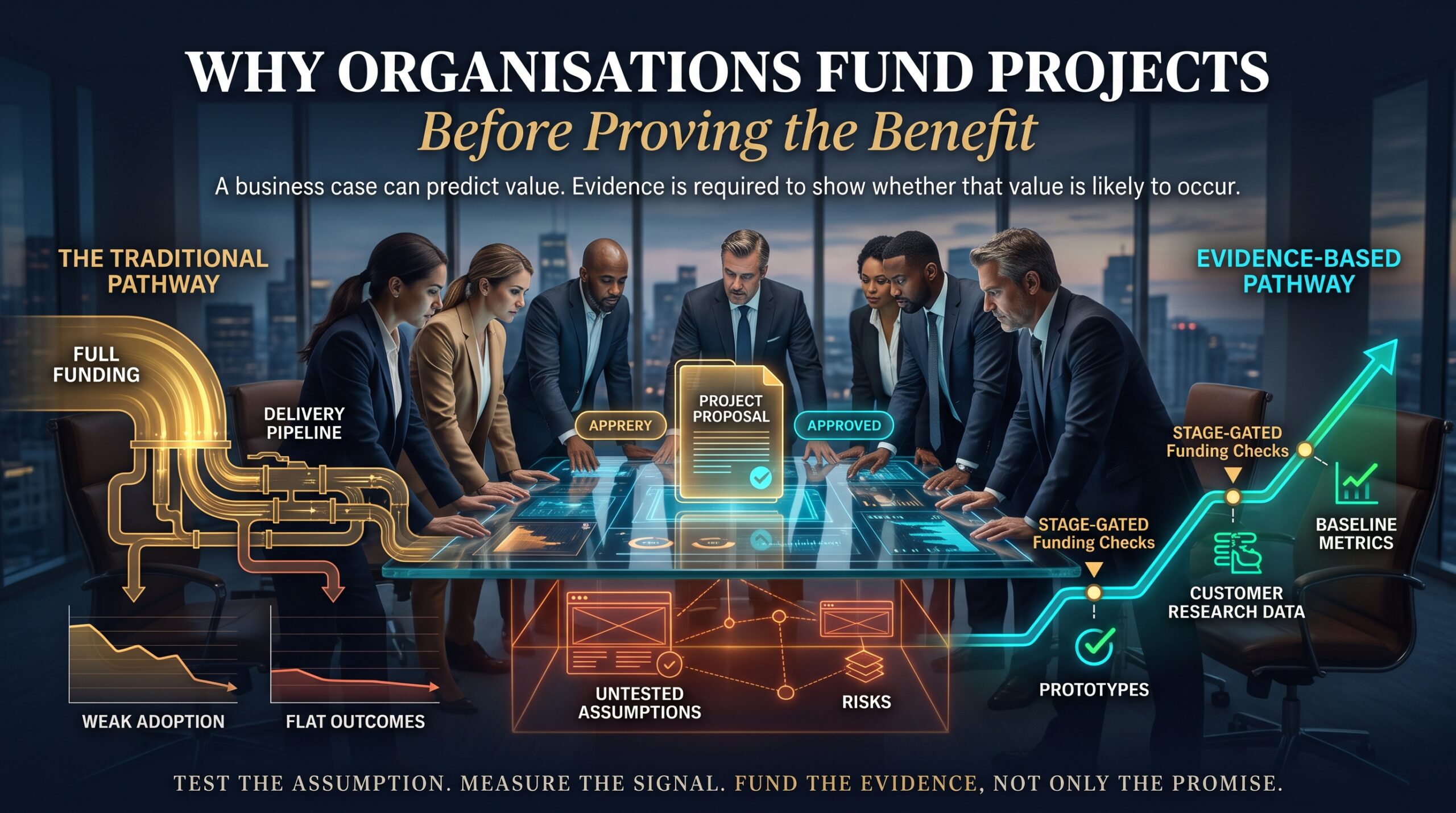
The value hypothesis gap is not caused by stupidity. It is caused by incentives, calendars and habits that make skipping the proof feel perfectly reasonable. Five patterns show up again and again.
1. The budget cycle moves faster than the evidence
Funding rounds run to a calendar. Testing a value hypothesis takes weeks of interviews, data pulls and small experiments. When a submission is due on Friday, the team writes the benefits section from memory and good intentions. The deadline wins, and the proof is promised for “after approval”.
2. The business case becomes an approval ticket
Once a document exists to get a yes, it is written to get a yes. Benefits drift upward. Risks are softened. Nobody builds a value hypothesis that might say no, because a no is treated as a failure of the proposal instead of a useful result.
3. Solutions arrive before problems are defined
A vendor demo, a competitor announcement or an executive who returned from a conference excited about a platform can start a project long before anyone has described the problem. By the time analysis begins, the solution is already half chosen. The value hypothesis then gets reverse-engineered to fit it.
4. Optimism is rewarded and doubt is not
In most meeting rooms the person asking “how will we know this worked?” sounds negative. The person with a confident forecast sounds like a leader. Over time, teams learn to stop asking, and the gap widens quietly.
5. Nobody owns the benefit after go-live
Project teams are measured on delivery: scope, schedule, budget. Benefits show up months later, in a different part of the business, often after the project team has moved on. With no named benefit owner and no baseline, there is nothing to compare against. The organisation never learns whether its bet paid off, so it makes the same bet again.
What the Value Hypothesis Gap Really Costs
The visible cost is the budget spent on a project that does not deliver the promised return. The hidden costs are usually larger.
- Features built on an untested assumption are rebuilt when the assumption fails.
- Opportunity cost. Money and people committed to the wrong project cannot be used on the right one.
- Lost credibility. Sponsors who report benefits that never appear find the next funding request harder to win.
- Change fatigue. Staff who are asked to adopt a new process that improves nothing become sceptical of the next one.
- No learning. Without measured outcomes, the organisation cannot improve how it chooses projects.
Guidance from bodies such as the Project Management Institute and the International Institute of Business Analysis keeps returning to the same idea: value has to be defined, tracked and owned across the life of an initiative, not just asserted at the start.
A Composite Example: The Customer Portal That Saved Nothing
Illustrative scenario only. It is a composite of patterns common in project work and does not describe a specific organisation.
A mid-sized Australian retailer approves a customer self-service portal. The business case claims the portal will cut call-centre volume by a large margin, which will pay for the build within two years. Nobody checks why customers call in the first place.
After launch, a business analyst reviews the contact data. Most calls are about delivery delays, and a portal cannot speed up a delivery. Customers log in, see the same delay information the agents would have given them, and call anyway. The portal works exactly as designed. The value hypothesis behind it was never true.
Two weeks of call-reason analysis before funding would have exposed the problem. That is the core argument for writing a value hypothesis early: the test is cheap, and the mistake is not.
How Business Analysts Close the Value Hypothesis Gap
Business analysis exists to connect a business need to a justified solution. Closing the value hypothesis gap is that job, done properly. A practical sequence looks like this.
- Define the problem or opportunity first. Describe it without naming a solution. If the statement contains the word “system”, “platform” or “tool”, it is probably a solution in disguise.
- Write the value hypothesis in one sentence. Use a fixed format so everyone can read it (see the template below).
- Set a baseline. Record today’s number before anything changes. Without a baseline, no benefit can ever be proven.
- List and rank the assumptions. Ask which assumption, if false, would sink the whole case. Test that one first.
- Run the cheapest possible test. Interviews, data analysis, a paper prototype, a pilot with one team or a minimum viable product can all produce evidence quickly.
- Stage the funding. Release money in steps tied to evidence, so that a failed assumption stops spending early.
- Name a benefit owner and keep measuring after go-live. Benefits belong to the business, not the project team.
A simple value hypothesis template
If we [make this change], then [these people] will [do this differently], which will move [this measure] from [baseline] to [target] by [date]. We will know because [evidence], and we are assuming [riskiest assumption].
The tools behind this are standard business analysis techniques: stakeholder analysis, root cause analysis, process modelling, key performance indicators and benefits mapping. The BABOK Guide describes many of them, and the Business Analysis Techniques course teaches how to apply them to real situations.
Agile Does Not Remove the Value Hypothesis Gap
A common belief is that agile delivery solves this problem because teams ship in small increments. It helps, but only if each increment is tied to a hypothesis. A team can deliver twenty sprints of working software and still prove nothing about value. Agile business analysis adds the discipline of asking what each release is meant to change and how that will be measured. If you want to build that habit, the AgileBA Foundation course and the AgileBA Practitioner course cover agile business analysis in practical terms.
Where the Value Hypothesis Gap Shows Up Across Australian Cities
The gap is not tied to one industry or location, but the pressure points differ by city. The table below describes common patterns and links to the local course page for each.
| City | Where the value hypothesis gap often appears | Local course page |
| Sydney | Financial services and technology programs with large, multi-vendor budgets | Business analysis courses Sydney |
| Melbourne | Digital transformation in banking, utilities, health and education | Business analysis course Melbourne |
| Brisbane | Infrastructure, government and logistics projects with long delivery timelines | Business analysis courses Brisbane |
| Perth | Resources and engineering programs where benefits depend on operational change | Business analysis training Perth |
| Adelaide | Health, defence-related and public-sector initiatives with strict funding gates | Business analysis courses Adelaide |
| Canberra | Federal agency business cases where benefits must be justified to oversight bodies | Business analysis courses Canberra |
Public-sector projects in particular face scrutiny on benefits. Agencies uch as Infrastructure Australia publish assessment frameworks that expect proposals to show clear evidence of value. Analysts who can build a defensible value hypothesis are in demand wherever funding has to be justified.
Build the Skills to Prove Value Before Projects Are Funded
Spotting the value hypothesis gap is a learnable skill. If you are moving into business analysis or strengthening your current practice, these programs are a practical place to start:
- Business Analysis Techniques: the core toolkit for defining problems, analysing processes and measuring outcomes.
- AgileBA Foundation and AgileBA Practitioner: agile business analysis with a focus on delivering value in increments.
- ISQI Agile Business Analysis Certification: a recognised agile business analysis credential.
- IREB Requirements Engineering Foundation (CPRE-FL): structured requirements practice that links needs to outcomes.
- BCS Business Change Foundation and BCS Business Finance Certificate: business change and financial literacy for building credible business cases.
You can browse the full list on the courses page, read more on our blog, or learn about the team on the About Us page. For related training, see businessanalystcourse.au and Logitrain.
Frequently Asked Questions About the Value Hypothesis
What is a value hypothesis in business analysis?
A value hypothesis is a testable statement that links a proposed change to a measurable business result. It names the people affected, the measure that should move, the baseline and target, and the main assumption that must be true.
How is a value hypothesis different from a business case?
A business case argues for an investment. A value hypothesis is designed to be tested and possibly disproved. The best business cases contain one, but many contain only projections.
Who is responsible for testing the value hypothesis?
Business analysts usually lead the work, but the benefit owner in the business must agree on the measures and accept accountability for the result. Project managers and sponsors support by protecting time for early testing.
Can a value hypothesis be tested in an agile project?
Yes. Each release or sprint goal can carry its own hypothesis and measure. Agile delivery makes testing faster, but only if teams define what they expect to change before they build.
Do I need a business analysis certification to work with a value hypothesis?
No certification is required to use the idea, but formal training gives you proven techniques, a shared vocabulary and credibility with senior stakeholders. Foundation-level courses suit beginners and career changers.
Final Thoughts: Prove It, Then Fund It
The value hypothesis gap persists because skipping the proof feels efficient. It is not. Every project approved on untested assumptions is a gamble the organisation may not realise it is making. A single clear value hypothesis, written early and tested cheaply, turns that gamble into a decision.
If you want to become the person who asks the right question before the money moves, explore our business analysis courses or talk to a course advisor on 1300 649 299.