
Business analysts driving business outcomes get promoted, retained through restructures, and hired into senior roles at a noticeably different rate than BAs who see their job as purely writing and documenting requirements. This isn’t a subtle distinction it’s the single biggest factor separating BAs who plateau at intermediate level from those who move into lead, principal or product-adjacent roles across Sydney, Melbourne, Brisbane, Perth, Adelaide and Canberra.
This guide explains exactly what the shift from “requirements writer” to “outcomes driver” actually looks like day to day, why organisations increasingly reward it, and the specific habits that make the transition.
Why Requirements-Writing Alone Has a Ceiling
A BA who documents requirements accurately is doing genuinely necessary work but it’s work that’s increasingly treated as a baseline expectation rather than a differentiator. IIBA’s BABOK guide itself frames requirements elicitation and documentation as core competencies, but positions them within a much broader remit of enabling organisational change and value delivery which is exactly the part many BAs never fully step into.
Organisations facing budget pressure increasingly ask a hard question about every role: does this position demonstrably move the business forward, or does it primarily produce documents? BAs who can only point to requirements documents as their output are more vulnerable in that conversation than BAs who can point to measurable business outcomes they helped drive.
What “Driving Business Outcomes” Actually Looks Like
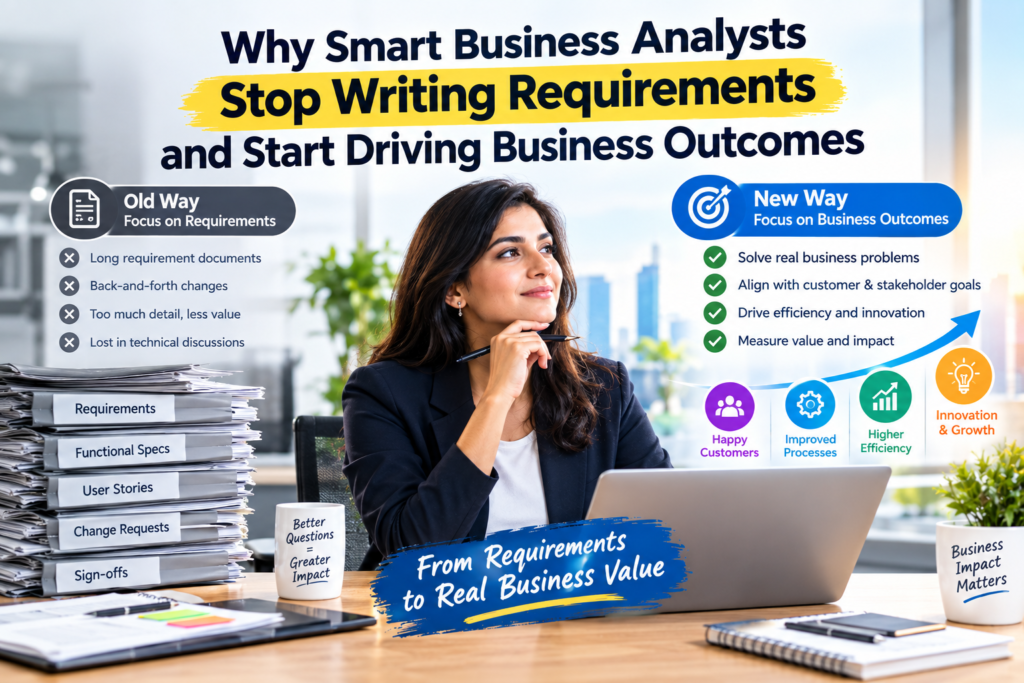
1. Starting With the Business Problem, Not the Solution Request
Requirements-writers take a solution request at face value and document it. Outcome-driven BAs ask what business problem the request is actually trying to solve, and sometimes discover the requested solution isn’t the best way to solve it surfacing a better option before development time is spent on the wrong thing.
2. Defining Success Metrics Before the Project Starts
Rather than only documenting what the system should do, outcome-driven BAs push for a clear definition of what success looks like in measurable terms reduced processing time, fewer support tickets, higher self-service completion rate and track it after delivery, not just before.
3. Challenging Requirements That Don’t Serve the Outcome
When a stakeholder requests a feature that doesn’t clearly connect to the intended business outcome, outcome-driven BAs raise the question directly rather than documenting it uncritically. This is often uncomfortable, but it’s precisely the behaviour that separates a BA who adds strategic value from one who’s simply a documentation conduit between stakeholders and developers.
4. Following Through After Go-Live
Requirements-writers often consider their job done at sign-off or delivery. Outcome-driven BAs stay engaged after go-live to check whether the delivered solution is actually producing the intended business result and adjust or flag gaps if it isn’t, rather than treating post-launch performance as someone else’s problem.
5. Speaking the Language of Business Value, Not Just Features
When reporting to sponsors or leadership, outcome-driven BAs frame updates around business impact (“this reduces manual processing by an estimated 15 hours a week”) rather than purely feature status (“the approval workflow is 80% complete”). This single habit changes how senior stakeholders perceive a BA’s strategic value.
Requirements-Writer vs Outcomes-Driver: A Practical Comparison
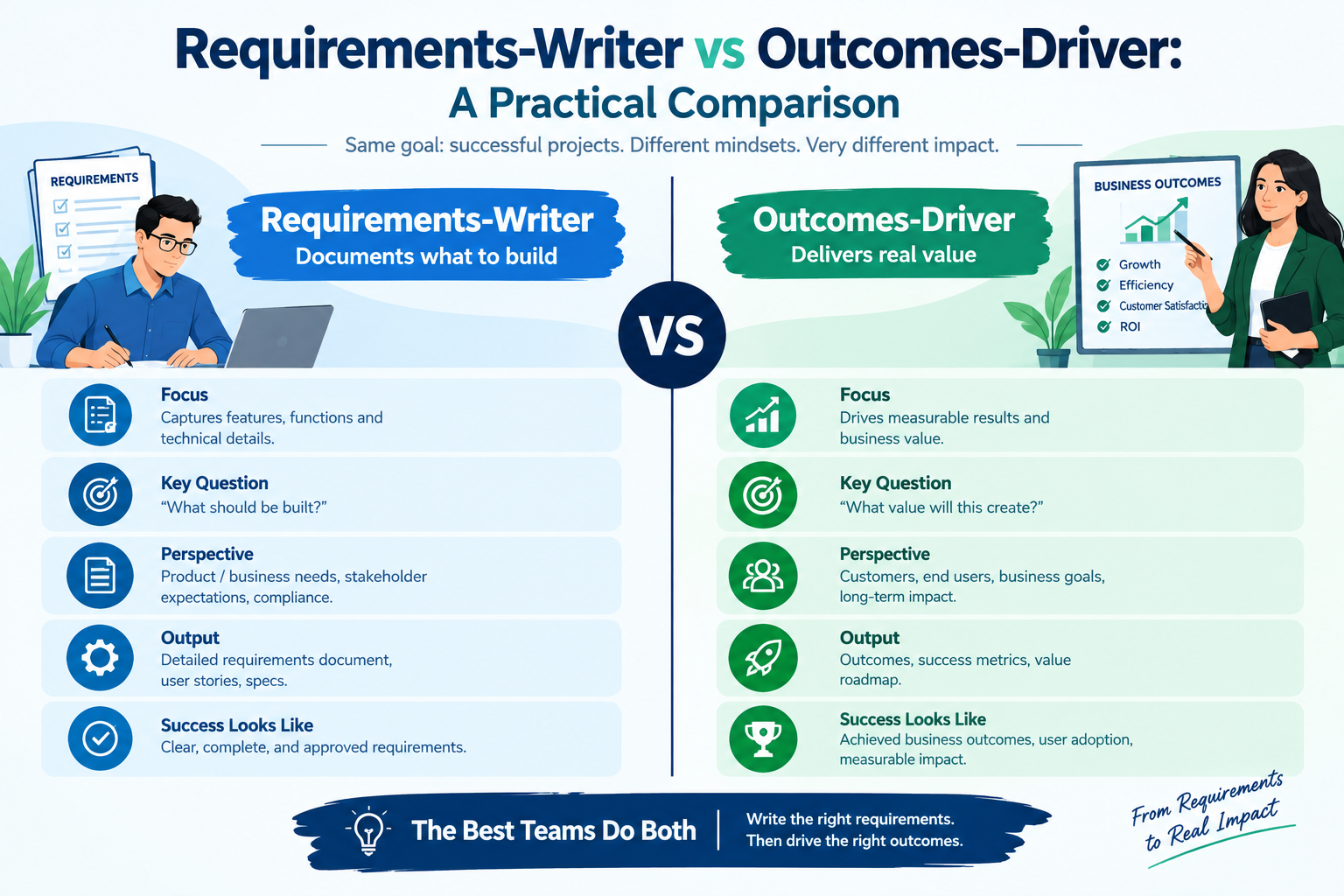
| Situation | Requirements-Writer Approach | Outcomes-Driver Approach |
| Stakeholder requests a feature | Documents it as requested | Asks what business problem it solves first |
| Project kickoff | Focuses on scope and requirements list | Also defines measurable success criteria upfront |
| A requirement seems disconnected from goals | Documents it without question | Raises it directly with the stakeholder |
| Project reaches go-live | Considers the job complete | Tracks whether the outcome was actually achieved |
| Reporting to leadership | Reports feature/requirement status | Reports business impact and value delivered |
How to Make This Shift Deliberately
This transition rarely happens by accident it requires deliberately practising outcome-focused questioning and business-case thinking, not just requirements documentation technique. The business analysis courses at businessanalysiscourses.com.au are built to include this outcomes-focused thinking alongside core BA technique, so graduates learn to connect requirements work to measurable business value from the start, rather than adding that skill years into a career.
For BAs building the full technical and strategic toolkit together, the business analyst training at businessanalystcourse.au covers the documentation and elicitation foundations this outcomes-driven approach is built on top of.
Frequently Asked Questions
What does it mean for a business analyst to drive business outcomes?
It means focusing on measurable business impact defining success metrics, challenging requirements that don’t serve the goal, and tracking results after delivery rather than treating requirements documentation as the end point of the role.
Why do outcome-focused business analysts get promoted faster?
Because they can point to measurable business impact they helped drive, which is far more persuasive in performance and promotion conversations than a list of requirements documents produced.
Is this shift something junior BAs can start practising, or only senior ones?
Junior BAs can start immediately by asking “what business problem does this solve” before documenting any request, and by pushing to define success metrics at project kickoff both are habits, not seniority-gated skills.
Final Thoughts
Business analysts driving business outcomes consistently outperform requirements-writers in promotion, retention and hiring decisions across Sydney, Melbourne, Brisbane, Perth, Adelaide and Canberra not because documentation skill stops mattering, but because organisations increasingly reward BAs who can demonstrate measurable business impact, not just accurate paperwork.
To build this outcomes-driven mindset alongside core BA technique, Logitrain offers structured training, and the businessanalysiscourses.com.au and businessanalystcourse.au microsites cover the full skill set employers are hiring senior BAs for.