
AI for Business Analysts is no longer a future trend it is already reshaping how BAs run stakeholder interviews, capture requirements, and produce documentation. Tools like Microsoft Copilot can transcribe meetings, draft business requirements documents (BRDs), and summarise sprawling discovery sessions in minutes instead of hours. This article breaks down exactly how Copilot is changing requirements gathering and documentation, and what it means for business analysts working in Australia today.
If you’re building or updating your BA skillset, understanding where AI fits into the process is now a genuinely useful part of professional development alongside core frameworks taught in a structured Business Analysis Course.
Why AI for Business Analysts Matters Right Now
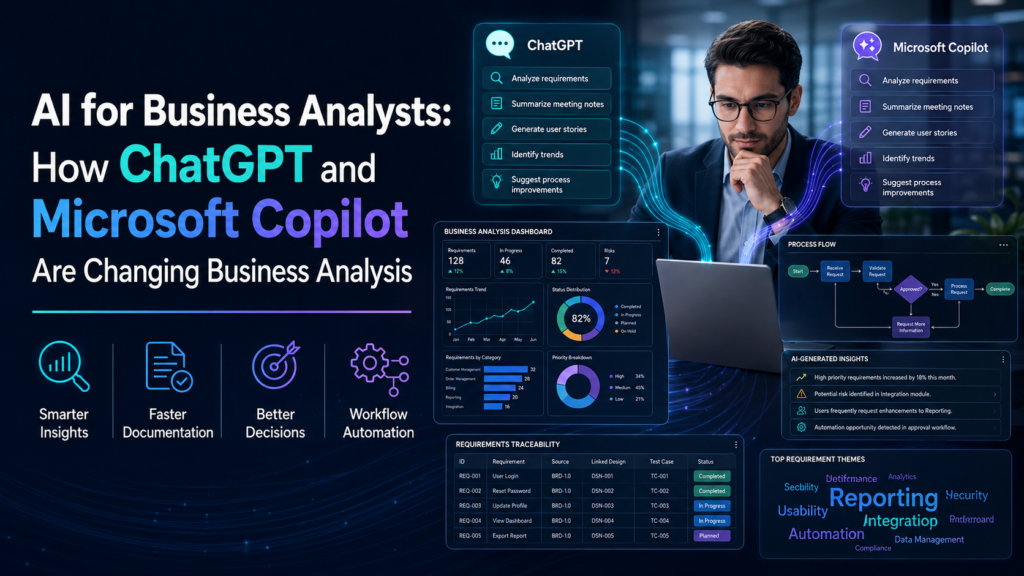
Requirements gathering has always been one of the most time-consuming parts of a BA’s job. Interviews, workshops, and stakeholder emails generate huge volumes of unstructured information that someone has to turn into clear, testable requirements. AI tools now sit directly inside that workflow inside Word, Teams, and Outlook which is why AI for business analysts has moved from ‘nice to have’ to a genuine productivity shift.
How Microsoft Copilot Supports Requirements Gathering
1. Real-Time Meeting Transcription and Summaries
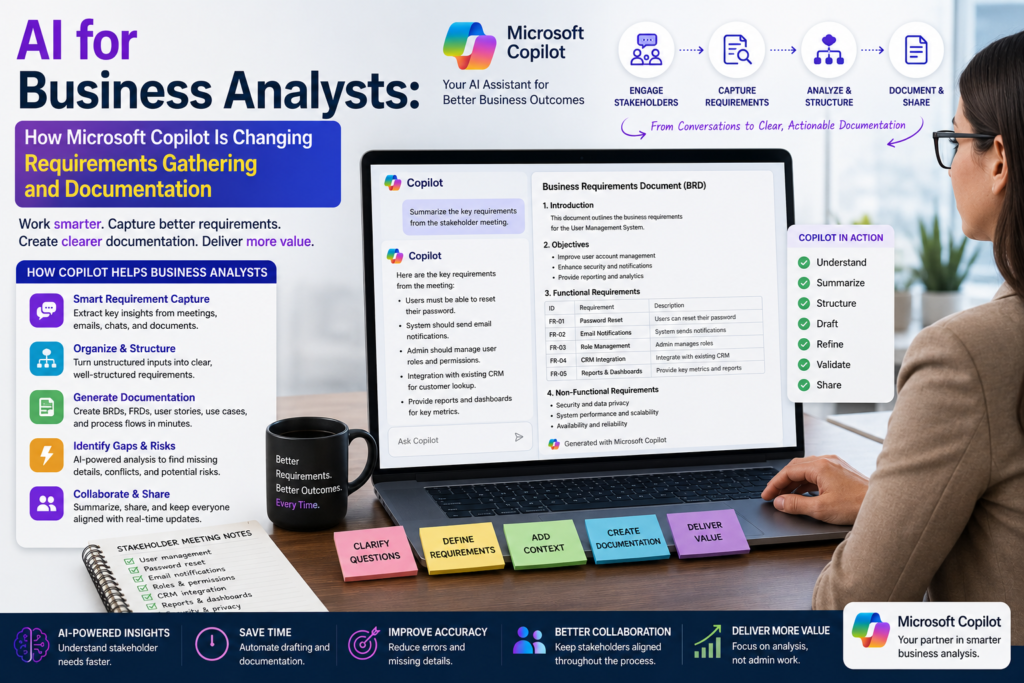
When a BA runs a stakeholder interview in Microsoft Teams, Copilot can transcribe the conversation and generate a structured summary key points, decisions, and open questions immediately after the call ends. This removes hours of manual note-cleanup and reduces the risk of missed requirements.
2. First-Draft Business Requirements Documents
Instead of starting a BRD from a blank page, a BA can prompt Copilot in Word to turn interview notes or transcripts into a structured first draft, organised into sections like scope, objectives, functional requirements, and assumptions. The BA still validates every requirement but the starting point is far faster to produce.
3. User Story and Acceptance Criteria Drafting
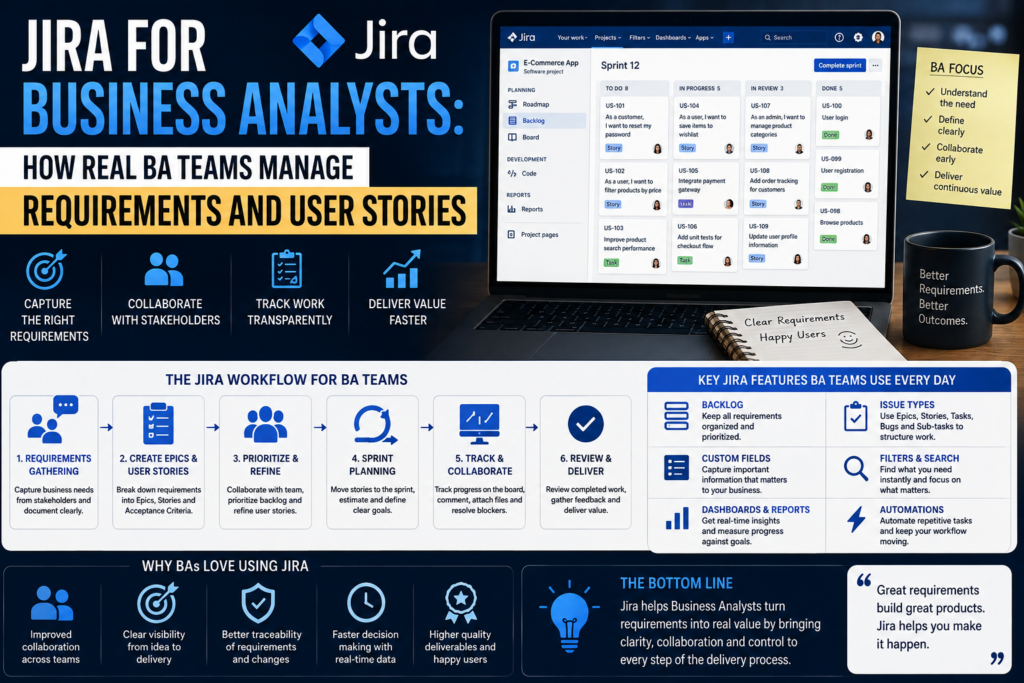
For BAs working in Agile environments, Copilot can help draft user stories and acceptance criteria from a short description of a feature or stakeholder request, giving the BA a workable starting point to refine with the development team.
4. Faster Stakeholder Communication
Copilot in Outlook can help draft follow-up emails, requirement clarification requests, or status updates, keeping stakeholders informed without the BA spending large amounts of time on written communication.
5. Gap and Ambiguity Detection
Because large language models are good at pattern recognition in text, Copilot can flag vague or ambiguous requirement statements such as missing acceptance criteria or contradictory statements across a document for the BA to review and clarify with stakeholders.
Traditional BA Workflow vs AI-Assisted Workflow
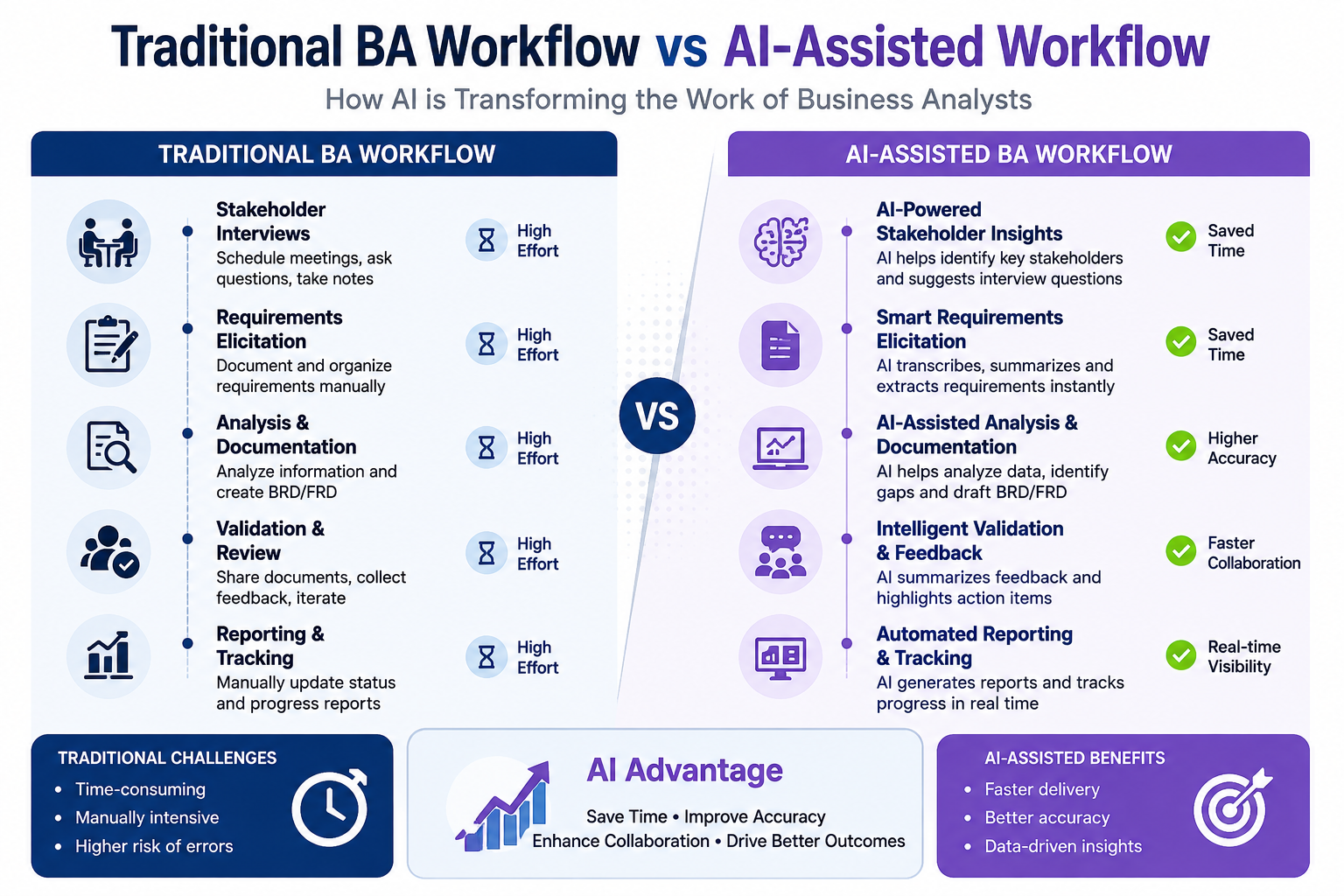
| BA Task | Traditional Approach | AI-Assisted Approach with Copilot |
| Stakeholder interviews | Manual notes, later typed up | Auto-transcribed and summarised in Teams |
| Requirements documentation | Written from scratch in Word | First draft generated from notes/meeting data |
| User stories | Hand-written by the BA | Drafted from acceptance criteria prompts |
| Process mapping | Manually diagrammed | Draft flow described in text, refined by the BA |
| Document review | Full manual proofread | AI highlights gaps, BA validates accuracy |
Suggested Screenshots to Add to This Post
Add original screenshots (not copied from Google Images, to keep this content plagiarism-free) at the points below. File names and alt text are pre-optimised with the focus keyword to fix the ‘Add an image with your Focus Keyword as alt text’ warning.
| Suggested Screenshot | File Name | Alt Text (Focus Keyword Included) |
| Copilot drafting a requirements summary inside Word | ai-for-business-analysts-copilot-requirements-draft.png | AI for Business Analysts using Copilot to draft a requirements document |
| Copilot in Teams summarising a stakeholder interview | ai-for-business-analysts-copilot-meeting-summary.png | AI for Business Analysts using Copilot to summarise stakeholder meetings |
| Before/after comparison of a manual vs AI-assisted BRD | ai-for-business-analysts-before-after-brd.png | AI for Business Analysts comparison of manual versus AI-assisted BRD |
| BA workflow diagram: interviews → Copilot → draft BRD → review | ai-for-business-analysts-workflow-diagram.png | Workflow diagram showing AI for Business Analysts in requirements gathering |
What AI Cannot Replace in the BA Role
AI for business analysts is a productivity multiplier, not a replacement for the role itself. Copilot cannot attend a stakeholder workshop and read the room, negotiate conflicting priorities between departments, or make a judgement call about which requirement genuinely matters to the business. These remain core BA skills that no AI tool replicates.
- Stakeholder relationship management and negotiation
- Critical thinking about business priorities and trade-offs
- Validating that AI-generated requirements are actually accurate
- Applying structured frameworks such as BABOK to real business problems
How to Prepare for an AI-Enabled BA Career
The BAs who benefit most from AI for business analysts are the ones with strong fundamentals already in place requirements elicitation, process modelling, and stakeholder analysis. AI tools amplify a skilled BA’s output; they don’t substitute for the underlying skillset taught in courses like our Agile Business Analysis Foundation and Business Analysis Techniques Course.
Build Your Business Analysis Skills Across Australia
Whether you’re new to the profession or upskilling for an AI-enabled workplace, we deliver instructor-led business analysis training for learners in Melbourne, Sydney, Brisbane, Adelaide, Perth and Canberra, with flexible live online options available nationwide.
Frequently Asked Questions
Will AI replace business analysts?
No. AI for business analysts speeds up documentation and admin-heavy tasks, but interpreting business needs, managing stakeholders, and making judgement calls remain distinctly human skills.
How is Microsoft Copilot used in requirements gathering?
Copilot can transcribe and summarise stakeholder meetings, draft first-pass requirements documents, help write user stories, and flag ambiguous requirement statements for review.
Do business analysts need to learn AI tools?
It’s increasingly valuable. Employers are looking for BAs who can use tools like Copilot to work faster, on top of strong fundamentals from a recognised Business Analysis Course.
What BABOK skills matter most in an AI-enabled BA role?
Requirements elicitation, stakeholder analysis, and requirements validation remain essential you can learn these through the BABOK-aligned techniques covered in our courses.
Final Thoughts
AI for business analysts is fundamentally changing how requirements gathering and documentation get done faster transcription, faster first drafts, and faster stakeholder communication. But the value a skilled BA brings judgement, negotiation, and business insight is exactly what AI cannot replicate. The most future-proof move is to build strong BA fundamentals and learn to use AI tools like Copilot as an accelerator, not a shortcut.
Ready to build job-ready business analysis skills for an AI-enabled workplace? Enrol in a Business Analysis Course today, or explore all available courses.