




Business Analyst salary Australia figures are the first thing most career-changers and IT professionals search for before enrolling in a course or applying for their first BA role and fair enough, since business analysis is one of the more accessible, better-paid entry points into Australian corporate and tech careers. Short answer: yes, it pays well, and the jump from support or admin work into a BA role is often an immediate $20,000–$30,000 pay increase. “Worth it” depends on your industry, your city, and whether you back your experience with a recognised certification.
This guide breaks down the Business Analyst salary Australia employers are actually paying in 2026, how pay changes by experience and city, what CBAP, CCBA and other certifications cost, and a realistic plan to build a BA career.
What Does a Business Analyst Actually Do?
A Business Analyst sits between the business and the solution translating a vague problem (“our onboarding process is too slow”) into clear requirements a delivery team can build against. Day to day, that means:
- Running stakeholder workshops to uncover business requirements
- Documenting current-state and future-state processes
- Writing user stories, functional specs, and acceptance criteria
- Facilitating Agile ceremonies and working closely with product owners and developers
- Using AI tools like ChatGPT and Miro AI to accelerate requirements drafting and process mapping
It’s a communication-heavy role as much as an analytical one the BAs who progress fastest are the ones who can translate between technical and non-technical stakeholders fluently.
For a live view of current openings and advertised pay by role, see SEEK Career Advice: Business Analyst salary
Business Analyst Salary Australia 2026: The Real Numbers
Business Analyst salary Australia data varies by source because each platform pulls from a different sample (job ads vs. self-reported salaries vs. recruiter placements), so it’s worth looking at more than one.
| Source | Average / Range (AUD) |
| Glassdoor (Business Analyst, national) | Average $105,500/yr; typical range $85,750–$120,950; top earners to $146,200 |
| SEEK (Business Analyst) | Average $105,000–$125,000/yr |
| SalaryExpert (Business Analyst) | Average $139,531/yr; entry-level (1–3 yrs) $99,549; senior (8+ yrs) $160,561 |
| PayScale (Business Analyst, IT) | Average $87,908/yr; early career (1–4 yrs) $82,039; low end $63,000 |
| Jobted Australia (Business Analyst) | Average $88,393/yr; starting salary ~$55,111; highest salaries exceed $130,000 |
| SyncSkills industry roundup (Melbourne permanent roles) | $105,000–$125,000/yr; senior contractors $900–$1,100/day |
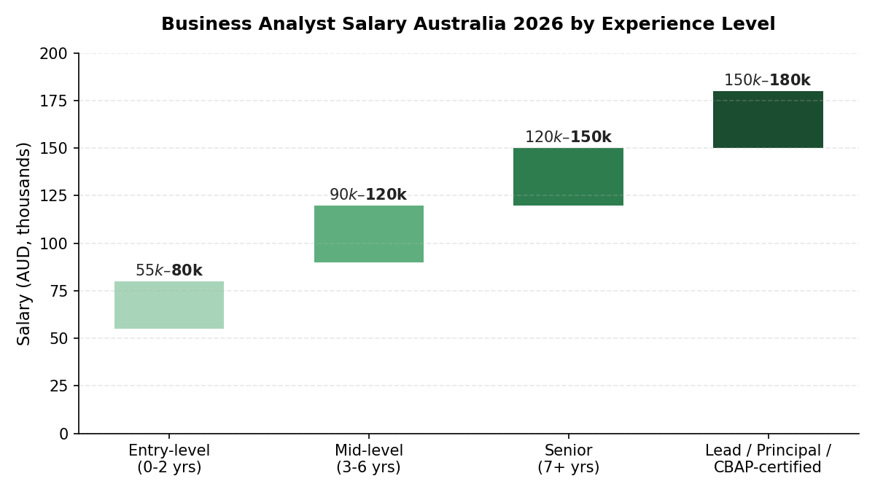
Pulling these together, a realistic Business Analyst salary Australia range for 2026 looks like:
- Entry-level (0–2 years): $55,000–$80,000
- Mid-level (3–6 years): $90,000–$120,000
- Senior (7+ years): $120,000–$150,000
- Lead / Principal / CBAP-certified: $150,000–$180,000+
Contract BA rates run roughly $350–$450/day at entry level, $500–$700/day at mid-level, and $750–$1,000+/day at senior level, with premium rates of $1,000–$1,200+/day for lead or principal-level BAs with specialised domain knowledge.
Business Analyst Salary Australia by City
Demand and pay aren’t even across the country. Sydney and Canberra consistently offer the highest advertised Business Analyst salaries, driven by financial services concentration and government contracts respectively. Melbourne is Australia’s second-largest BA market and pays well, particularly for BAs with strong stakeholder management and regulatory experience. Adjusted for cost of living, Brisbane, Adelaide and Perth can offer comparable or better take-home value.
Sydney Business Analyst roles — the deepest market, financial services driving demand, salaries generally at or above the national average. View Sydney courses
Melbourne Business Analyst roles — strong in financial services, government, and a growing technology sector, averages of $105,000–$125,000 for permanent roles. View Melbourne courses
Brisbane Business Analyst roles — growing steadily, strong take-home value once cost of living is factored in. View Brisbane courses
Perth Business Analyst roles — resources and energy sector transformation work, competitive contract rates. View Perth courses
Adelaide Business Analyst roles — defence and government-adjacent work, smaller volume but stable, strong relative value. View Adelaide courses
Canberra Business Analyst roles — public sector demand, government contracts often pay a clear premium over the national average. View Canberra courses
Business Analyst Certifications: Which One Increases Your Salary?
Certifications matter more in business analysis than in many other professions, largely because the role itself is less standardised a recognised credential is a fast way to prove you follow a consistent framework like the BABOK Guide. IIBA data shows CBAP-certified professionals earn meaningfully more than non-certified peers, and roughly one in five senior BA job descriptions now explicitly prefer or require CBAP.
| Certification | Cost (approx.) | Best for |
| ECBA (Entry Certificate in Business Analysis) | USD $137–$196 (member/non-member) | Newcomers with little to no BA experience |
| CCBA (Certification of Capability in Business Analysis) | USD $455–$550 total incl. membership & application | BAs with 2–3+ years’ experience |
| CBAP (Certified Business Analysis Professional) | USD $555–$650 total (application $145 + exam $350–$505) | Senior BAs with 7,500+ hours of experience |
| PMI-PBA (Professional in Business Analysis) | USD $405–$555 depending on PMI membership | BAs working closely with project/program management |
| AgileBA (Agile Business Analysis) | GBP £450–£600 depending on provider | BAs in Agile/Scrum delivery environments |
For full eligibility rules and the official application process, see the IIBA CBAP certification page
CBAP requires 7,500 hours of relevant BA experience, so it’s a senior-career credential, not a starting point. If you’re earlier in your career, ECBA or CCBA are more realistic first steps, and both still carry meaningful weight with employers.
Step-by-Step: How to Build a Business Analyst Salary Australia Employers Will Pay For
- Start with structured training. A guided course builds requirements-gathering, process mapping, and stakeholder management skills faster than learning on the job alone. Explore the Business Analyst Fundamentals course for a guided, Australia-relevant study path.
- Build real-world artefacts. Practice writing user stories, process maps, and requirements documents against realistic scenarios — not just theory.
- Add an Agile credential early. Most Australian BA roles now sit inside Agile delivery teams. See our Agile Business Analysis course to get started.
- Learn AI-assisted BA tools. Employers are paying $15,000–$20,000 more for BAs who use AI tools to draft user stories and map processes faster.
- Target your city’s strongest sectors. Financial services in Sydney, government in Canberra, resources in Perth — tailoring applications to local demand speeds up hiring.
- Work toward CBAP once eligible. Once you’ve logged 7,500 hours of BA experience, CBAP is the clearest way to move into lead and principal-level pay. See our CBAP Exam Preparation course for guidance.
Is a Business Analyst Career Worth It in 2026?
For most people with strong communication skills and an analytical mindset, yes. Business analysis remains one of the most accessible ways into a six-figure corporate career in Australia, particularly for career-changers moving from support, admin, or operations roles. It’s most worth it for:
- Career-changers who want a fast, well-paid entry point into tech-adjacent corporate roles
- People who enjoy translating between business and technical stakeholders
- Anyone willing to invest in a recognised certification (CCBA or CBAP) to unlock senior pay bands
It’s a slower path if you expect certification alone to do the work the BAs earning the most combine a credential with strong stakeholder management and, increasingly, AI-assisted delivery skills.
Frequently Asked Questions: Business Analyst Salary Australia
What is the average Business Analyst salary in Australia in 2026?
The average Business Analyst salary in Australia sits between $90,000 and $125,000 per year across most data sources, with senior and lead roles reaching $150,000–$180,000+, and entry-level roles starting around $55,000–$80,000.
How much does CBAP certification cost?
CBAP costs roughly USD $555–$650 in total, including a $145 application fee and an exam fee of $350 (IIBA members) or $505 (non-members).
Do I need a certification to become a Business Analyst in Australia?
No, it’s not mandatory, but certifications like CCBA or CBAP significantly improve job prospects and salary outcomes, especially for senior roles — roughly one in five senior BA job ads now prefers or requires CBAP.
Which Australian city pays Business Analysts the most?
Sydney and Canberra generally lead on advertised pay, driven by financial services and government contracts respectively, though Melbourne is a close second and offers strong volume.
How long does it take to become CBAP eligible?
You need 7,500 hours of relevant business analysis experience within the past 10 years, which typically takes 4–6 years of full-time BA work to accumulate.
Can I become a Business Analyst without an IT background?
Yes — many successful BAs transition from operations, admin, customer service, or project coordination roles, particularly with structured training to build core requirements-gathering and stakeholder management skills.
Ready to start?
Explore the Business Analyst Fundamentals course at BusinessAnalysisCourses.com.au, or check out our guides on Agile Business Analysis and CBAP Exam Preparation to plan your next move.