



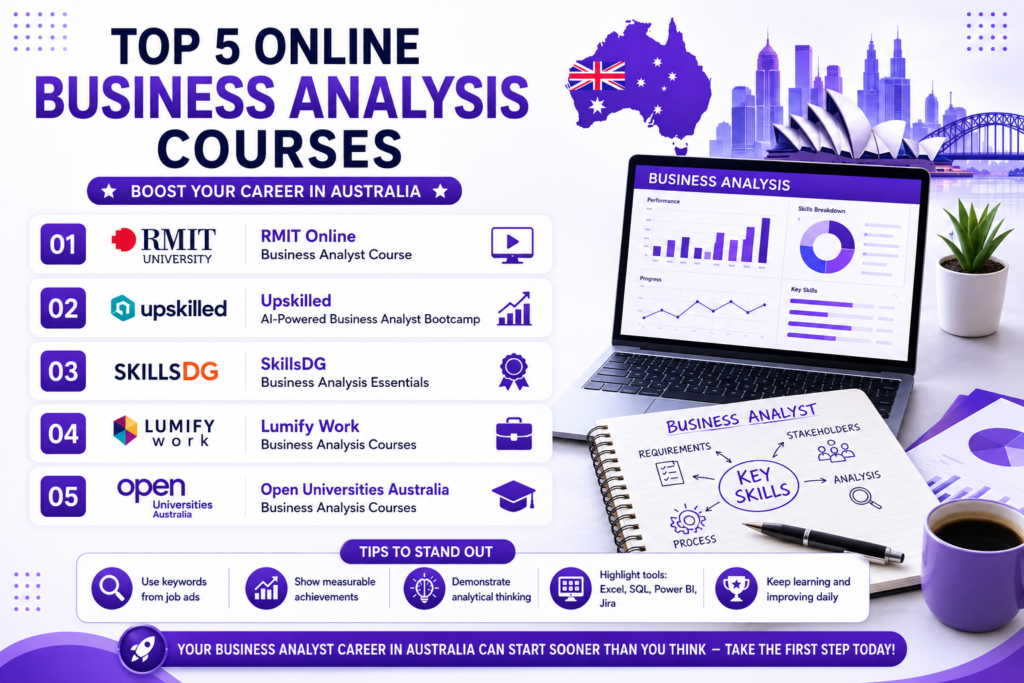
Choosing the right online business analysis courses can make a real difference in your career growth. The internet is full of course lists, but many of them feel generic, outdated, or written only for promotion. The goal is simple: help learners, career changers, and working professionals find practical business analysis training that actually builds useful skills.
Business analysis is no longer just about writing requirements or attending meetings. Today, companies need professionals who can understand business problems, communicate with stakeholders, improve processes, support digital transformation, and use data to guide better decisions. That is why choosing the right course matters.
What you’re about to read reflects that research — not affiliate commission rankings. Whether you’re trying to break into the field or finally get that promotion you’ve been angling for, the right online business analysis course can be a genuine career accelerant in 2026. Here’s how to pick the right one for where you are right now.
Business Analysis Certification 2026: Best Online Courses to Boost Your Career
The timing genuinely matters here. Companies across Sydney, Melbourne, and Brisbane are under pressure to move faster, cut waste, and make better decisions with data — and business analysts are the ones bridging the gap between what the business needs and what technology can deliver. That’s not a trend. That’s a structural shift happening right across Australia.
What’s changed in 2026 specifically? AI tools have taken over a lot of the repetitive data-crunching that used to define junior BA work. As a result, employers in Sydney, Melbourne, and Brisbane now need business analysts who can operate at a higher level — focusing more on stakeholder management, advanced requirements gathering, and business process modelling rather than basic reporting tasks. The certifications that train you in these real-world, decision-making skills are the ones with true long-term value and staying power in today’s job market.
| TIP
If you’re completely new to the field, start with the ECBA (entry-level) before investing in CBAP. You’ll build the conceptual foundation you need and avoid overwhelming yourself with exam prep that assumes experience you don’t have yet. |
| 1 | EDITOR’S PICK
CBAP Certification Prep Course IIBA-aligned curriculum · Available via Udemy & LinkedIn Learning |
| Duration
40–60 hours |
Price
$89–$199 |
Level
Advanced |
Pacing
Self-paced |
Certificate
Yes (+ CBAP CDUs) |
The Certified Business Analysis Professional (CBAP) is the gold standard in the field — the one credential that hiring managers across industries consistently point to as a meaningful differentiator. This prep course is built specifically for people who already have 5+ years of BA experience and are ready to make that experience count on paper.
What separates the best CBAP prep courses from the mediocre ones is coverage depth across all six knowledge areas in the BABOK® Guide v3: business analysis planning and monitoring, elicitation and collaboration, requirements life cycle management, strategy analysis, requirements analysis and design definition, and solution evaluation. The top-rated courses on Udemy walk you through each domain with real-world scenarios — not just rote memorization.
One thing that genuinely surprised us: the practice exam banks on the better platforms have gotten significantly harder in the past year, more closely matching the difficulty of the actual CBAP exam. That’s a good thing. You want to struggle in practice, not in the testing center.
| WHAT WORKS WELL
✓ Strongest name recognition on a resume ✓ Covers all six BABOK® domains in depth ✓ Affordable compared to in-person alternatives ✓ Self-paced — fits around a full-time job |
WORTH KNOWING
× Requires 5+ years BA experience to sit the exam × Quality varies a lot between instructors — research first × No job placement support |
| BEST FOR: Experienced BAs ready to earn the field’s top credential |
| 2 | GREAT FOR BEGINNERS
ECBA Foundation Certification Program IIBA Official Learning · Online self-paced |
| Duration
20–30 hours |
Price
$250–$450 |
Level
Beginner |
Pacing
Self-paced |
Exp. Required
None |
Here’s the thing about the Entry Certificate in Business Analysis (ECBA): it’s the smartest starting point for anyone pivoting into business analysis from another field. There are zero experience requirements to sit the exam — just 21 hours of professional development training and IIBA membership.
The IIBA’s official ECBA prep material covers the fundamentals you need: understanding what business analysis actually is (and isn’t), how to elicit requirements from stakeholders, and how BA fits into broader project and product delivery frameworks. It’s not flashy, but it’s rigorous, and it comes from the organization that wrote the book on BA standards.
For career changers — teachers, accountants, project coordinators, QA testers — this certification is often the bridge that gets your resume taken seriously in a field where experience otherwise creates a catch-22. We’ve spoken to hiring managers who specifically look for ECBA on entry-level BA applications because it signals someone who took the initiative to understand the craft before showing up.
| WHAT WORKS WELL
✓ No experience required — genuinely beginner-friendly ✓ Accredited directly by IIBA ✓ Clear pathway to CCBA and CBAP later ✓ Recognized globally by employers |
WORTH KNOWING
× Requires IIBA membership (extra cost) × Less practice material than third-party prep courses × Pricier than Udemy alternatives |
| BEST FOR: Career changers and complete beginners in business analysis |
| 3 | PROJECT MANAGEMENT FOCUS
PMI-PBA Exam Prep Training PMI Learning · Multiple accredited providers |
| Duration
35–50 hours |
Price
$199–$600 |
Level
Intermediate+ |
Pacing
Self-paced / cohort |
Certificate
PMI-PBA |
The PMI Professional in Business Analysis (PMI-PBA) is the credential that makes sense if you’re already working in project-adjacent roles — a project manager looking to deepen your BA skills, or a business analyst who works heavily within PMI-framework organizations.
What distinguishes the PMI-PBA from the CBAP is its emphasis on how business analysis integrates with project management practices. The exam covers needs assessment, planning, analysis, traceability and monitoring, and solution evaluation — with a strong undercurrent of how these activities map to project delivery. If your organization runs on PMI methodologies, this credential speaks the same language as your stakeholders.
The prep courses from PMI-aligned providers (REPs) are generally high quality and often include instructor Q&A sessions. Some cohort-based programs pair exam prep with real-world case studies, which is where you’ll get the most value if you’re a more hands-on learner.
| WHAT WORKS WELL
✓ Strong fit for PM-BA hybrid roles ✓ PMI brand recognition is massive in enterprise ✓ Covers Agile and predictive BA approaches ✓ Some programs include live instructor support |
WORTH KNOWING
× Experience requirements are significant × PMI membership adds to total cost × Less known outside PM-heavy industries |
| BEST FOR: Project managers and BAs in PMI-framework organizations |
| 4 | AGILE SPECIALIST
Agile Business Analysis Fundamentals LinkedIn Learning · Pluralsight · Coursera |
| Duration
8–15 hours |
Price
$0–$50 (subscription) |
Level
Beginner–Int. |
Pacing
Self-paced |
Certificate
Completion cert |
If you work in tech, startups, or any product-led organization, the honest truth is that traditional BA methodologies only get you so far. Agile business analysis is now a baseline expectation in most modern product and engineering environments — and these courses fill that gap efficiently.
The best Agile BA courses teach you how to apply business analysis techniques within sprint-based delivery: how to write effective user stories, how to facilitate backlog refinement, how to do just-enough documentation without slowing teams down, and how to collaborate with product owners and developers in a way that actually accelerates delivery.
The LinkedIn Learning and Pluralsight tracks are particularly strong for professionals who already understand agile but want to formalize their BA skills within that context. The Coursera offerings (especially through the University of Michigan and UC Davis) go deeper and are worth the extra time if you’re building this from scratch.
| WORTH NOTING
LinkedIn Learning subscriptions often come free with premium LinkedIn accounts, and many public libraries offer Coursera course access at no cost. Check before you pay. |
| WHAT WORKS WELL
✓ Extremely affordable or free via subscription ✓ Directly applicable in modern product teams ✓ Short enough to complete in a weekend ✓ No experience requirements |
WORTH KNOWING
× Completion certificate is not a formal credential × Quality varies significantly by platform/instructor × Less recognized in traditional/enterprise environments |
| BEST FOR: Tech and product professionals in Agile environments |
| 5 | DATA-DRIVEN BA
Microsoft Power BI for Business Analysts Coursera · Microsoft Learn · Udemy |
| Duration
15–25 hours |
Price
$0–$150 |
Level
Beginner–Int. |
Pacing
Self-paced |
Hands-on
High — real projects |
In 2026, a business analyst who can’t navigate data tools is operating with one hand tied behind their back. Power BI has become the dominant BI tool in enterprise environments, and proficiency with it is increasingly listed as a requirement — not a nice-to-have — in BA job postings.
This course type teaches you how to connect to data sources, build calculated fields and measures with DAX, design dashboards that communicate insights (not just display numbers), and translate data findings into business narratives that stakeholders can act on. That last skill — data-driven decision making and storytelling — is what separates BAs who get promoted from those who don’t.
Microsoft’s own learning path on Microsoft Learn is free and surprisingly comprehensive. If you want more structured guidance with real-world case studies, the Coursera version (part of the Microsoft Power BI Data Analyst Professional Certificate) is worth the subscription. The hands-on work you’ll do here is more portfolio-worthy than anything you’ll get from pure certification prep courses.
| WHAT WORKS WELL
✓ Directly applicable from day one on the job ✓ Microsoft’s own platform (free tier available) ✓ Builds a real, demonstrable portfolio ✓ Pairs well with any other BA certification |
WORTH KNOWING
× Not a standalone BA certification × Less relevant outside Microsoft-ecosystem orgs × DAX learning curve can be steep initially |
| BEST FOR: BAs who want to lead with data skills and build a visible portfolio |
Online Business Analysis Courses: Side-by-Side Comparison
Here’s how the five courses stack up across the factors that matter most when you’re making a decision:
| Course | Price | Level | Formal Credential | Beginner-Friendly | Job Market Impact |
| CBAP Prep (IIBA) | $89-$199 | Advanced | CBAP | No | ***** |
| ECBA Foundation (IIBA) | $250-$450 | Beginner | ECBA | Yes | **** |
| PMI-PBA Prep | $199-$600 | Intermediate+ | PMI-PBA | No | ***** |
| Agile BA Fundamentals | $0-$50 | Beg.-Int. | Completion only | Yes | *** |
| Power BI for BAs | $0-$150 | Beg.-Int. | Microsoft Cert | Yes | **** |
How to Choose the Best Online Business Analysis Course for You
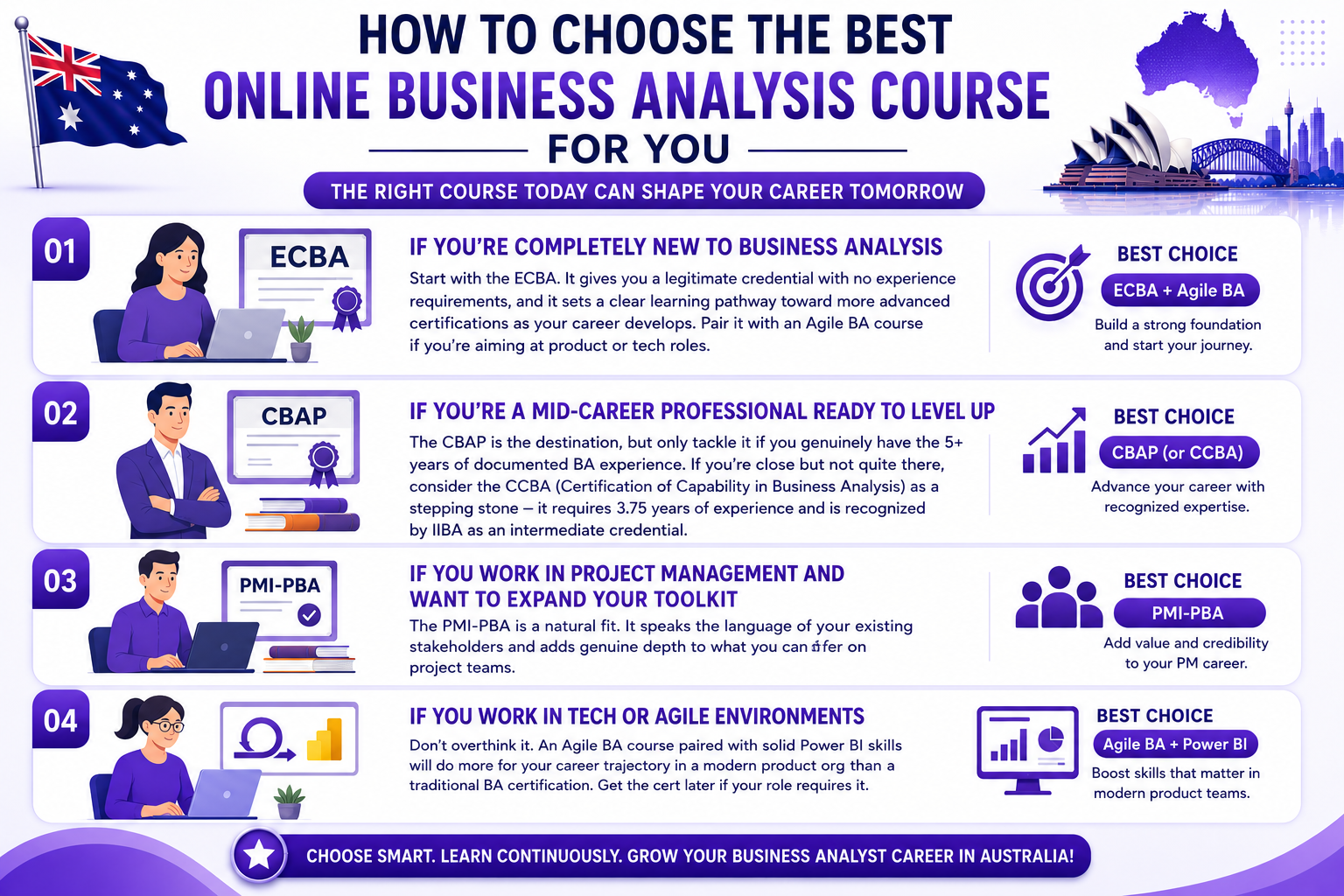
Here’s the framework we’d use: start with where you are, not where you want to be.
If you’re completely new to business analysis
Start with the ECBA. It gives you a legitimate credential with no experience requirements, and it sets a clear learning pathway toward more advanced certifications as your career develops. Pair it with an Agile BA course if you’re aiming at product or tech roles.
If you’re a mid-career professional ready to level up
The CBAP is the destination, but only tackle it if you genuinely have the 5+ years of documented BA experience. If you’re close but not quite there, consider the CCBA (Certification of Capability in Business Analysis) as a stepping stone — it requires 3.75 years of experience and is recognized by IIBA as an intermediate credential.
If you work in project management and want to expand your toolkit
The PMI-PBA is a natural fit. It speaks the language of your existing stakeholders and adds genuine depth to what you can offer on project teams.
If you work in tech or Agile environments
Don’t overthink it. An Agile BA course paired with solid Power BI skills will do more for your career trajectory in a modern product org than a traditional BA certification. Get the cert later if your role requires it.
| WATCH OUT FOR
Certificate mills that sell “BA certifications” not backed by IIBA, PMI, or another recognized standards body. The credential is only as valuable as the organization behind it. Check if the course earns Continuing Development Units (CDUs) from IIBA or PDUs from PMI — that’s usually a reliable signal of legitimacy. |
Frequently Asked Questions About Online Business Analysis Courses
What is business analysis certification, and do I actually need one?
A business analysis certification is a credential issued by a recognized professional body (primarily IIBA or PMI) that validates your knowledge of BA principles and practices. You don’t strictly need one to work as a business analyst — many successful BAs are uncertified — but having one makes a meaningful difference in hiring processes and salary negotiations, particularly in enterprise environments. In 2026, a certification is an efficient way to distinguish yourself when the competition has similar experience.
Which business analyst course is best for career growth?
It depends on your experience level. For pure career-growth potential (salary, title, senior opportunities), the CBAP is the most impactful credential in the field. For someone starting out, the ECBA provides the most accessible entry point. If you’re in a tech-adjacent role, Agile BA skills combined with a data tool like Power BI often drive faster career progression than any formal certification.
How long does it take to complete a business analysis course online?
The course content ranges from 8 hours (introductory Agile) to 60+ hours for comprehensive CBAP prep. In practice, most working professionals need 8–16 weeks to complete a full program while maintaining their day job. Self-paced formats make it easy to fit around your schedule, though we’d caution against dragging it out too long — momentum matters for exam prep.
Can I become a business analyst with no experience?
Yes — but you’ll need to be strategic about it. The ECBA certification has no experience requirement and is specifically designed for people transitioning into BA from other fields. Pairing it with practical projects (even self-directed ones using publicly available datasets or volunteer work with nonprofits) helps you build the portfolio that makes your application competitive.
Are there affordable business analyst courses with certification?
Absolutely. Agile BA courses on LinkedIn Learning and Pluralsight are available via subscription (often $30–$40/month). Microsoft Learn offers free Power BI training. For formal IIBA or PMI certifications, the prep course cost is modest ($89–$199 via Udemy); the larger costs are the exam fees and membership dues from the certifying bodies themselves.
How do I become a business analyst in 2026?
The clearest path: start with an ECBA certification to validate your foundational knowledge, gain hands-on experience through your current role, build proficiency in at least one data tool (Power BI or Tableau), and document your experience toward a CBAP or PMI-PBA once you hit the eligibility thresholds. Networking in BA communities — the IIBA has local chapters globally, and there are active online communities on LinkedIn and Reddit — accelerates this timeline more than most people expect.