


Requirements traceability is supposed to answer one simple question: why does this feature exist? On most projects, six months in, nobody can answer it. The original business need has faded, the feature has been tweaked three times, and the only person who remembers the reason has moved to another team. That slow fading is what we call requirements traceability decay, and it quietly drains budgets on projects of every size.
If you’ve ever been in a steering committee and heard “who asked for this?” followed by an awkward silence, you already know the problem. This guide explains why traceability decays, what it costs, and how business analysts can fix it without drowning in paperwork. We’ve also pointed you to practical business analysis courses in Australia if you want to build the skills properly.
What Is Requirements Traceability (and Why Does It Decay)?
Requirements traceability is the ability to follow a requirement from its origin, usually a business need or stakeholder goal, through analysis, design, build and testing, and back again. Wikipedia’s overview of requirements traceability describes it as the documented link between a requirement and the artefacts that come before and after it. The BABOK Guide from IIBA treats it as a core task for the same reason: without it, nobody can prove the solution delivers value.
Decay is what happens when those links stop being maintained. Nobody decides to break traceability. It erodes through hundreds of small moments: a story gets split, a requirement is reworded in a chat thread, a stakeholder verbally approves a change, a developer “just adds” a field. Each moment is reasonable. Together they leave you with features that float free of any business need.
Signs of Requirements Traceability Decay on Your Project
Decay rarely announces itself. Look for these warning signs:
- Testers can’t say which requirement a test case proves.
- Backlog items reference tickets that were closed or renamed long ago.
- Stakeholders ask for a feature that, it turns out, already exists under another name.
- Scope debates drag on because nobody can show the original objective.
- Your requirements document and your delivered product describe two different systems.
- New team members spend weeks asking “why does it work like this?”
If three or more of these sound familiar, your traceability is already decaying and the cost is being paid somewhere, whether you’ve measured it or not.
Why Nobody Knows Which Business Need a Feature Supports
In our experience training analysts, the same root causes appear again and again.
1. Traceability is treated as a one-off document
Teams build a requirements traceability matrix at the start, tick the box, and never open it again. A matrix that isn’t updated with every change is a snapshot of a project that no longer exists.
2. The business need was never written down clearly
You can’t trace to something vague. “Improve customer experience” is a wish, not a business need. Without a measurable objective at the top of the chain, every link below it is guesswork.
- Information lives in too many places. Requirements sit in Confluence, decisions in email, changes in Slack, and tasks in Jira. No single tool holds the whole story, so nobody maintains it.
- Agile gets blamed for what is really a discipline gap. Teams say “we’re agile, we don’t do traceability.” Agile doesn’t forbid it. Lightweight links between epics, stories and business outcomes work perfectly well in a sprint; skipping them is a choice, not a methodology.
- People move on. Business analysts, product owners and sponsors change roles. When the memory of why leaves with them and nothing is recorded, decay accelerates.
- Nobody owns it. If traceability is “everyone’s job,” it is nobody’s job. The BA is usually the natural owner, but only if the organisation says so.
The Real Cost of Poor Requirements Traceability
Weak requirements traceability doesn’t blow up in a single dramatic moment. It leaks value slowly:
- Gold-plating and scope creep. Features nobody needs get built because nothing says they shouldn’t be.
- Expensive rework. Changing a requirement without knowing what depends on it breaks things downstream.
- Weak impact analysis. Every change request becomes a guessing game about what else it touches.
- Failed audits. In government, banking, health and insurance, regulators expect you to show how each control or rule is implemented and tested.
- Lost trust. Sponsors lose confidence when you can’t connect spending to outcomes.
None of this is a new idea, but it is easy to forget when delivery pressure is high. Good traceability is cheap insurance.
How to Fix Requirements Traceability Decay: 7 Practical Steps

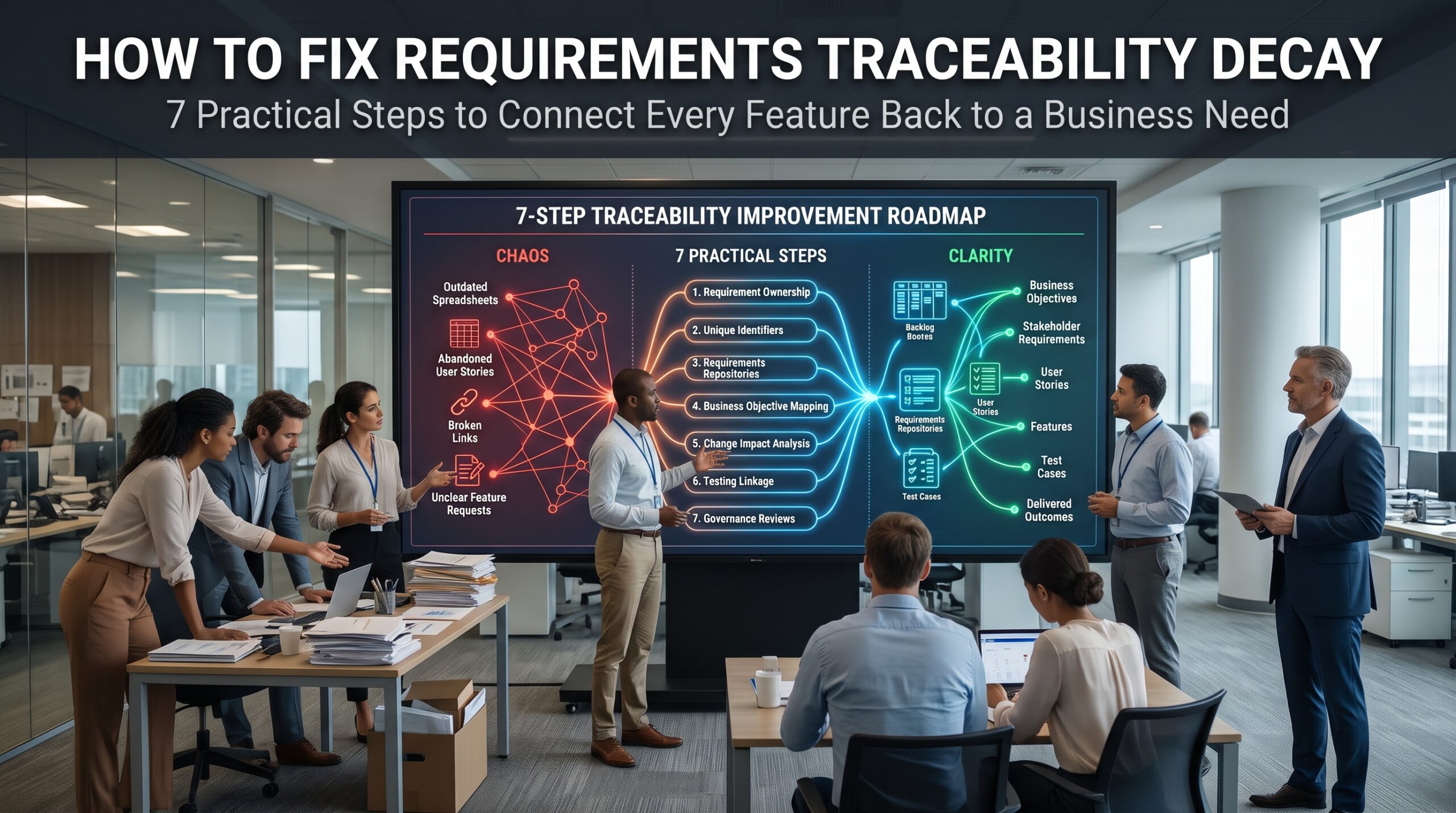
- Start at the top. Write each business need as a short, measurable statement tied to the business case. Give it a unique ID.
- Link, don’t duplicate. Reference the business need ID from every epic, story or requirement beneath it. One source of truth, many links.
- Pick one home for the links. Choose the tool (Jira, Azure DevOps, a spreadsheet, a dedicated requirements tool) and make it the place where traceability lives. Consistency beats sophistication.
- Make it part of the definition of ready. A story without a parent business need doesn’t enter the sprint. This single rule prevents most decay.
- Trace changes, not just starting points. When a requirement changes, update the link and note the reason. Decisions are part of the trail.
- Review traceability on a rhythm. A 20-minute check at each sprint review or phase gate catches orphans early.
- Name an owner. Usually the business analyst. Write it into the role so it doesn’t depend on goodwill.
Requirements Traceability Matrix Example
A requirements traceability matrix (RTM) doesn’t need to be fancy. Here is a simple version you can copy into a spreadsheet:
| Business need | Requirement | Feature / story | Test case | Status |
| BN-01 Reduce call-centre volume by 15% | REQ-07 Customers can track orders online | US-112 Order tracking page | TC-45, TC-46 | In test |
| BN-01 Reduce call-centre volume by 15% | REQ-08 Send delivery SMS alerts | US-118 SMS notification | TC-52 | Built |
| BN-02 Meet new privacy obligations | REQ-11 Customers can delete their data | US-130 Data deletion request | TC-61, TC-62 | Planned |
| (none) | REQ-15 Add dark mode | US-141 Dark theme | TC-70 | Orphan: review |
See the last row? That’s an orphan feature, one with no business need behind it. Spotting these is exactly what a healthy matrix is for. It doesn’t mean the feature is wrong, but someone should be able to explain why it is there.
Tools for Requirements Traceability
You can maintain requirements traceability in almost any tool, as long as the team uses it consistently. Spreadsheets work for small projects. Jira, Azure DevOps and Confluence handle linking between epics, stories, tests and pages. Larger or regulated programmes often use dedicated requirements management tools. The right choice depends on team size, compliance needs and budget, but the habit matters far more than the software.
Requirements Traceability in Agile Teams
Agile teams often think traceability means heavy documentation. It doesn’t. A practical agile approach keeps three things: a clear outcome at the epic level, acceptance criteria on every story, and a visible link from each story back to its epic and outcome. That’s enough to answer “why are we building this?” in seconds. If you want a structured way to learn this, the Agile Business Analysis (AgileBA®) Foundation course covers agile principles from a BA perspective, and the AgileBA Practitioner course goes further into applying them.
Learn Requirements Traceability: Business Analysis Training in Australia
Knowing the theory is one thing. Practising it on realistic cases, with feedback from experienced trainers, is where analysts really improve. Business Analysis Courses offers hands-on training that covers requirements elicitation, documentation, traceability and change control.
- Requirements Engineering Foundation (IREB CPRE-FL) builds the core discipline of eliciting, documenting and managing requirements. The International Requirements Engineering Board (IREB) sets the standard behind this certification.
- Business Analysis Techniques Course gives you practical tools you can use on your next project.
- ISQI Agile Business Analysis Certification suits analysts working in agile delivery.
- BCS Business Change Foundation helps you link requirements to wider organisational change.
Looking for training near you? Courses are available in major cities, with flexible online options for everyone else:
- Business analysis course in Melbourne
- Business analysis courses in Sydney
- Business analysis courses in Brisbane
- Business analysis training in Perth
- Business analysis courses in Adelaide
- Business analysis courses in Canberra
Many analysts later pursue advanced credentials such as CBAP, or the PMI-PBA from the Project Management Institute. A strong grounding in requirements traceability helps with both.
Requirements Traceability FAQs
What is requirements traceability in simple terms?
It’s the ability to follow a requirement from the business need that created it through design, build and testing, and back again, so you can always explain why something exists.
What is the difference between a traceability matrix and a backlog?
A backlog lists work to be done. A requirements traceability matrix shows how each item connects to a business need and to its tests. Many teams generate the matrix from linked backlog items.
Who is responsible for requirements traceability?
Usually the business analyst, with support from the product owner, delivery lead and testers. The key is naming one clear owner.
Does agile need requirements traceability?
Yes, in a lightweight form. Linking stories to epics and outcomes keeps agile teams focused on value and makes change decisions faster.
How do I stop traceability decaying over time?
Make it part of your workflow: require a parent business need for every story, review links regularly, and record why changes were made.
Final Thoughts: Make Every Feature Earn Its Place
Requirements traceability decay isn’t a tooling problem. It’s a habit problem, and habits can be changed. Start with clear business needs, link everything beneath them, give someone ownership, and check the links regularly. Do that and the question “which business need does this feature support?” will have an answer every time.
Ready to build these skills? Explore our business analysis courses, read more on the Business Analysis Courses blog, or contact our team to find the right course for you.